


Radu Dumitrescu

As Head of Digital Transformation, Radu looks over multiple departments across the company, providing visibility over what happens in product, and what are the needs of customers. With more than 8 years in the Technology era, and part of BlueTweak since the beginning, Radu shifted from a developer (addressing end-customer needs) to a more business oriented role, to have an influence and touch base with people who use the actual technology.
Recent articles
Hiver Alternatives: 7 Best Options to Consider in 2026
Many teams start with Hiver because it offers a simple way to manage shared inboxes inside Gmail. But as customer support operations grow, what once felt efficient can quickly become limiting.
Support teams today are expected to manage conversations across email, chat, voice, social media, and messaging apps while maintaining fast response times, consistent service quality, and operational visibility. At the same time, AI-powered automation is becoming a competitive requirement rather than a nice-to-have feature.
That's why more organizations are evaluating Hiver alternatives. Some need greater flexibility outside the Google ecosystem, while others need advanced automation, omnichannel support, and deeper operational insights. Platforms such as BlueTweak are designed specifically for this next stage of growth, helping teams move beyond shared inbox management and build a more scalable customer support operation.
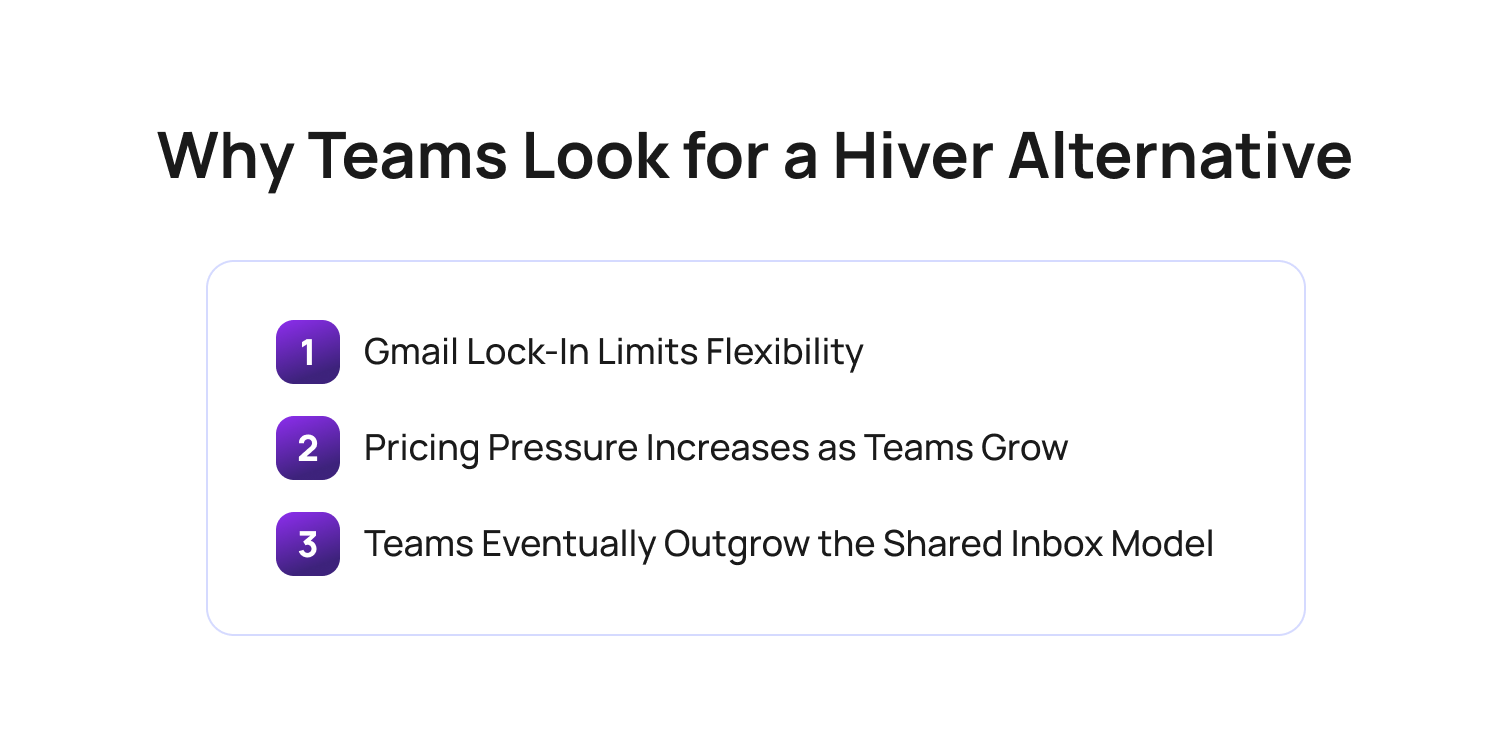
Why Teams Look for a Hiver Alternative
Most searches for a Hiver alternative happen when a team's customer support requirements have outgrown the shared inbox model that Hiver was built around.
Hiver remains a popular choice for small teams using Google Workspace as its user-friendly interface, collaborative shared inbox functionality, and seamless Gmail integration make it an attractive starting point for customer support teams that primarily handle email-based customer communication.
However, most searches for a Hiver alternative are driven by three common challenges. As support teams grow, customer expectations change, and support channels multiply, many organizations find that Hiver's strengths become limitations.
Gmail Lock-In Limits Flexibility
Hiver is built directly inside Gmail as a Chrome extension. While this approach makes onboarding simple for Google Workspace users, it also creates dependency on Google's ecosystem.
Teams using Microsoft Outlook, or organizations considering a move away from Google Workspace, cannot simply take Hiver with them. The platform's functionality is fundamentally tied to Gmail accounts, Gmail labels, and the Google environment.
For support leaders evaluating long-term customer support software investments, this can create unnecessary restrictions. A platform decision should support future business needs, not dictate which productivity suite the organization must use.
As companies expand, merge with other organizations, or introduce new customer support operations, flexibility often becomes more important than convenience.
Pricing Pressure Increases as Teams Grow
Pricing scalability is another common reason teams begin exploring Hiver alternatives.
Hiver's pricing model is based on per-agent subscriptions, with additional costs for AI capabilities. While this may be manageable for very small teams, costs can rise quickly as support teams expand from five agents to 20 or more.
This creates a challenge for growing organizations. Support leaders are not simply evaluating software costs today; they are forecasting what customer support software will cost 12 to 24 months from now.
Many modern help desk software providers now include AI features, automation capabilities, advanced reporting, and workflow management tools within their core offerings. As a result, organizations often find themselves comparing Hiver's add-on costs against platforms that bundle advanced functionality into a more comprehensive package.
Teams Eventually Outgrow the Shared Inbox Model
The biggest reason organizations search for an alternative to Hiver is that they have outgrown the shared inbox model entirely.
Hiver was designed around collaborative email management. It helps multiple team members manage shared inboxes, assign tasks, leave internal notes, and track incoming requests without leaving Gmail. For many teams, that works perfectly.
However, modern customer support rarely happens through email alone.
Today's customer support teams often manage conversations across live chat, voice, SMS, social media, messaging apps, self service portals, and knowledge base channels. They also need AI tagging, advanced automation, AI agents, collision detection, proactive messaging, and advanced analytics to maintain efficiency as volumes increase.
According to PwC's 2025 Customer Experience Survey, 70% of executives believe customer expectations are evolving faster than their organizations can adapt. This helps explain why many support teams begin searching for a Hiver alternative. As customer interactions spread across chat, voice, social media, messaging apps, and self-service channels, a shared inbox alone often struggles to provide the visibility, automation, and consistency needed to keep pace.
This is where many teams discover that a basic shared inbox is no longer enough. They need omnichannel support, automation rules, workflow orchestration, and AI-powered customer service capabilities that extend far beyond email collaboration tools.
As a result, the search for a Hiver alternative is often less about replacing Hiver itself and more about finding a platform that can support the next stage of growth.
Hiver Alternatives at a Glance
A Hiver alternative comparison helps support leaders quickly identify which platform best aligns with their team's size, support channels, AI requirements, and long-term growth plans.
The market offers everything from lightweight Gmail-based collaboration tools to enterprise-grade customer service software with AI automation, omnichannel routing, and advanced reporting capabilities.
The comparison below provides a high-level overview of the leading Hiver alternatives available in 2026. Pricing should always be verified directly with each vendor before making a purchasing decision, as plans and included features can change.
BlueTweak Hiver Alternatives Comparison Table
*Pricing verified at the time of writing and subject to change. Always confirm current pricing, AI feature availability, and billing terms directly with the vendor before making a purchasing decision.
While feature checklists are useful, they rarely tell the whole story. The real question is not which platform has the most features, but which platform aligns with how your customer support operation will evolve over the next 12 to 24 months.
The sections below provide a more detailed breakdown of each platform, including where it excels, where it falls short, and the types of teams most likely to benefit from switching.
7 Best Hiver Alternatives in 2026
A Hiver alternative can range from a simple shared inbox replacement to a fully featured customer support platform with AI automation and omnichannel capabilities.
The tools below represent the strongest Hiver alternatives in 2026. Each assessment covers what the platform does well, where it falls short, pricing considerations, and the type of team it is best suited for. Pricing was verified at the time of writing but should always be confirmed directly with the vendor before making a purchasing decision.
1. BlueTweak: Best for AI-Powered Omnichannel Customer Support
BlueTweak is an AI-powered customer support platform designed for organizations that need to manage customer interactions across voice, email, live chat, social media, and messaging channels from a single workspace. Unlike a basic shared inbox, it combines customer support operations, AI automation, workforce management, and quality assurance in one platform.
Why it beats Hiver for growing teams: Hiver is fundamentally a shared inbox layer built inside Gmail. BlueTweak is a complete customer support platform built for teams that have outgrown email-centric support and need a unified approach to customer communication across multiple channels.
Key capabilities:
- Conversational AI agents for tier-one support - automatically resolve common customer enquiries, reducing ticket volumes and freeing agents to focus on more complex issues.
- AI ticket triage and intelligent routing - categorise, prioritise, and assign support tickets automatically so customers reach the right team faster.
- AI-generated ticket summaries and suggested replies - reduce manual admin work and help agents respond more quickly with relevant, context-aware recommendations.
- Multi-brand support from a single workspace – manage customer interactions across multiple brands, business units, or product lines without switching platforms, giving agents a unified view while maintaining separate brand experiences.
- Real-time knowledge base retrieval for agents - surface accurate information during live interactions, improving consistency and reducing resolution times.
- Workforce management and scheduling tools - forecast demand, optimise staffing levels, and improve operational efficiency across support teams.
- 100% automated QA coverage and performance monitoring - review every customer interaction automatically to identify coaching opportunities and maintain service quality at scale.
- Advanced analytics and reporting across channels - track performance, customer satisfaction, and operational trends through a single reporting environment
The biggest mistake support leaders make is treating AI as an add-on rather than an operating model. Shared inboxes solve collaboration challenges, but they don’t fundamentally transform customer support. The organizations seeing the strongest results are using AI across routing, quality assurance, knowledge retrieval, workforce optimization, and customer interactions in a single ecosystem.

The honest limitation: BlueTweak is not the right fit for a three-person team looking to manage a Gmail account collaboratively with minimal setup. The platform is built for organizations that need automation, omnichannel support, quality oversight, and operational scalability.
Pricing: BlueTweak operates a transparent pricing model of €65 per agent, per month, all-in (including ticketing, omnichannel, AI chatbot, AI voicebot, copilot tools, WFM, QA, analytics, integrations). This pricing model is designed to keep things simple, affordable, and easy to scale as your team does.
Best for: Mid-market and enterprise support teams that need AI automation, omnichannel routing, and operational visibility beyond a traditional shared inbox.
If you're evaluating Hiver alternatives and want to see what a fully integrated AI-powered customer support platform looks like in practice, start a free BlueTweak trial and explore the platform firsthand.
2. Zendesk: Best for Enterprise Teams Needing Scale and Ecosystem Breadth

Zendesk is one of the most established customer service software platforms on the market. It combines ticketing, self-service portals, workflow management, reporting, AI capabilities, and one of the largest integration marketplaces in the industry.
Why teams choose it: Zendesk's greatest strength is scale; large support organizations can manage customer support operations across multiple channels while integrating deeply with CRM systems, e-commerce platforms, and business applications. Its AI capabilities have matured considerably in recent years, transforming Zendesk from a traditional ticketing system into a broader customer experience platform.
Key capabilities:
- Omnichannel customer support and ticketing
- AI-powered agent assistance and automation
- Extensive integration marketplace
- Advanced workflow management and automation rules
- Self-service portals and knowledge base functionality
- Enterprise-grade reporting and analytics
- Support for large-scale customer service operations
The honest limitation: Zendesk is significantly more complex than Hiver. While that complexity unlocks flexibility, it also increases implementation effort, administration requirements, and overall cost.
Teams that already feel overwhelmed by customer support software may find Zendesk introduces more functionality than they realistically need. Organizations seeking simplicity often face a steep learning curve and higher ownership costs than expected. If you value simplicity, it’s worth looking into Zendesk alternatives.
Pricing: Zendesk uses a custom pricing model, but costs can become difficult to predict as teams add advanced functionality. Many AI features, automation capabilities, and enterprise-level tools are only available on higher-tier plans or through additional add-ons, which can significantly increase the total cost of ownership.
Best for: Large support teams that need enterprise scalability, deep integrations, and sophisticated workflow management.
3. Freshdesk: Best for Mid-Market Teams Wanting Breadth at Lower Cost

Freshdesk is a popular help desk software platform that offers a broad range of customer support features at a lower entry price than many enterprise competitors. It is often considered by teams that need more than a shared inbox but are not yet ready for enterprise-grade complexity.
Why teams choose it: Freshdesk strikes a balance between affordability and functionality. Teams can start with a free plan and gradually add capabilities as support operations become more sophisticated. Its Freddy AI suite, omnichannel support options, and modular pricing structure make it attractive to growing customer support teams that need flexibility.
Key capabilities:
- Omnichannel support across email, chat, phone, and messaging
- Freddy AI tools for automation and agent assistance
- Ticketing system and workflow automation
- Knowledge base and self-service portals
- Team inbox management and collaboration tools
- Advanced reporting and customer satisfaction tracking
- Free plan for small support teams
The honest limitation: Freshdesk's breadth can become complex. Teams looking for a simple customer support solution may find the number of features, menus, and configuration options overwhelming during implementation. Additionally, many advanced AI capabilities require higher-tier subscriptions or add-ons, which can increase costs significantly as teams grow.
Pricing: A limited free plan is available, with paid plans typically starting from around $15 per agent, per month (billed annually). Pro and Enterprise tiers are priced at $49 and $79 per agent, per month, respectively. Freddy AI functionality may require additional investment; verify with the vendor for details.
Best for: Growing mid-market teams that want a wide feature set and are comfortable investing time in setup and configuration.
4. Help Scout: Best for Small Teams That Want Email-First Simplicity

Help Scout is an email-first help desk platform designed for organizations that want a cleaner, more structured approach to customer support without the complexity of larger enterprise systems.
Why teams choose it: Many organizations choose Help Scout because it delivers a genuine help desk experience while remaining remarkably easy to use. Teams can move beyond a shared inbox without facing the steep learning curve often associated with larger customer service software platforms. Its combination of shared inboxes, live chat, and knowledge base functionality makes it a strong fit for growing support teams.
Key capabilities:
- Shared inbox and team inbox management
- Live chat and customer messaging
- Knowledge base creation and management
- AI Assist and AI Summarize features
- Internal notes and collision detection
- Email assignments and workflow automation
- Customer conversation history tracking
The honest limitation: Help Scout is not designed for voice support, advanced AI automation, or highly complex routing scenarios. While it excels at email and chat-based support, organizations requiring sophisticated omnichannel customer support may eventually outgrow the platform.
Pricing: Pricing is positioned toward teams that want a dedicated support platform without enterprise-level complexity. Plans have historically started around $25 per user, per month, for core shared inbox and collaboration features, with higher tiers adding capabilities such as advanced automation, reporting, and AI tools. Pricing is available on monthly or annual billing cycles.
Best for: Small to mid-sized support teams that prioritize simplicity, quick deployment, and email-first customer support.
5. Front: Best for Teams Blending Internal and External Communication
Front is a collaborative inbox platform that combines customer-facing communication with internal team collaboration. It is designed for organizations where customer conversations often involve multiple departments and stakeholders.
Why teams choose it: Front helps teams manage both internal discussions and external customer communication within the same workspace. This makes it particularly useful for organizations where support, sales, operations, and account management frequently collaborate on customer issues. Its collaborative approach feels familiar to teams moving from email management software and shared inbox tools.
Key capabilities:
- Shared inboxes for team collaboration
- Internal commenting and conversation threads
- Email, SMS, and social media support
- AI drafting and response assistance
- Workflow automation and routing rules
- Team assignments and collaboration features
- Customer communication tracking
The honest limitation: Front can become expensive as team sizes increase. While its collaboration features are strong, its AI capabilities are generally less advanced than platforms built specifically around AI-powered customer support operations. Organizations looking for advanced automation or AI agents may find themselves needing additional tools.
Pricing: Front offers several pricing tiers depending on team size and workflow complexity:
- Starter plans begin at approximately $25 per seat, per month (capped at 10 seats) and include core shared inbox and collaboration features.
- Growth plans start around $65 per seat, per month and add more advanced automation, workflow management, and reporting capabilities.
- Scale plans begin at roughly $105 per seat, per month and introduce enterprise-focused features, governance controls, and enhanced support options.
Best for: Teams that need to manage internal collaboration and external customer communication from a single platform.
6. Missive: Best for Gmail and Outlook Teams Wanting Collaborative Email
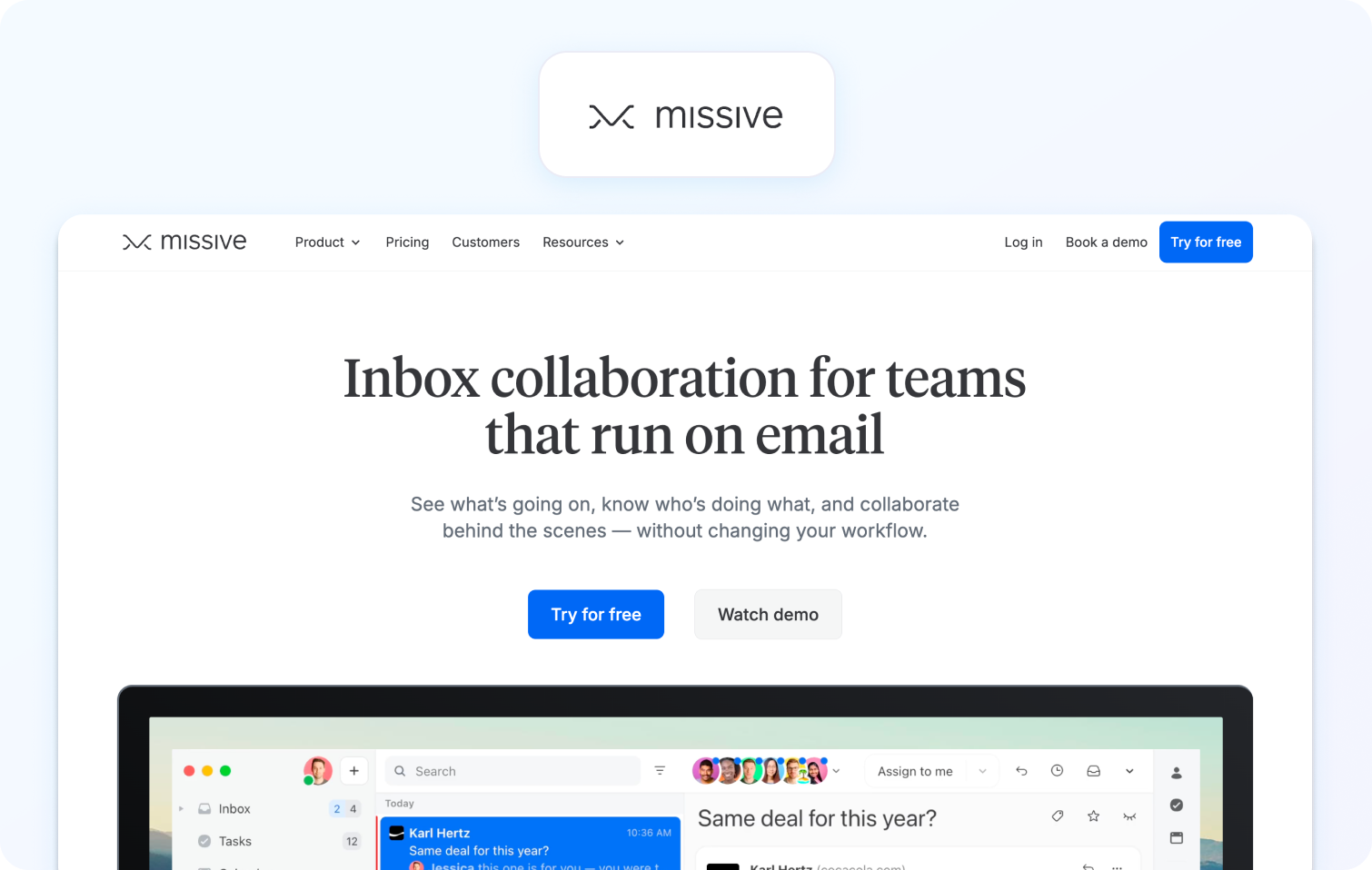
Missive is a collaborative email platform that supports both Gmail and Outlook environments. It is often considered the closest direct alternative to Hiver for teams focused primarily on email collaboration.
Why teams choose it: Unlike Hiver, Missive is not tied exclusively to Google Workspace. Teams can manage shared inboxes, communicate internally, and collaborate on customer conversations across both Gmail and Outlook accounts. This flexibility appeals to organizations that want collaborative email management without committing to a Gmail-only workflow.
Key capabilities:
- Shared inbox management for Gmail and Outlook
- Team chat and internal collaboration
- Email assignments and ownership tracking
- Basic workflow automation
- Support for SMS communication
- Team inbox visibility and accountability
- Shared drafts and collaborative responses
The honest limitation: Missive is fundamentally a collaborative email client rather than a true help desk platform. It lacks the advanced ticketing, omnichannel routing, workforce management, and AI automation capabilities that larger customer support operations often require. Teams can outgrow Missive quickly as customer support complexity increases.
Pricing: Missive uses tiered pricing that starts at approximately $14 per user per month, with higher plans adding advanced collaboration, administration, and workflow capabilities. The entry-level plan includes core features such as shared inboxes, team chat, internal comments, assignments, and collaborative drafting, but costs increase as teams require increased automation, permissions, analytics, and/or security controls.
Best for: Small teams using Gmail or Outlook that want collaborative email management without moving to a full help desk platform.
7. Gmelius: Best for Lightweight Gmail Power Users

Gmelius is a Gmail-native collaboration tool designed to enhance email productivity through shared inboxes, automation, and lightweight workflow management.
Why teams choose it: For organizations deeply invested in Google Workspace, Gmelius provides many of the collaboration features found in Hiver at a competitive price point. Its lightweight approach appeals to teams that want better email management without introducing a dedicated customer support platform.
Key capabilities:
- Shared inboxes inside Gmail
- Gmail sequences and email automation
- Kanban-style workflow management
- Team collaboration and assignments
- Basic reporting and analytics
- Gmail labels and workflow organization
- Lightweight automation capabilities
The honest limitation: Gmelius shares many of the same limitations as Hiver because it remains heavily dependent on Gmail. Teams looking to move beyond Google Workspace, introduce voice support, or adopt advanced AI capabilities will likely need a more comprehensive solution. Its AI features and omnichannel capabilities are limited compared to every other platform in this roundup.
Pricing: Tiered pricing plans start at approximately $19 per user, per month. Gmelius offers several plan levels, including Meli, Growth, Pro, and custom Enterprise pricing. The Meli plan focuses on core shared inbox and collaboration features for small teams, while Growth adds more advanced automation, reporting, and workflow capabilities. The Pro plan is designed for larger or more sophisticated teams that need enhanced productivity tools, deeper automation, and greater operational flexibility.
Best for: Very small Gmail-based teams that want affordable shared inbox functionality and have no immediate need for advanced customer support software.
What to Look for in a Hiver Alternative
A Hiver alternative should solve not only today's customer support challenges, but also the challenges your team is likely to face as it grows over the next 12 to 24 months. Many teams begin evaluating Hiver alternatives because they have outgrown a shared inbox model. The most important question is not which platform has the longest feature list, but which platform can support your future customer support operation without requiring another migration a year from now.
Omnichannel Support Beyond Email
Hiver is built around Gmail, making it an excellent solution for email-centric teams. However, many customer support organizations now manage interactions across live chat, voice, SMS, social media, and self-service portals.
When evaluating alternatives, consider:
- Whether all customer interactions are visible in a single workspace
- How easily agents can move conversations between channels
- Whether customer history remains intact across touchpoints
- If channels are native to the platform or reliant on third-party integrations
As support operations become more complex, fragmented customer communication can create inefficiencies, duplicated work, and inconsistent customer experiences.
AI That Delivers Operational Value
AI capabilities are now available in most customer support software, but the depth of those capabilities varies significantly. Many platforms offer basic AI features such as reply drafting or ticket summaries. More advanced platforms use AI to automate workflows, route conversations intelligently, retrieve knowledge base content in real time, and reduce repetitive tasks for agents.
When assessing AI capabilities, look for:
- AI ticket triage and routing
- Suggested replies grounded in a knowledge base
- Automated summaries and tagging
- Agent assistance during live interactions
- AI agents that can resolve simple customer issues independently
The goal should be measurable productivity improvements, not simply adding AI features to a workflow.
Scalability and Operational Visibility
The requirements of a five-person support team are very different from those of a 25-person support team. As organizations grow, visibility becomes increasingly important. Reporting, workforce management, quality assurance, and performance monitoring all play a larger role in maintaining customer satisfaction and operational efficiency.
Consider whether a platform provides:
- Advanced reporting and analytics
- Customer satisfaction tracking
- Quality assurance capabilities
- Workforce management tools
- Visibility into team performance across channels
These capabilities may not be essential today, but they often become critical as support volumes increase.
Pricing Beyond the Starter Plan
Many support platforms appear affordable at first glance. However, costs can change significantly as teams grow, add channels, or enable advanced functionality.
Before choosing a Hiver alternative, evaluate:
- Current cost per user
- Projected cost at your expected team size
- AI feature pricing
- Omnichannel support costs
- Add-on requirements for reporting or automation
The most affordable platform today may not be the most cost-effective platform 12 months from now.
The Bottom Line
The best Hiver alternative is the one that aligns with your future operating model. Some teams simply need a more capable shared inbox. Others need a complete customer support platform with AI automation, omnichannel routing, analytics, and operational oversight.
Understanding where your support organization is heading will make it much easier to identify which solution is the right long-term fit.
How to Choose the Right Hiver Alternative for Your Team
The right Hiver alternative depends on your team's size, support model, growth plans, and customer communication requirements. While feature comparisons are useful, the most successful software decisions are based on where your support operation needs to be in 12 months, not where it is today.
A platform that works well for a five-person support team may become a limitation when that team grows to 25 agents managing multiple channels.
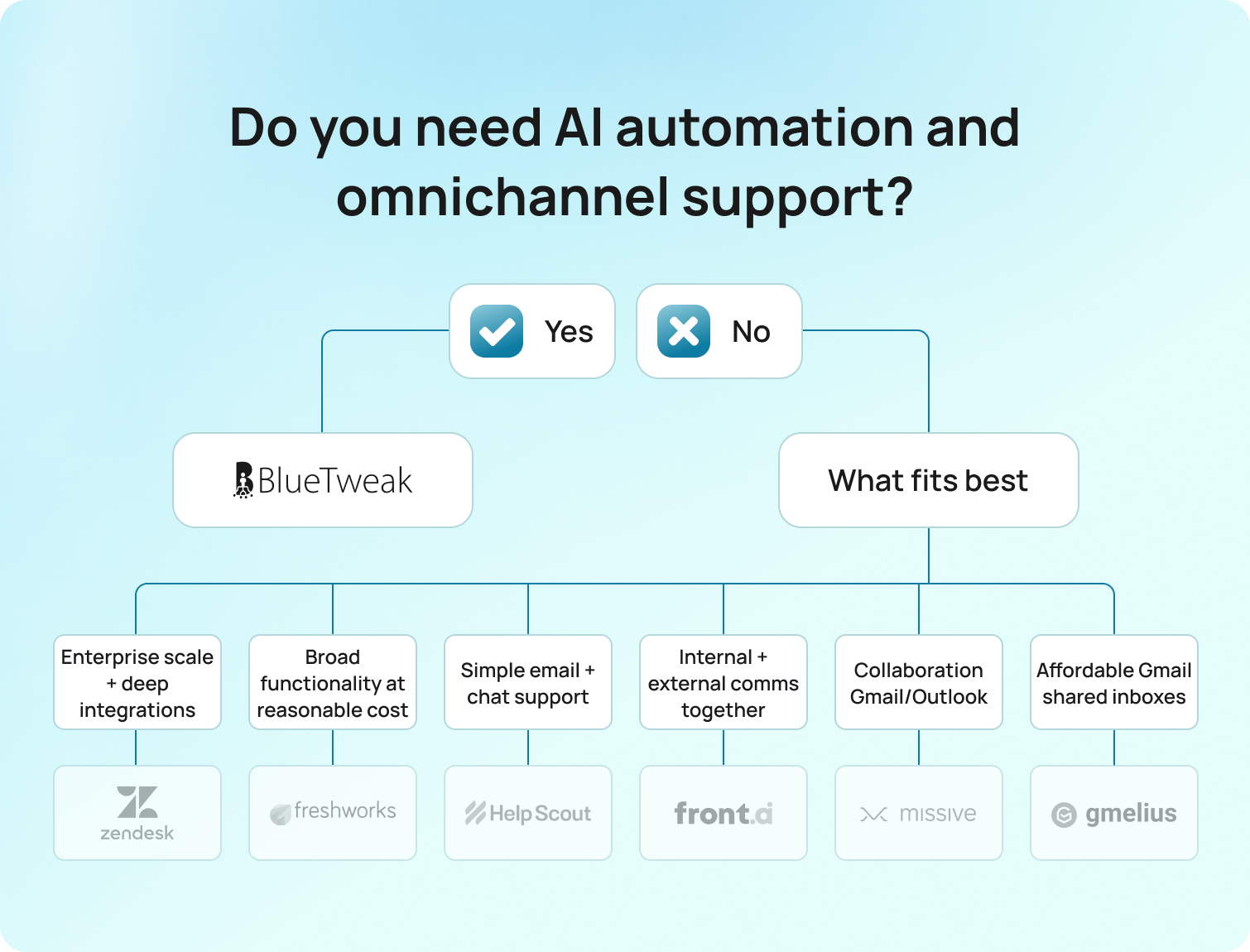
The most important consideration is scalability; before making a decision, evaluate how your customer support operation is likely to evolve over the next year. If your roadmap includes additional support channels, AI automation, advanced reporting, or larger support teams, it is worth choosing a platform that can grow with those requirements rather than switching tools again in the near future.
Final Thoughts: Choosing a Hiver Alternative That Supports Long-Term Growth
Most teams start looking for a Hiver alternative when a shared inbox is no longer enough. As support volumes increase and customer conversations expand across multiple channels, teams often need stronger automation, deeper visibility, and more scalable workflows.
If your goal is simply to improve collaborative email management, several options in this guide can help. However, for organizations that need AI automation, omnichannel support, workforce management, quality assurance, and advanced analytics in a single platform, BlueTweak stands out as one of the strongest Hiver alternatives available in 2026.
If you'd like to explore how BlueTweak can help your team automate workflows, improve customer satisfaction, and manage customer interactions across every channel, why not book a personalized demo or start a free 14-day trial to see the platform in action.
Top 15 Customer Support Challenges in 2026 (& How to Solve Them)
What Makes a Customer Support Challenge Hard to Solve?

Most customer support challenges are not caused by a single failure. They are caused by a combination of volume growth outpacing process design, technology gaps that force manual workarounds, and measurement blind spots that hide problems until they are already affecting customer satisfaction and retention.
The result is that customer service teams spend time fixing symptoms: slow response times, low FCR, and inconsistent service quality, without addressing the root causes behind them. Poor routing logic, incomplete knowledge bases, and no automated oversight at scale.
This article addresses both. Each challenge below includes the root cause, the KPI it damages, and the specific fix. According to Salesforce's State of Service report, 80% of customers say the experience a company provides is as important as its products. Bad customer service is not usually the result of bad intentions. It is the result of customer service problems that were never properly diagnosed or resourced. Most of the challenges below are the reasons that the gap exists between stated values and customer reality.
Note on hypothetical customer support challenge examples: Where this article uses scenarios to illustrate a challenge, they are composites drawn from common patterns rather than specific organisations. A hypothetical customer support challenge is useful for illustrating the root cause, but the fixes described are operational and applicable to real teams today.
Customer Support Challenges at a Glance
| Challenge | Root Cause | Primary KPI Impact | Fix Category |
|---|---|---|---|
| High ticket volume | Volume growth without automation | AHT, response time, concurrency | AI automation |
| Slow response times | Manual routing, understaffing | First response time, CSAT, and abandon rate | Routing + WFM |
| Inconsistent quality | No QA at scale; agent variability | CSAT, FCR, repeat contact rate | AI QA + coaching |
| Agent burnout | Repetitive tasks, poor tooling, poor scheduling | Attrition, CSAT, absenteeism | Automation + WFM |
| Lack of customer context | Siloed customer data, no unified profile | AHT, FCR, repeat contact rate | CRM integration |
| Poor knowledge management | Outdated or incomplete KB | Containment rate, FCR, AHT | KB maintenance |
| Channel fragmentation | Separate tools per channel | FCR, CSAT, response time | Omnichannel platform |
| Scaling without losing quality | No automated oversight at volume | CSAT, QA coverage, error rate | AI QA + HITL |
| Poor AI deployment | Wrong use cases, missing oversight | Containment, CSAT, customer trust | HITL framework |
| Misaligned KPIs | Measuring volume over quality | CSAT, FCR, agent engagement | Metrics redesign |
| Reactive rather than proactive service | No triggered outreach system | Inbound volume, CSAT | Proactive outreach |
| Handling angry customers poorly | No real-time sentiment guidance | CSAT, churn, escalation rate | Sentiment AI + training |
| Ticket routing failures | Rules-based routing breaks on paraphrase | FCR, AHT, misroute rate | AI routing |
| Data silos and poor integration | Separate tools with no unified view | AHT, FCR, data accuracy | Platform consolidation |
| Self-service that does not help | Incomplete KB; AI not grounded in content | Inbound volume, containment rate | KB grounding + AI chatbot |
The Top 15 Customer Support Challenges in 2026: How to Fix Them
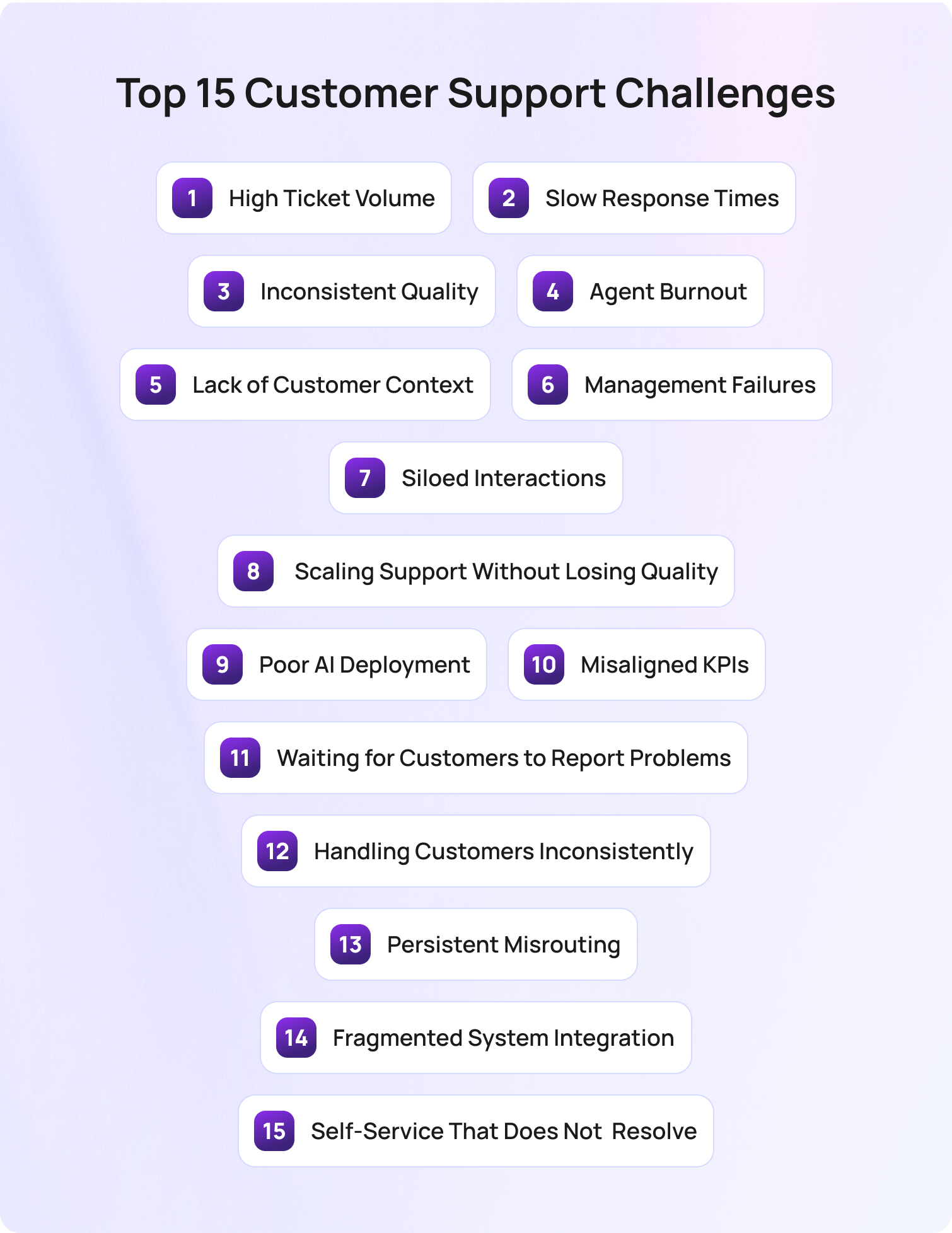
Each challenge below follows the same structure: what the challenge is, the root cause behind it, the KPI it damages, and the specific fix. Where AI capabilities are the solution, the fix names the specific tool to deploy.
1) High Ticket Volume Overwhelming Agent Queues
The challenge. Total inbound contact volume exceeds what customer service representatives can handle without backlogs, extended wait times, and quality shortcuts. This is the pressing customer service challenge most teams encounter first as they grow. Multiple customers submitting customer inquiries simultaneously, across multiple communication channels, creates concurrency pressure that manual workflows cannot absorb.
Root cause. Volume growth was not matched with automation for tier-1 queries. Support agents handle customer interactions that AI could resolve at a fraction of the cost and with higher consistency. The customer service process was built for lower volume and never redesigned.
KPI impact. AHT, response time, abandon rate, and agent concurrency.
The fix. Deploy a RAG-grounded conversational AI chatbot and voicebot to resolve repetitive tickets instantly before they reach agents. Target customer requests where the correct answer is definitive: FAQs, order status, password resets, and account queries. This lets agents focus on complex, high-value customer conversations where human judgment matters. Measure containment rate, not deflection rate. A deflected customer who follows up is a cost transfer, not a resolution.
For a deeper look at how AI removes volume pressure without sacrificing quality, read how AI improves customer support.
2) Slow Response Times Across Channels
The challenge. Customers expect fast answers, particularly on digital channels where expectations are highest. Slow response times are the single most cited driver of customer satisfaction decline in customer service research, and one of the most common reasons customers switch to a competitor. Frustrated customers who wait too long do not stay frustrated silently; they escalate, churn, or leave public feedback that damages your brand's reputation.
Root cause. Manual routing sends customer interactions to the wrong team or into long queues. No prioritisation logic means urgent customer requests wait alongside routine ones. Understaffing during peak periods compounds both. Most common customer service challenges around response times trace back to a customer service process that was not designed to handle current communication channels at the current volume.
KPI impact. First response time, CSAT, and abandon rate.
The fix. Intelligent routing that assigns incoming interactions by intent, urgency, and skill in real time. Pair with WFM forecasting to staff peaks accurately rather than reactively. Teams that address routing and scheduling together see the fastest improvement in response times. For the metrics that reveal where response time is breaking down, see the customer service analytics guide. Providing seamless support across multiple channels also requires that each channel is monitored with equal priority, not siloed into separate queues where some customer calls sit unanswered.
3) Inconsistent Quality Between Agents and Channels
The challenge. Customer satisfaction varies significantly by agent, shift, and channel. Customers receive different quality depending on who picks up the interaction and where. Dissatisfied customers who experienced inconsistent service quality on one channel often abandon that channel entirely. This inconsistency, one of the most common customer service challenges, is often invisible until it shows up in aggregate metrics, by which point customer loyalty has already been affected.
Root cause. No standardised QA at scale. Manual QA reviews only 5 to 15 percent of customer interactions. Ongoing training covers the process but not real-time quality guidance during live interactions. Customer service agents struggle to maintain consistent service quality when they have no live feedback mechanism and no standard for what good customer service looks like in practice.
KPI impact. CSAT, FCR, repeat contact rate.
The fix. AI QA scoring across 100% of interactions to identify patterns that manual sampling misses. Proposed reply standardises response quality during live customer conversations by surfacing KB-grounded responses agents can review and send. Both tools improve service quality and reduce the gap between best and worst performers, creating more consistent, excellent customer service regardless of who is handling the interaction.
4) Agent Burnout and High Turnover
The challenge. Customer service agents experience high stress, cognitive fatigue, and disengagement, leading to attrition that disrupts service quality and increases recruitment and training costs. Contact centre attrition rates frequently exceed 30% annually. When experienced agents leave, customer service representatives who remain absorb additional volume, accelerating the cycle.
Root cause. Repetitive tasks drain cognitive capacity with no intellectual reward. Poor tooling forces service agents to search for answers manually during every customer interaction. Unpredictable scheduling creates peak-period overload and makes it harder for agents to maintain a positive customer experience under pressure.
KPI impact. Attrition rate, CSAT, absenteeism, quality scores.
The fix. Automate repetitive tasks, particularly tier-1 customer inquiries, to remove them from agent queues. Give agents focus on complex, nuanced customer conversations where their skills are genuinely needed. Surface answers instantly during interactions, so agents stop searching. Use Workforce Management to create predictable, manageable workloads. The right tools make the difference between a customer service department that retains its best people and one that constantly replaces them.
5) Lack of Customer Context During Interactions
The challenge. Customer service agents start each interaction without full visibility of the customer's history, previous contacts, account status, or open issues, forcing customers to repeat themselves and agents to ask questions the system should already answer. Customers expect to be known. When a customer feels like a stranger every time they contact support, it signals bad customer service, regardless of how well the agent performs in the moment.
Root cause. Customer data is siloed across CRM, ticketing, and commerce platforms with no unified view in the agent workspace. Full customer journey visibility requires manually switching between tools. Without a unified customer profile, agents cannot deliver the customer context that makes interactions feel personalised and efficient.
KPI impact. AHT, FCR, CSAT, repeat contact rate.
The fix. A unified customer profile that centralises customer data and surfaces full interaction history, account data, and open tickets before the agent responds, providing instant access to the complete customer journey from a single workspace. The customer should never have to repeat themselves. When agents have full customer context from the first message, handle time drops, FCR improves, and the customer experience shifts from transactional to genuinely good customer service.
6) Knowledge Management Failures
The challenge. The knowledge base is incomplete, outdated, or too difficult to search quickly during live customer interactions, leading to inconsistent and inaccurate responses across the team. For customer service agents, this is one of the most damaging customer service problems: they want to give the right answer, but the right tools to find it are not there.
Root cause. KB ownership is unclear. Updates are reactive rather than proactive. Agents do not have a structured way to flag gaps in real time, so customer pain points accumulate silently in the gap between what customers ask and what the KB can answer.
KPI impact. FCR, AHT, containment rate.
The fix. Assign KB ownership with a defined review cadence. Deploy a RAG-grounded knowledge base that AI queries in real time during customer interactions, surfacing the right article at the right moment. Ongoing training should include regular KB updates so customer service representatives always have accurate, current answers. KB quality is the single most important prerequisite for AI accuracy in customer support and for outstanding customer service at scale.
7) Channel Fragmentation and Siloed Interactions
The challenge. Customer interactions across email, chat, social, voice, and messaging are managed in separate tools across multiple channels. Agents have no single view. Customers receive inconsistent experiences depending on which communication channels they use and which agent picks it up. Managing customer expectations across multiple communication channels is impossible when each channel operates independently.
Root cause. Channels were added incrementally to solve individual problems. Each tool has its own customer data, routing logic, and reporting, with no unified customer thread across them. Most customer service challenges around channel consistency trace back to this fragmented infrastructure.
KPI impact. FCR, CSAT, response time, repeat contact rate.
The fix. An omnichannel inbox that unifies all communication channels in one agent workspace with full customer history, regardless of channel. This enables seamless support across multiple channels without requiring customers to restart their customer journey every time they switch contact methods.
8) Scaling Support Without Losing Quality
The challenge. As customer interaction volume grows, consistent service quality declines. The oversight processes that worked at lower volume cannot keep pace. Support teams focus on throughput and quality monitoring, which falls behind one of the most critical challenges experienced in customer support operations as they scale.
Root cause. Manual QA, manual coaching, and human-led oversight do not scale proportionally with volume. When teams grow, quality review coverage shrinks as a percentage of total customer interactions. Customer service practices that worked for 50 agents do not translate to 200.
KPI impact. CSAT, QA coverage rate, error rate, and customer trust.
The fix. Automated QA scoring at 100% coverage maintains oversight regardless of volume. Human-in-the-loop AI frameworks keep humans in control of the interactions that require judgment while AI handles the oversight data collection that makes that judgment possible. To improve service quality at scale, support teams need measurement infrastructure that scales with volume, not manual processes that break under it. The customer service analytics guide covers how to build that measurement layer.
9) Poor AI Deployment Automation That Damages CX
The challenge. Customer service teams deploy AI across interaction types it cannot handle reliably, producing inaccurate responses that damage customer trust and generate repeat contacts that cost more to resolve than the original interaction. This is one of the most avoidable critical challenges experienced in customer support today because the failure pattern is well-documented and preventable.
Root cause. Automation scope is set too broadly at launch. Oversight thresholds are not configured. The distinction between AI-appropriate customer requests and those that require human judgment is not made before go-live. Customer service agents struggle to recover trust after customers have already experienced poor AI responses.
KPI impact. Containment rate, CSAT, repeat contact rate, customer trust.
The fix. Deploy AI only on high-confidence tier-1 customer inquiries initially. Configure escalation triggers for emotional, complex, and compliance-sensitive interactions before launch. Review the scope quarterly as AI performance data accumulates. Poor AI deployment is a customer service process failure, not a technology failure. Exceptional customer service from AI requires the same scoping rigour applied to human agent workflows.
See how BlueTweak's AI Empowerment tools are designed with this in mind.
10) Misaligned KPIs: Measuring Volume Over Quality
The challenge. Customer service teams track and reward volume metrics, such as calls handled and tickets closed, that incentivise speed over resolution quality. The result is declining FCR and customer satisfaction as customer service representatives optimise for throughput rather than outcomes. Teams cannot measure customer satisfaction accurately when the KPIs they use do not reflect what satisfied customers actually look like in the data.
Root cause. KPI frameworks were designed for cost reduction rather than a positive customer experience. Quality metrics exist but are not tied to agent recognition, ongoing training, or team goals. Most customer service challenges around quality are sustained by measurement systems that were never updated to reflect a customer-centric culture.
KPI impact. FCR, CSAT, agent engagement, attrition.
The fix. Reframe team KPIs around FCR, customer satisfaction, and containment rate. Use AI performance analytics to identify patterns across quality and volume separately. To measure customer satisfaction accurately, track how satisfied customers are after the first contact, not how many contacts were processed.
For the full list of customer service metrics that matter in 2026, the BlueTweak customer service analytics guide covers benchmarks and measurement frameworks. You can also use the BlueTweak ROI calculator to quantify what misaligned KPIs are costing your operation.
11) Reactive Support Waiting for Customers to Report Problems
The challenge. Customers contact support because they were not informed before they needed to ask. Avoidable inbound volume is generated daily on predictable trigger events, such as service outages, delivery delays, and payment failures, for which support teams have the data to anticipate. A reactive customer service department is structurally incapable of managing customer expectations because it always responds after the customer's frustration has already formed.
Root cause. No system for triggered proactive outreach. The customer service process is entirely reactive by design, waiting for the customer to initiate contact before addressing a known issue. Communicating proactively requires a workflow that does not exist in most teams.
KPI impact. Inbound contact volume, CSAT, and repeat contact rate.
The fix. Communicate proactively using AI-triggered messaging for order updates, delivery alerts, payment failures, and service outages. When support teams address customer pain points before customers need to ask, inbound volume drops, customer loyalty increases, and the customer experience shifts from damage control to genuine value.
Use the BlueTweak ROI calculator to estimate how much avoidable inbound volume is costing your team, and read how AI improves customer support for the full proactive outreach framework.
12) Handling Angry Customers Inconsistently
The challenge. Handling angry customers is one of the most common customer service challenges and one of the most consequential. Emotionally charged customer interactions are handled inconsistently, often escalating rather than resolving. Frustrated customers and dissatisfied customers who escalate and do not get a resolution are the highest churn risk in any customer base. Customer service agents struggle to detect the emotional shift in real time and adapt their approach before the situation deteriorates.
Root cause. No real-time sentiment detection in the customer service process. De-escalation training is delivered in onboarding and not reinforced in the moment when it actually matters. Ongoing training alone cannot replicate the in-the-moment guidance agents need when a customer feels unheard.
KPI impact. CSAT, churn rate, escalation rate.
The fix. AI sentiment analysis that flags emotional distress during live customer conversations and surfaces guidance for the agent in real time. Catching the shift in customer sentiment before it escalates is significantly less costly than recovering from a complaint. Agents who can address customer concerns in the moment before the customer feels dismissed deliver outcomes closer to exceptional customer service than those working without real-time support.
13) Ticket Routing Failures and Persistent Misrouting
The challenge. Customer interactions reach the wrong team or wrong skill level, requiring transfers that add handle time and frustrate customers who already explained their issue once. For dissatisfied customers, being transferred is often the moment they decide the brand's reputation for good customer service is undeserved. Routing failures are one of the most persistent customer service problems in teams that have grown without updating their routing infrastructure.
Root cause. Rules-based routing relies on keyword matching that breaks when customers phrase their requests in unexpected ways. New query types emerge without triggering a routing rule update because no one owns the customer service process for routing maintenance.
KPI impact. FCR, AHT, misroute rate, customer frustration.
The fix. AI-powered routing that classifies intent, sentiment, and required skill from natural language in real time across multiple channels. No manual rule updates needed when new query types emerge. For the case for AI-driven ticket routing over rules-based systems, the linked article covers the operational and scalability arguments.
14) Data Silos and Fragmented System Integration
The challenge. Support data lives in separate platforms: CRM, ticketing, commerce, and analytics, with no unified operational view. Agents lose time switching tools. Reporting is fragmented. Decisions are made on incomplete customer data. One of the most common customer service challenges in scaling organisations is that the customer service department operates without a single source of truth.
Root cause. Tools were added incrementally to solve isolated problems without considering the data architecture required to centralise customer data for unified support operations. Integration was always the next project.
KPI impact. AHT, FCR, data accuracy, reporting quality.
The fix. Platform consolidation that brings ticketing, AI, analytics, WFM, and customer profile data into one workspace, giving agents instant access to the complete customer journey without switching tools. For teams not ready for full consolidation, explore BlueTweak's contact center integrations for the integration architecture and priority order.
15) Self-Service That Does Not Actually Resolve Customer Issues
The challenge. Self-service options exist but fail to resolve customer queries, generating inbound contacts from customers who have already tried to help themselves and got nowhere. The frustration from a failed self-service attempt makes the follow-up interaction harder to resolve and leaves the customer feeling that the brand's customer service experience is deliberately unhelpful. Improving self-service options is one of the most high-leverage fixes available to support teams managing high inbound volume.
Root cause. KB content is incomplete or not surfaced effectively. AI chatbots are not grounded in the KB and generate inaccurate responses that erode customer trust in the self-service channel. Self-service options cannot address customer concerns that they were never trained to answer.
KPI impact. Inbound volume, containment rate, CSAT for bot-handled interactions.
The fix. RAG-grounded AI chatbot that retrieves accurate KB content rather than generating from a base model. Regular KB review to close content gaps. For a guide to building an AI-powered customer support knowledge base, see the BlueTweak Smart Knowledge Base page, which covers both the architecture and the maintenance cadence. Teams that improve self-service options alongside proactive outreach see the greatest reductions in avoidable inbound volume.
For more on AI-driven self-service done right, see how AI improves customer support.
How BlueTweak Solves the Most Common Customer Support Challenges
Most customer support challenges in 2026 are not people problems. They are customer service process and tooling problems that capable people cannot overcome with effort alone. Building a customer-centric culture starts with giving support teams the right tools, and removing the friction that prevents them from delivering excellent customer service.
Almost every customer service challenge we see traces back to one of two things: volume that the team was never set up to handle efficiently, or quality oversight that stopped scaling when the team started growing. The fix in both cases is the same. You need the right AI capabilities deployed against the right interaction types, with the right measurement in place from day one.
BlueTweak addresses the root causes behind the challenges above in a single unified platform. Conversational AI removes tier-1 volume from agent queues and helps resolve repetitive tickets instantly. The omnichannel inbox eliminates channel fragmentation across all communication channels. The QA module enables 100% interaction scoring to maintain consistent service quality at scale.
Analytics surfaces quality and volume metrics in the same view, making it straightforward to identify patterns and address customer concerns before they compound. WFM forecasting prevents understaffing-driven quality failure. The suggested reply workflow keeps humans in control of sensitive customer interactions while AI reduces the cognitive load of every other one.
Final Thoughts
Most customer support challenges in 2026 share the same root causes: volume outpacing automation, quality oversight not scaling with volume, and fragmented tools creating customer data gaps that support agents cannot overcome manually, whether you are dealing with slow response times, inconsistent service quality, agent burnout, or failed self-service options. The fix in most cases follows the same logic: the right AI capabilities deployed against the right customer interaction types, measured on the right KPIs, with human oversight maintained where it matters most.
A customer-centric culture is not built through mission statements. It is built by removing the customer service problems that prevent good customer service from happening, and giving support teams the right tools, visibility, and AI capabilities to address customer concerns consistently at scale.
Start your free trial today and see how BlueTweak addresses your biggest customer support challenges from day one.
Start your free trial now
Start Now
Biggest Challenges Training AI for Customer Support Intent Recognition (2026)
What Is Intent Recognition Training in Customer Support?

Customer intent recognition in customer support is the process of teaching AI models to classify what a customer wants from their message accurately enough to trigger the right automated action or route the interaction to the right human agent.
Understanding how AI intent recognition works starts with the training data. The model maps customer input to a predefined intent category using natural language processing NLP and natural language understanding to interpret human language as it actually appears in real-world customer conversations. In practice, that training data consists of historical support tickets, live chat transcripts, voice call transcripts, and email threads, each labelled with the intent they represent: refund request, account access issue, shipping query, cancellation, escalation, and so on.
Support is a harder domain to train for than most other NLP applications. Customer queries are often incomplete, emotionally charged, or phrased in ways that do not map to any clean category. The vocabulary shifts constantly as products change. Customer expectations are high: people expect the AI system to understand their needs without requiring them to repeat themselves.
And unlike a closed-domain task like booking a flight, customer intent in support can range from a simple password reset to a complex complaint spanning account status, customer history, and several previous interactions.
If you want to understand how conversational AI detects customer intent once the model is live, that is covered separately. This article is about what makes training that model hard in the first place.
Challenge 1: Insufficient or Unrepresentative Training Data
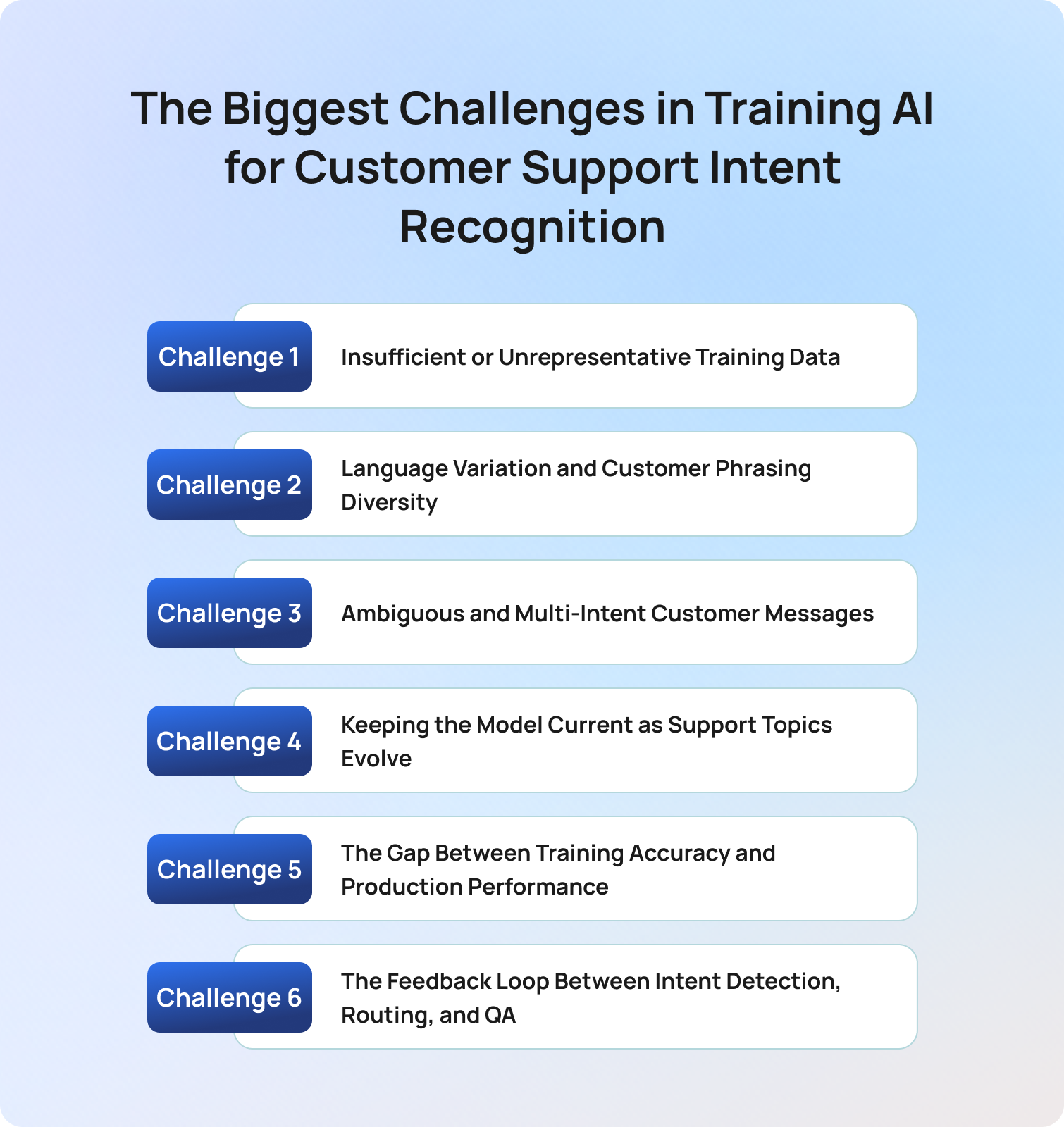
The most common root cause of intent model failure is not a flaw in the algorithm. It is a flaw in the data the algorithm was trained on.
The cold start problem
When a support team launches a new product, opens a new communication channel, or handles a new category of customer inquiry for the first time, there is no historical data to draw from. The model has never seen these customer interactions before.
This cold start problem forces teams into an uncomfortable choice: deploy with no coverage for the new intent class, guess at how customers will phrase queries and build synthetic examples, or wait until enough real interactions accumulate before training. During that waiting period, every interaction in the new category is misrouted or unhandled.
The class imbalance problem
Most support queues are dominated by a handful of high-frequency customer requests: password resets, billing queries, order status checks. These intents are well-represented in training data. Rare but high-value intents (churn signals, escalation triggers, compliance-sensitive requests) have far fewer examples.
A model trained on imbalanced data learns to classify the common intents reliably and performs poorly on the rare ones. The result is that the interactions most in need of accurate intent detection are the ones the model handles worst.
The labelling quality problem
Support tickets used as training data are labelled by human agents, and agents are inconsistent. One agent writes "refund request." Another writes "wants money back." A third writes "billing dispute." All three map to the same customer intent, but the model sees three different labels.
Poor labelling quality introduces noise that degrades classification accuracy regardless of how sophisticated the underlying machine learning models are. The fix requires minimum sample thresholds per intent class before deployment, active learning loops that surface uncertain classifications for human review, and a labelling quality audit before each retraining cycle.
Customer feedback and user feedback captured post-interaction are also valuable insights for identifying which intent classes produce inaccurate responses. Teams that route this signal back into training achieve accurate intent recognition significantly faster than those relying on internal labels alone.
The connection between labelling quality and first contact resolution is covered in depth in the AI ticket classification guide, which is worth reading before you define your intent taxonomy.
Challenge 2: Language Variation and Customer Phrasing Diversity
Customers do not describe their problems the way a training dataset expects. This is one of the most persistent challenges in training AI for customer support intent recognition and one of the least discussed.
Paraphrase variation
Consider these four messages: "My package hasn't arrived." "Where is my order?" "I've been waiting two weeks and nothing has shown up." "Is my delivery lost?"
All four map to the same customer intent: a delivery status query. But a model trained on one phrasing pattern and tested on another will misclassify real-world customer conversations at a rate that aggregate accuracy scores hide.
Paraphrase augmentation during training, specifically generating alternative phrasings for each intent class, is the standard fix. Pre-trained language models, which have been exposed to broad human language patterns, significantly reduce this problem compared to models trained from scratch on a narrow support corpus. AI-powered intent recognition that draws on diverse training corpora is better at recognizing intent across the full range of ways businesses interact with their customers.
Channel-specific language
The way a customer phrases something on live chat differs from an email, a voice call, or a social media message. Chat messages tend to be short and colloquial. Emails are longer and more formal. Voice transcripts include false starts, filler words, and incomplete sentences.
A model trained on email transcripts and deployed on voice or chat will underperform, not because the intent is different but because the surface form of natural language varies by channel.
Voice channels introduce speech recognition outputs with transcription noise and incomplete sentences. Sentiment analysis adds a further layer: customers expressing frustration and customers making neutral factual requests may use near-identical phrasing, and a model without sentiment analysis capability cannot distinguish between them. Chat channels reflect informal customer behavior and abbreviated phrasing. Each channel expresses the same underlying customer needs and customer preferences differently.
Omnichannel customer support operations that handle customer interactions across multiple communication channels need intent models trained on channel-stratified datasets, or at a minimum, evaluated separately by channel to surface where accuracy degrades.
Multilingual support complexity
For teams providing multilingual support, the phrasing variation problem compounds further. The same customer intent expressed in French, Dutch, and Portuguese will produce very different input tokens. Regional dialects and code-switching (customers mixing languages mid-message) add a layer that many intent detection models are not trained to handle.
The result is that multilingual customer interactions are systematically underserved by models trained predominantly on one language.
Challenge 3: Ambiguous and Multi-Intent Customer Messages
Single-intent classification models fail most visibly on the customer interactions that matter most. Complex queries are also the ones most likely to contain ambiguous or multiple intents.
Ambiguous intent
"I need help with my account" contains no deterministic classification signal. The model must either attempt a classification based on the most common account-related user intent it has seen, ask the customer a clarifying question, or escalate to a human agent.
Guessing wrong triggers a misroute. Asking a clarifying question adds friction. Escalating everything with low confidence is expensive.
Understanding how intent detection works handles this ambiguity is what separates AI-powered systems that provide relevant responses from those that produce detected intent errors at scale. The solution is a properly calibrated confidence threshold: if the model's confidence score falls below a defined level, the interaction goes to a human agent rather than being auto-routed. Most teams deploy without tuning this threshold, which means the model assigns classifications even when it should not.
Multi-intent messages
Customers frequently combine intents in a single message. "I want to cancel my subscription, but first I need a refund for last month's charge" contains two separate customer requests requiring two separate workflows. Most intent classification models are trained to output a single label per input. On a multi-intent message, the model either classifies on the dominant intent and ignores the secondary one, or fails on both.
The BlueTweak Intent Hierarchy Model addresses this by classifying primary and secondary intent slots separately, ensuring that both the cancellation workflow and the refund request are captured and routed without requiring the customer to send two separate messages.
Virtual assistants and virtual agents that handle multi-intent queries correctly enable better customer interactions and free human agents to focus on more complex tasks rather than recovering from misrouted tier-1 queries.
Intent drift across a conversation
In longer customer conversations, intent can change. A conversation that starts as a delivery query can shift to a complaint, then to a refund request, as the customer learns more about what happened.
Models trained on single-turn inputs do not handle this shift reliably. Conversation-level context windows that re-evaluate intent as new customer input arrives are required for accurate intent detection in complex, multi-turn interactions. Contextual understanding of the full customer journey is what makes intent recognition technology reliable in practice rather than in controlled tests.
Context-aware AI suggested replies are one practical output of getting this right: the system can respond appropriately because it is tracking how customer intent shifts across the conversation, not just what was said in the first message.
Challenge 4: Keeping the Model Current as Support Topics Evolve
A model trained on last year's support tickets degrades the moment the product, policy, or customer base changes. Concept drift, the gradual shift in the statistical distribution of live traffic away from the training distribution, is one of the most underestimated challenges in training AI for customer support intent recognition.
How concept drift accumulates
New products launch and introduce customer queries that the model has never classified. Policies change and shift the language customers use to describe their problems. Seasonal events such as a peak shipping period, a billing cycle change, or a product recall generate spikes in query types that the training data does not represent.
Each of these events erodes model accuracy silently. There is no error message. Misclassifications are assigned with the same confidence as correct ones.
Most teams retrain on a scheduled cadence: quarterly or biannual cycles driven by the calendar rather than performance signals. Accuracy degradation accumulates between cycles, and the team only discovers the problem when customer satisfaction scores drop or escalation rates rise.
Enhancing customer satisfaction and customer engagement through AI-driven customer service requires continuous learning. The model must improve as customer behavior evolves, not just when the next calendar retrain is scheduled.
The new intent category problem
When a genuinely new intent emerges (a new product fault, an unexpected policy change, a public incident generating a spike in a specific type of customer query) the model has no class for it. It routes the new query as the closest approximation from its existing intent taxonomy.
Which is often wrong. And which generates handle time, repeat contacts, and dissatisfied customers before anyone notices the misroute pattern.
The fix is live customer service analytics that monitor per-intent accuracy in real time, with automated alerts that trigger retraining when a specific intent class drops below threshold, and a fast-path process for adding new intent categories before misrouted tickets accumulate.
Challenge 5: The Gap Between Training Accuracy and Production Performance
A model that achieves 92% accuracy in testing can perform significantly worse in production. This is one of the most common and most avoidable failures in AI-powered customer support deployments in 2026. It is not a model quality problem. It is an evaluation methodology problem.
Distribution shift between test and production
Test data is drawn from the same historical corpus as training data. It represents the past. Production traffic includes edge cases, new customer phrasings, and query types that emerged after the training cutoff. The model was never exposed to them.
Accuracy on a historical test set tells you how well the model performs on data that looks like your training data. It tells you very little about how it performs on the next six months of live customer interactions.
The wrong evaluation metric
Overall accuracy is a poor metric for intent classification in customer support. A model that correctly classifies 95% of high-frequency intents but fails on 40% of rare ones looks excellent in aggregate. It is not. The interactions it gets wrong are disproportionately likely to be the high-value, high-sensitivity ones: churn signals, escalation triggers, compliance queries that most require accurate routing.
Evaluating intent detection models on per-intent precision and recall, not overall accuracy, surfaces these failure patterns before they reach production. Precision measures how often the model is correct when it assigns a given label. Recall measures how often it correctly identifies a given intent when it is present. Both matter. Neither is visible in an aggregate accuracy score.
Miscalibrated confidence thresholds
Deploying without a properly calibrated confidence threshold means the model assigns classifications at high confidence even when it is uncertain. A customer input that genuinely falls between two intent categories gets assigned to one of them as if the classification were clear. The routing system acts on that. The customer arrives at the wrong team. The agent sees a misrouted ticket with no flag that the AI system was uncertain.
The result is not just a failed interaction. It is an operational costs problem, because recovering a misrouted interaction costs more than handling it correctly the first time. Accurate intent recognition is the foundation of accurate responses, personalized responses, and the operational efficiency that customer expectations increasingly demand.
Per-intent confidence threshold calibration, which means setting different escalation thresholds for different intent classes based on the cost of a misclassification, is standard practice in well-deployed support ticket automation systems. It is rarely implemented at first deployment and rarely revisited after.
Challenge 6: The Feedback Loop Between Intent Detection, Routing, and QA
Intent recognition does not operate in isolation. Its output feeds the routing system, which feeds the QA process, which generates the data that should feed back into the next training cycle. When that loop is broken, training failures propagate downstream and accumulate silently.
How misclassified intent reaches the customer
A routing system that relies on intent labels from an underperforming model sends interactions to the wrong team. Agents receive tickets outside their skill area. Handle time increases. Customer satisfaction drops. First contact resolution falls.
How well an AI customer support platform handles the routing integration layer is one of the clearest differentiators between systems that work in production and ones that look good in a demo.
The customer in this scenario does not know that an AI system misclassified their request. They know they explained their problem, were transferred, and had to explain it again. What they experience is bad service. What the data shows is a rising escalation rate that no one has attributed to an intent classification problem.
The customer journey breaks not at the moment of human intervention, but at the moment the AI agent made a silent misclassification that no one caught. Customer service teams that surface these failures quickly are the ones that recover fastest.
Human agents as an underused training signal
Every time a human agent overrides an AI classification by reassigning a ticket to a different category, transferring an auto-routed interaction, or escalating a query the AI system marked as tier-1, they are creating a labelled training example. The model got it wrong. The agent corrected it. That correction is the most accurate signal available for improving accurate intent classification over time.
AI agents and virtual agents that improve through this loop reduce the volume of queries requiring human intervention, freeing agents to focus on complex tasks where judgment genuinely matters: from account status disputes to queries that resemble tailored financial advice more than a standard FAQ resolution.
Most teams do not have a structured process for capturing these overrides as training data. The corrections happen. The improved labels are never fed back into the retraining pipeline. The same misclassification pattern repeats in the next deployment cycle.
QA as a retraining signal
AI quality assurance scoring across 100% of interaction surfaces, interactions where the AI system performed poorly: wrong routing, poor response quality, unnecessary escalation. These QA flags are the richest available signal for identifying which intent classes are underperforming in production.
Teams that feed QA data back into their training pipeline close the feedback loop that makes continuous improvement practical rather than aspirational.
Tracking per-intent performance metrics through a proper customer service analytics layer is what turns QA flags into actionable retraining signals rather than numbers on a dashboard no one acts on.
How BlueTweak Handles Intent Recognition Training Challenges
Most of the challenges above trace back to the same structural gap: intent recognition is treated as a one-time deployment problem rather than an ongoing operational discipline. Train the model, launch it, move on. BlueTweak is built on the premise that AI-powered customer support requires the same continuous learning commitment as the human teams it supports.
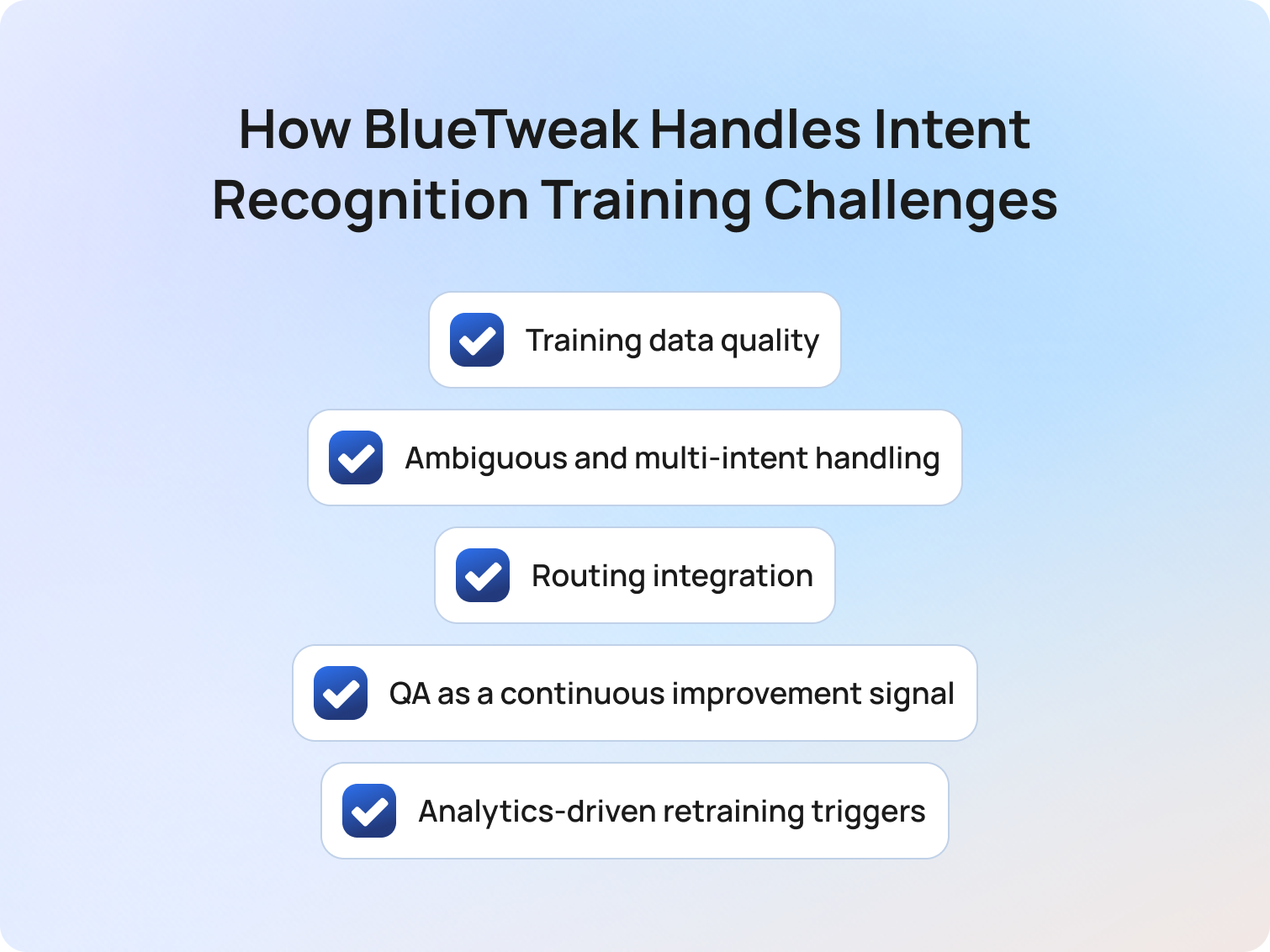
Training data quality. BlueTweak's conversational AI is grounded in support-specific interaction data rather than general-purpose language corpora, reducing the distribution mismatch that causes production degradation. The Smart Knowledge Base provides the structured content layer that grounds automated responses in verified information, reducing the gap between what the model classifies and what it can actually resolve.
Ambiguous and multi-intent handling. BlueTweak's confidence scoring and escalation triggers prevent low-confidence classifications from reaching the customer as if they were certain. When customer intent is ambiguous, the interaction is routed to a human agent rather than being misclassified. Virtual agents handle tier-1 interactions where intent is clear and consistent. Human agents focus on the complex queries where contextual understanding and judgment are required.
Routing integration. Intent classification output connects directly to the AI Ticket Triage system, closing the loop between classification and routing correction. Agent overrides are captured as labelled training signals rather than lost as one-off corrections.
QA as a continuous improvement signal. The QA module scores 100% of interactions, not the 5 to 15% that manual review covers. QA flags on misrouted or poorly resolved interactions surface directly as retraining candidates rather than disappearing into an aggregate satisfaction score.
Analytics-driven retraining triggers. Rather than retraining on a calendar schedule, BlueTweak surfaces per-intent accuracy signals through the analytics and reporting layer. Teams see when a specific intent class starts underperforming before that degradation affects CSAT or escalation rates.
The teams that get the most out of AI in customer support are not the ones with the most sophisticated models. They are the ones with the tightest feedback loops. Every misclassification is a training example. Every agent correction is a signal. The system gets better only if you build the infrastructure to capture those signals and act on them.
Intent classification is one piece of a larger picture. How AI improves customer support across the full operation is worth reading alongside this.
Final Thoughts
The challenges in training AI for customer support intent recognition are not technology problems. They are data quality problems, evaluation methodology problems, and operational discipline problems.
Insufficient training data, language variation, ambiguous customer intent, concept drift, the test-production gap, and broken feedback loops are all fixable with the right process, the right measurement infrastructure, and the right commitment to treating intent recognition as an ongoing practice rather than a one-time deployment.
Customer service teams that build this discipline see the key benefits compound over time: more accurate intent classification, better routing, higher first contact resolution, and customer interactions that feel genuinely responsive rather than mechanically routed. AI-powered intent recognition that learns continuously is what enables businesses to meet customer needs at scale and deliver exceptional customer experiences.
The customer experience does not improve because the model is smarter. It improves because the model keeps getting better.
If you want to go deeper into what happens once the model is deployed, how conversational AI detects customer intent in real time covers the full detection pipeline.
Start your free trial and see how BlueTweak handles intent recognition against your own support data.
Start your free BlueTweak trial
Start Today
Customer Support Automation ROI: How to Measure What Matters
Why Most Customer Support Automation ROI Numbers Are Wrong

Let's start with the honest version of this conversation, because in 2026, most customer service operations teams are working with customer service ROI projections that will not survive contact with reality. Measuring customer service ROI accurately is harder than vendors make it look, and the gap between what gets promised and what gets delivered is almost always a measurement problem, not a performance problem.
That is not a technology problem. Automation genuinely delivers a significant return when it is deployed well and measured correctly. The problem is the measurement methodology, which inflates early results, hides long-term performance problems, and sets teams up to explain why the numbers looked better in the proposal than they do six months in.
Three measurement errors account for most of it.
Deflection Rate Is Not Containment Rate
This is the single most common and most consequential measurement error in support automation. Deflection rate counts the number of sessions that ended inside the bot without escalating to a human agent. Containment rate counts the number of contacts that reached a full resolution without the customer following up on any channel within 24 hours.
A customer who used the bot, got an incomplete answer, and then sent an email is counted as deflected. They are not contained. They generated two contacts instead of one. Most customer service AI and AI customer service automation vendor dashboards report deflection by default, because deflection is the metric that makes customer interactions look resolved faster than they are.
Cost Per Ticket Ignores Resolution Quality
Dividing the total support operating cost by the total tickets closed produces a number that falls when automation closes more tickets, even when automation is creating repeat contacts by failing to resolve the underlying issue. A team with a bot generating failed self-service attempts will show a lower cost per ticket and declining customer satisfaction scores simultaneously. Improved customer satisfaction and service quality are moving in opposite directions from the cost metric, while the cost metric flatters the deployment. The metric looks good. The operation is getting worse.
Headcount Savings Are Counted Before They Exist
Reducing average handle time by 20% does not automatically reduce headcount by 20%. It creates capacity. Real headcount ROI requires either a hiring freeze applied against projected growth or an actual reduction in force. Both are real outcomes, but they take time and deliberate management decisions to materialise. Most ROI projections count them on day one.
The Customer Support Automation ROI Formula
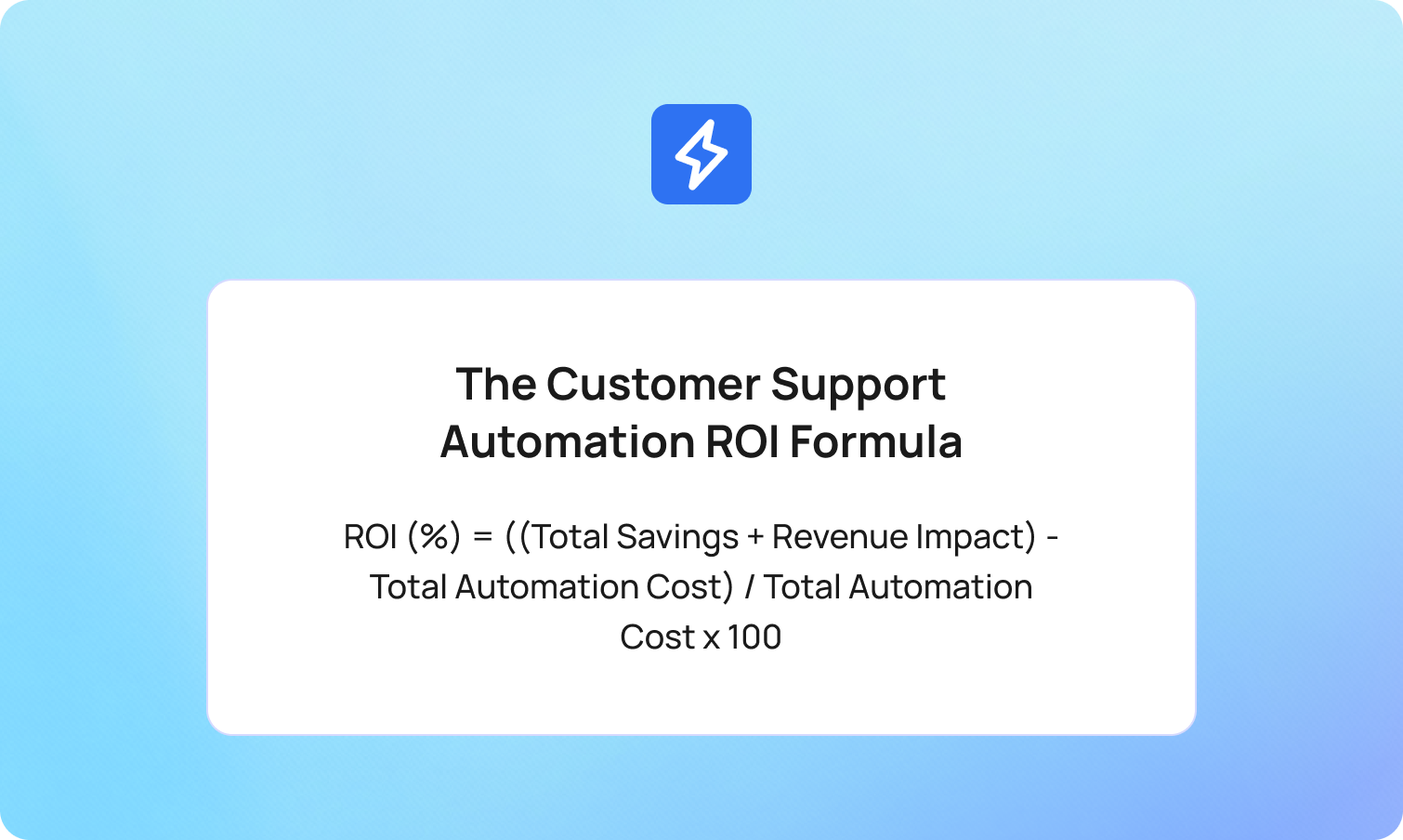
The formula itself is straightforward. The discipline is in what you put into it.
ROI (%) = ((Total Savings + Revenue Impact) - Total Automation Cost) / Total Automation Cost x 100
Each component deserves a precise definition.
Total Savings
The reduction in cost per resolved contact, multiplied by resolved contact volume. Not deflection volume. Not ticket closure volume. Resolved contact volume: the number of contacts that reached a full resolution in the measurement period. If your cost per resolved contact falls from €8 to €3 on automated interactions, and you handle 15,000 automated resolutions per month, your monthly saving is €75,000.
Revenue Impact
The improvement in customer retention is attributable to service quality, quantified through churn rate reduction. Keeping existing customers costs less than acquiring new ones. Customer expectations of fast, accurate service are rising, and automation that meets those expectations compounds value through customer loyalty, higher lifetime value, and revenue growth over time. A 1% reduction in monthly churn on a customer base with an average lifetime value of €500 is a concrete number. Most ROI models leave this cell empty or fill it with aspirational estimates. It is the hardest component to measure and the most important to get right, because it is where automation either creates or destroys long-term value.
Total Automation Cost
Platform licensing, implementation fees, ongoing KB maintenance, model retraining, escalation overhead, and internal resource time for managing the system. Most teams calculate the first two correctly and ignore the rest. The cost savings and cost reduction numbers that appear in vendor proposals are built on the first two. The operational costs that determine whether lowering operational costs at scale is genuinely achievable are the ones that come after. The hidden costs of inefficient customer support systems are well documented, and the same logic applies to automation: the costs that do not appear in the vendor proposal are the ones that erode ROI silently.
Worked Example
A team handling 50,000 contacts per month at €8 cost per resolution deploys automation scoped to tier-1 queries. At 90 days, the containment rate on automated interactions is 62%. That means 31,000 contacts are fully resolved by automation at €2.50 cost per resolution, and 19,000 are handled by human agents at €8. Monthly saving: (31,000 x €5.50) = €170,500. Monthly platform cost, including maintenance: €18,000. Monthly net saving: €152,500.
That is a real number from a realistic deployment, and it only holds if the containment rate is measured correctly.
For an overview of customer support automation ROI calculator tools comparison, the BlueTweak ROI calculator is one of the few built specifically for contact centers running AI automation. It accepts your actual cost per resolution, contact volume, and containment targets and outputs a time-phased projection rather than a single headline number.
The Metrics That Actually Measure Customer Support Automation ROI

Containment Rate
Containment rate is the percentage of automated interactions that reach a complete resolution without a follow-up contact on any channel within 24 hours.
Calculation: (Fully resolved automated contacts / Total automated contacts attempted) x 100
The 24-hour cross-channel window is what makes this metric honest. A customer who ended a bot session and sent an email 90 minutes later was not contained. Measuring containment properly requires joining bot session data with email, chat, voice, and social contact data. That is why teams using fragmented tooling default to deflection rate. It is not a better metric. It is an easier one.
For a well-scoped tier-1 deployment at 90 days, a containment rate of 55–70% is a realistic target. Automating routine tasks and routine inquiries, password resets, billing inquiries, order status, and account updates is where self-service capabilities deliver the most consistent results. Below 50% usually signals either a scope problem (the bot is handling interactions it cannot resolve) or a knowledge base problem (the content it is grounding responses in is incomplete). Expanding self-service options before fixing a knowledge base gap will not improve containment.
Cost Per Resolved Contact
Total support operating cost divided by the number of contacts that were resolved, not closure, in the measurement period.
The distinction between closure and resolution matters. A ticket marked closed by an agent after a first response is not necessarily resolved. A contact where the customer sent three follow-up messages before the issue was addressed represents one resolution and three closures. Dividing cost by closures understates the true cost of poor resolution quality.
Split cost per resolved contact by channel and by interaction type (automated vs. human-handled). The gap between the two numbers is the efficiency case for automation. Watching that gap widen or narrow over time is how you track whether automation is improving or degrading.
First Contact Resolution Rate by Channel
First contact resolution rate is one of the key performance metrics that separates teams measuring automation correctly from those measuring it conveniently. It is the percentage of contacts resolved on the first interaction, tracked separately for automated and human-handled interactions. Contact resolution on the first touch is the outcome that reduces repeat contacts, lowers operational costs, and improves customer satisfaction in a single number.
Automation should increase FCR on the interactions it handles, not just reduce overall volume. If FCR on automated interactions is falling while overall contact volume is falling, the automation is resolving fewer issues per attempt. That means it is creating repeat contacts that are being absorbed elsewhere and not appearing in the automation metrics.
A misclassified contact is a misrouted contact, and a misrouted contact almost never resolves on the first touch. AI ticket classification is where that chain starts.
CSAT on Automated Interactions
CSAT scored specifically on bot-handled and automated interactions, tracked separately from human-handled interactions, and reported on the same cadence.
Automation that reduces cost while reducing CSAT is destroying customer lifetime value faster than it is saving on cost per ticket. The ROI model must net the two against each other. Higher customer satisfaction on automated interactions is not just a CX metric: it is the leading indicator for containment rate, customer loyalty, and net promoter score. A 1% drop in monthly CSAT on automated interactions is an early signal that containment rate is about to fall. Customer sentiment is shifting before the operational data catches up. Tracking it separately is the fastest way to improve customer service ROI before the churn data arrives.
Structuring customer service analytics to separate automated from human-handled CSAT is what makes the comparison meaningful rather than misleading.
Churn Rate Change Post-Automation
Change in customer churn rate at 90 and 180 days after automation deployment, segmented by customers who interacted primarily with automation versus human agents.
This is the metric most teams skip because it is the hardest to attribute. It is also the metric that captures whether automation is building or eroding the customer relationship over time. A team that reduces cost per resolved contact by 40% while increasing churn by 2% in its automated customer segment is not generating positive ROI. It is transferring cost from the support budget to the revenue line.
What Good Customer Support Automation ROI Looks Like at 30, 90, and 180 Days
Most ROI models present a single number. Operations teams report to leadership in time horizons. These are not the same thing, and the mismatch is where most automation deployments lose credibility internally.
30 Days: Baseline and Early Signals
At 30 days, the model is still being calibrated. Containment rates are lower than they will be at steady state. CSAT on automated interactions often dips before it recovers as the system learns which queries it can handle confidently. Handle time may temporarily increase as agents learn the escalation workflow.
The key metrics to track at 30 days are the containment rate improving week on week, whether the escalation rate to human agents is within the expected range, and what percentage of queries the bot is unable to answer. Also track agent productivity on escalated interactions, if the AI tools are passing poor context on handoff, agents are spending more time re-reading transcripts than resolving issues. Review customer data completeness in the handoff payload. These are trajectory metrics, not ROI metrics.
Do not report headcount ROI at 30 days. Do not report a cost saving based on deflection rate. Report trajectory.
90 Days: First Real ROI Signal
By 90 days, the containment rate should be approaching steady state for the scoped interaction types. Cost per resolved contact on automated interactions should be trackable against the pre-deployment baseline. FCR on automated interactions should be measurable and comparable to human-handled FCR on the same query types.
This is the first point at which a credible ROI number can be presented to leadership. For a well-scoped tier-1 deployment, a realistic 90-day benchmark is a 55–70% containment rate and a 30–40% reduction in cost per resolved contact on automated interaction types. This is also where AI for customer service starts delivering measurable value rather than trajectory signals. An AI-powered customer service that is showing efficiency gains at 90 days is a deployment that was scoped and measured correctly. Below those ranges, the deployment is either underscoped or the knowledge base needs attention before expanding automation coverage.
180 Days: Full ROI Picture
At 180 days, churn rate data becomes meaningful and attributable. Customer lifetime value impact is traceable through the retention data. Teams with predictive analytics in place can begin forecasting which customer segments are churn risks based on their automated interaction history, turning support data into a proactive customer experience input rather than a reactive report. The feedback loop between QA scoring and model improvement should be visible in containment rate improvements. A system built for continuous improvement will show steady containment rate gains between 90 and 180 days rather than a plateau, and support costs will continue to fall as the model gets better.
This is also the point at which headcount ROI can be credibly reported. The capacity freed by automation has had time to either reduce overtime costs, offset planned hiring, or support volume growth without additional headcount. Any of those outcomes is real ROI. None of them appears reliably in a 30-day measurement window.
The Hidden Costs That Kill Customer Support Automation ROI
Most vendor ROI models undercount costs. These four items appear consistently in post-deployment reviews and rarely in pre-deployment projections. Each one represents a customer service team resource, part of the ongoing customer service efforts, or a pattern in customer conversations that the initial proposal treated as zero-cost.
Knowledge Base Maintenance
The automation is only as accurate as the content it is grounded in. A RAG-grounded system retrieving from an incomplete or outdated knowledge base will produce inaccurate responses, reduce containment rate, and generate the kind of failed self-service contacts that inflate repeat contact volume. KB maintenance is not optional overhead. It is a direct driver of containment rate, which makes it a direct driver of ROI.
The BlueTweak Smart Knowledge Base is built on the assumption that KB quality and automation performance are the same problem.
Model Retraining and Optimisation
Intent models degrade as product changes, policy updates, and seasonal shifts alter the distribution of incoming queries. Retraining cycles, new intent category creation, and confidence threshold recalibration all require internal resource time or vendor fees. A model running on six-month-old training data against current traffic is not performing at its 90-day benchmark. Most initial ROI projections do not include a line item for ongoing optimisation.
Escalation Handling Overhead
When automation escalates to a human agent, the handoff quality determines whether the escalation adds or removes cost. A clean handoff, with full context, interaction summary, and intent classification passed to the agent, takes seconds. A poor handoff, where the agent re-reads an incomplete transcript and asks the customer to repeat their issue, adds minutes of handle time to every escalation. At scale, that is a material cost.
AI agents and conversational AI systems that pass full context across communication channels on escalation remove the need for human intervention to re-establish what the customer already explained. Human-in-the-loop AI done well is an efficiency gain. Done poorly, it offsets automation savings.
Failed Self-Service Follow-Up Volume
Customers who attempt self-service and fail do not disappear from the contact queue. They call, email, or message, and they arrive more frustrated than if they had contacted a human agent directly. Customer feedback on failed self-service interactions is a direct signal about customer preferences for resolution paths. Customers who prefer self-service but cannot get a resolution through it represent a containment problem and a satisfaction problem simultaneously. Failed self-service generates harder-to-handle customer inquiries with lower first-touch resolution rates and worse CSAT outcomes than contacts that never went near the bot. This volume must appear in the ROI model as a cost, not as evidence that automation is working.
How to Build a Customer Support Automation ROI Model That Holds Up
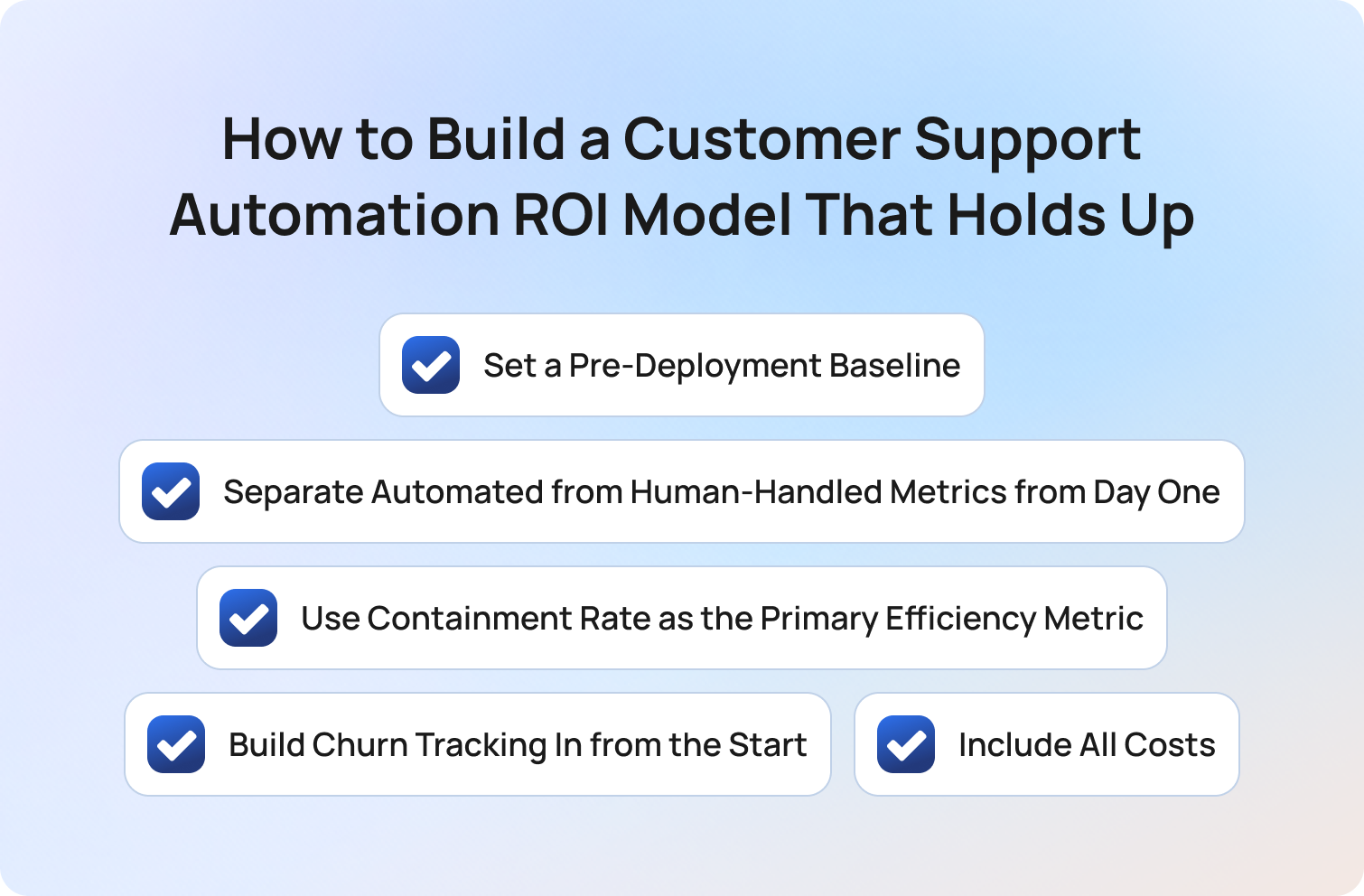
A ROI model that holds up under leadership scrutiny is built on five disciplines, not one formula. Customer service initiatives that reduce support costs and improve operational efficiency generate real returns. The measurement model is what determines whether customer support operations can prove it. Most AI implementation projects fail the ROI test, not because the technology underperformed but because the measurement model was not ready when the deployment went live.
Set a Pre-Deployment Baseline
Capture cost per resolved contact, FCR by channel, CSAT, and churn rate before automation goes live. Without a pre-deployment baseline, there is no ROI. There is only a before-and-after story that cannot be attributed to automation with any confidence.
Separate Automated from Human-Handled Metrics from Day One
Blended metrics hide automation performance behind human-handled performance. Set up reporting that tracks containment rate, CSAT, FCR, and cost per resolved contact separately for automated and human-handled interactions before the first automated contact is handled.
Use Containment Rate as the Primary Efficiency Metric
Define it precisely: resolution without follow-up contact across all channels within 24 hours. Report it weekly for the first 90 days. Any team using deflection rate as its primary automation efficiency metric is reporting a number that flatters the deployment and hides failure modes.
Build Churn Tracking In from the Start
Segment customers by their primary interaction type and track churn separately from the first month of deployment. This is the only way to capture the revenue side of the ROI equation with any precision. AI-driven automation that maintains service quality for existing customers will show this in churn data. AI-driven automation that is degrading customer relationships will also show it there, before it shows up anywhere else. Teams that skip this step cannot answer the question that matters most: Is automation improving or degrading customer relationships over time?
Include All Costs
Platform licensing, implementation, KB maintenance, model retraining, escalation overhead, and internal management time. If the vendor ROI model does not include KB maintenance and retraining, add them. They are not edge cases. They are the costs that determine whether 90-day performance holds at 180 days.
The BlueTweak ROI calculator is built on this framework. It accepts actual cost inputs, containment targets, and CSAT baselines and outputs a time-phased projection at 30, 90, and 180 days. A single headline number is not a measurement model. It is a marketing claim.
How BlueTweak Makes Customer Support Automation ROI Measurable
Most of the ROI measurement problems described above share a root cause: the platform being used to run customer service automation is not the same platform being used to measure it. Data lives in separate systems. Containment rate cannot be calculated because bot session data and email contact data are in different tools. CSAT on automated interactions is blended with human-handled CSAT because the reporting layer does not distinguish between them. The result is that AI customer support generates real service efficiency gains that the measurement model cannot capture as measurable ROI.
BlueTweak is designed so that measurement and automation run in the same workspace. AI-driven tools that generate data in one system and report it in another will always produce ROI numbers that operations teams cannot fully stand behind.
Containment Over Deflection
The platform tracks whether a contact recurs across channels within 24 hours, giving teams a containment rate they can report with confidence, not a deflection rate that counts sessions rather than resolutions.
Cost Per Resolved Contact in the Dashboard
The analytics and reporting layer separates automated and human-handled interaction costs, and reports cost per resolution rather than cost per ticket closure. The number that appears in the dashboard is the number that will hold up in a leadership meeting.
CSAT Tracked by Interaction Type
CSAT is tracked and reported separately for automated and human-handled interactions, so teams can see within the same view whether automation is improving or degrading satisfaction alongside cost. A rising containment rate paired with falling CSAT is a signal that the system surfaces before it compounds.
KB Quality as a Direct ROI Input
The Smart Knowledge Base and QA module work in the same system. QA flags on bot responses surface KB gaps that, once closed, directly improve containment rate. The relationship between content quality and automation ROI is visible rather than assumed.
The 30/90/180-Day View Built In
Rather than a single ROI snapshot, BlueTweak's reporting gives teams the trajectory view they need to report credibly at each stage of deployment: week-on-week containment improvement, 90-day FCR comparison, and 180-day churn segmentation, all in the same platform.
The teams that struggle to prove automation ROI are almost never struggling because the automation is not working. They are struggling because the measurement model they are using was built to show deflection, not resolution. Once you switch to measuring containment, cost per resolved contact, and churn by interaction type, the ROI story becomes a lot clearer and a lot more defensible. The question changes from ‘did the bot handle the contact?’ to ‘did the customer’s problem get solved?’ Those are very different questions, and they produce very different numbers.
Final Thoughts
Customer support automation ROI is real. The business outcomes it delivers, reducing costs across tier-1 interactions, better customer experience, and stronger customer retention, are significant for any customer service team running at scale. The teams generating measurable ROI are not doing anything exotic. They are measuring containment instead of deflection, tracking cost per resolved contact instead of cost per ticket, building churn segmentation into their model from the start, and including the hidden costs that most vendor proposals omit.
The teams that cannot show ROI at 180 days are usually the ones that reported a deflection rate at 30 days, called it success, and stopped measuring. The number looked good. The operation did not improve.
Get the measurement model right first. The ROI follows from the discipline, not the technology.
Run your own numbers with the BlueTweak ROI calculator and see what a realistic 90-day and 180-day projection looks like for your team. Or start your free trial and build the measurement infrastructure alongside the automation from day one.
Start your 14-day free trial
Start Today
How to Overcome Language Barriers in Customer Service (2026)
Why Language Barriers Are a Scaling Problem, Not Just a Communication Problem
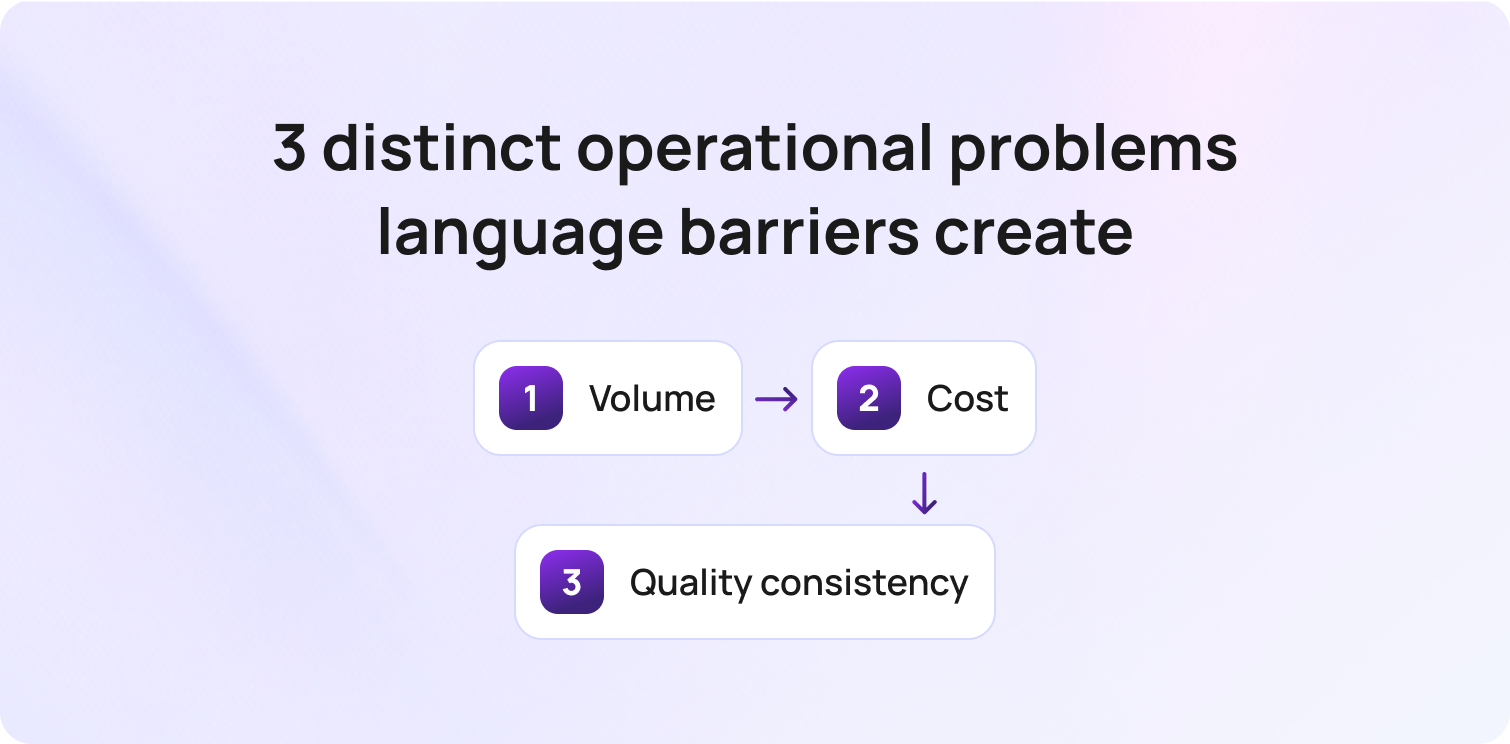
Imagine a customer reaching out in Portuguese to a support team that only speaks English. Both the customer and the agent want to resolve the issue. The communication barrier between them is not a matter of goodwill. It is a structural gap in how the business has organised its support operations.
Dealing with language barriers in customer service at the individual interaction level, using tips like speak slowly or choose simple words, works for occasional edge cases. It does not work when a growing, diverse customer base spans international markets across different languages and different cultures.
At scale, customer service language barriers create three distinct operational problems.
Volume. As a company expands into international markets, non-primary-language interactions grow proportionally. The question is not how to handle one difficult conversation. It is how to route, respond to, and resolve thousands of interactions monthly in a customer's language your core team does not speak.
Cost. Hiring and retaining native-speaking employees for every language in your customer base is expensive. Most teams can justify native speakers for their top two or three languages. Beyond that, cost and availability create barriers in customer service that go unfilled.
Quality consistency. Clients who do not speak English as a first language, or who do not speak the company's primary language, often receive slower response times, less accurate answers, and lower CSAT than primary-language customers. That gap in service quality affects retention across every industry.
The same principle applies to support. When customers cannot get help in their preferred language, frustration builds quickly, and the gap in service quality shows up in CSAT, repeat contacts, and churn before most teams realise there is a problem."
3 Approaches to Multilingual Coverage and When to Use Each
| Approach | Best For | Cost Model | Language Coverage | Quality Risk | Time to Deploy |
|---|---|---|---|---|---|
| Native-speaking agents | Top 2–3 languages; complex ideas and high-value interactions | High fixed cost; scales with headcount | Limited to hired languages | Low — human judgment and cultural nuance | Weeks to months |
| AI translation tools and multilingual NLP | High-volume tier-1 queries across different languages | Low variable cost; scales without headcount | 50+ languages depending on the platform | Medium — quality varies by language; needs monitoring | Days to weeks |
| Hybrid (native agents + AI translation) | Most teams managing 4+ languages and a diverse customer base | Optimised — AI covers volume; native agents handle complex cases | Broadest coverage | Low — AI handles routine; humans handle nuance | Phased deployment |
For most teams managing more than three languages, the hybrid model delivers the best combination of coverage, cost, and clarity. Native agents handle interactions that require cultural nuance, emotions, and judgment. AI translation tools cover the volume that those agents cannot economically staff for.
6 Ways to Overcome Language Barriers in Customer Service at Scale
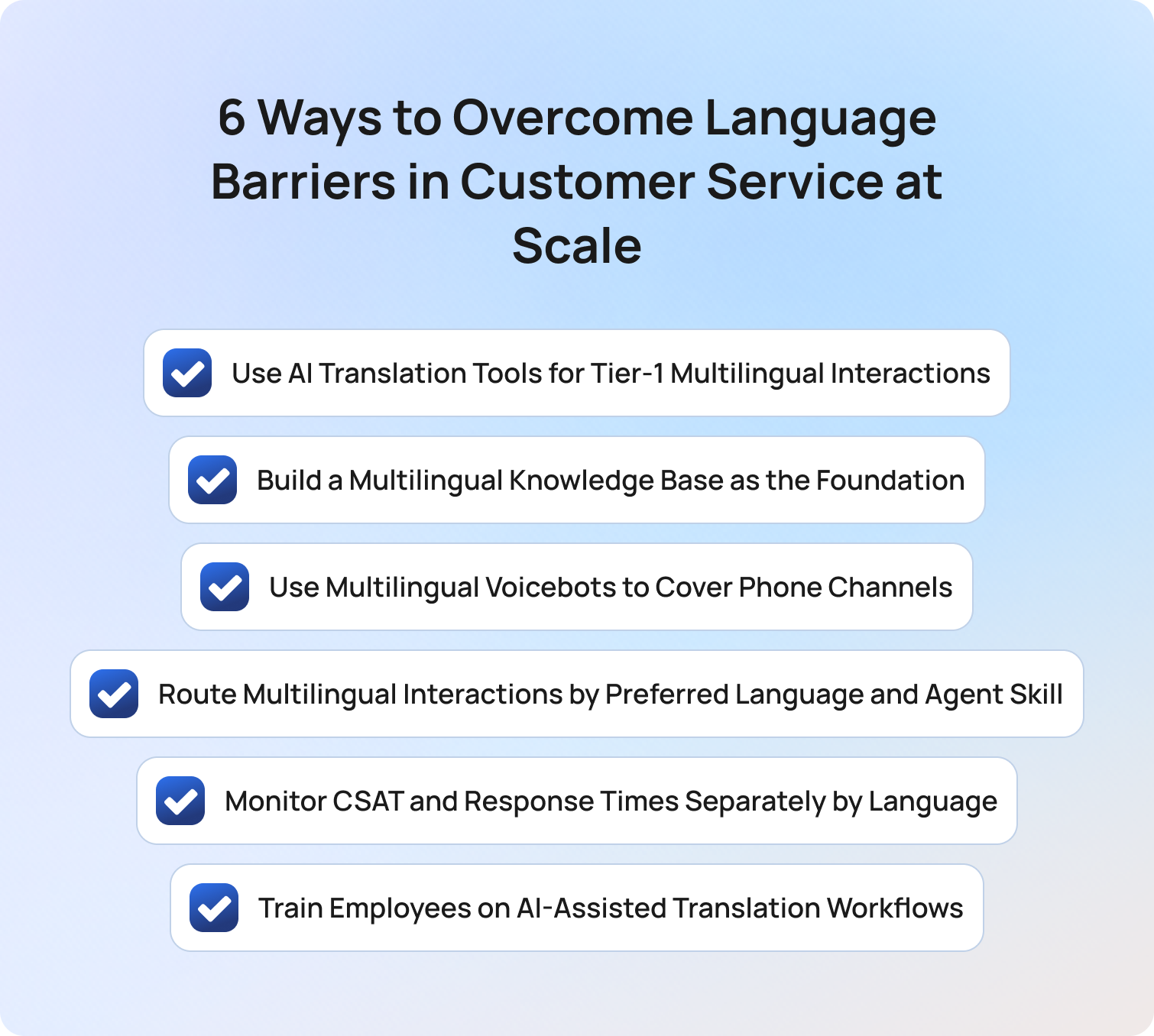
The strategies below address language barriers at the operational level. Each one scales with volume and focuses on building a system for clear communication rather than relying on individual agent ability.
1) Use AI Translation Tools for Tier-1 Multilingual Interactions
AI-powered translation and multilingual NLP handle high-volume, routine customer inquiries across different languages without native-speaking agents. In 2026, LLM-powered tools translate text and interpret context and nuance significantly better than earlier rule-based approaches or a basic tool like Google Translate, making them viable for customer-facing responses on predictable interaction types such as order status, account queries, and FAQs.
Translation services powered by AI now connect customers and agents who do not speak the same language in real time, reducing response times and eliminating the manual steps that slow down multilingual interactions. Start with your highest-volume non-primary languages and monitor CSAT per language from launch.
2) Build a Multilingual Knowledge Base as the Foundation
AI translation quality depends entirely on the source content it translates from. A well-structured, accurate knowledge base in the primary language gives translation tools a reliable foundation. Teams that deploy translation services without first auditing KB quality produce inconsistent outputs across different languages, regardless of the model's capability.
Clear communication starts with clear source content. Before implementing any translation tool, review your knowledge base for outdated information, jargon, and complex ideas that would be difficult to translate accurately into a customer's preferred language.
The most common mistake we see is teams deploying AI translation before they have fixed the underlying KB. The AI will translate whatever is in there, including the outdated, the inaccurate, and the inconsistent. Clean the source first.
3) Use Multilingual Voicebots to Cover Phone Channels
Language barriers in customer service are not limited to chat and email. Phone support often has the lowest multilingual coverage because native-speaking agents are the most expensive to staff. Multilingual voicebots handle inbound calls across different languages using voice recognition and NLP, covering after-hours volume and peak periods without language-specific agent scheduling.
For businesses where the phone is a key channel, this is often the highest-ROI multilingual investment. A voicebot that can speak with clients in their preferred language removes a communication barrier that a human staffing model cannot fill cost-effectively at low volume.
4) Route Multilingual Interactions by Preferred Language and Agent Skill
Intelligent routing that detects a customer's language from the opening message and assigns the interaction to an available native-speaking agent, or to an agent with translation support, reduces handle time and improves first contact resolution for multilingual clients. Preferred language should be a routing criterion alongside intent and urgency. Teams that rely on agents to self-identify language mismatches during a conversation add unnecessary delay and frustration to every multilingual interaction.
Clear communication in the customer's language is essential. Using visual aids where possible, such as links to illustrated guides or video content in the customer's language, can also help bridge gaps when translated text alone does not fully convey the message.
5) Monitor CSAT and Response Times Separately by Language
This is the strategy most companies skip and the one that reveals whether overcoming language barriers in customer service is actually working. Segmenting analytics by language from day one surfaces underperforming language segments before they lead to churn. A company with strong overall CSAT may have significantly lower scores for customers from different backgrounds who communicate in a non-primary language.
Set per-language CSAT and response time targets. Acknowledge performance gaps by language in the same way you would acknowledge any other service quality issue. Treat each language segment as its own benchmark, not a secondary concern.
6) Train Employees on AI-Assisted Translation Workflows
Agents who do not speak a customer's language can still handle interactions effectively in the workplace with real-time AI translation support, provided they understand how to use it and where its limits are. Training support employees on when to trust AI translation output, when to ask for clarification, and when to escalate to a native speaker increases effective language coverage without additional hiring.
Practice matters here. Agents who regularly work with translation tools in realistic scenarios develop the ability to sense when a translated message has lost context or meaning. Building that skill across the team creates a sense of confidence that improves both agent experience and customer experience.
According to a Common Sense Advisory study, 74% of customers are more likely to make a repeat purchase if after-sales support is in their native language. Getting employees comfortable with AI-assisted multilingual workflows is one of the most cost-effective ways to build trust with a diverse customer base across international markets.
How BlueTweak Supports Multilingual Customer Service at Scale
BlueTweak applies AI translation and multilingual NLP across chat, email, and voice channels in a unified platform, removing the need for separate translation services per language or channel.
The multilingual support platform handles tier-1 customer interactions across 100+ languages, grounded in the knowledge base, so responses are accurate and consistent. Multilingual voicebot coverage extends language support to inbound phone calls. Analytics surfaces CSAT, response times, and containment rate by language, giving teams the visibility to identify and resolve multilingual service gaps before they affect retention. Both the customer and the agent benefit from a platform where communication barrier risks are addressed systematically rather than interaction by interaction.
Final Thoughts
Overcoming language barriers in customer service at scale is not about finding the right words in the moment. It is about building a system where clear communication in the customer's preferred language is the default, not the exception. Native-speaking agents handle the interactions that require cultural context and human judgment. AI translation tools and multilingual voicebots cover the volume that those agents cannot staff for. Per-language analytics create the visibility to connect the dots between language coverage and retention.
For a full comparison of platforms that support multilingual customer service, see Best Multilingual Customer Support Software.
Start your free trial or request a demo to see how BlueTweak handles multilingual support at scale.
Get a 14-day free trial
Get Trial
How Can AI Improve Customer Service Efficiency Across Teams and Channels
What "Efficiency" Actually Means in Customer Service
Customer service refers to the full range of interactions between a business and its customers across every contact point. Customer service efficiency is not just speed. It is three things working together: volume handled per agent, resolution quality per contact, and consistency across teams and channels. Customer expectations for fast, accurate, consistent service have risen sharply, and most customer service agents are being asked to meet them with tools that have not kept pace.
An operation that handles more volume but resolves fewer is not more efficient. A customer service team that resolves quickly on chat but inconsistently on email is not efficient at scale. Customer satisfaction scores fall when any one of the three breaks down.
AI in customer service improves all three when deployed correctly. That is the honest answer to how AI can improve customer service efficiency: not by making one metric look better, but by removing the friction that causes all three to underperform.
6 Ways AI Improves Customer Service Efficiency
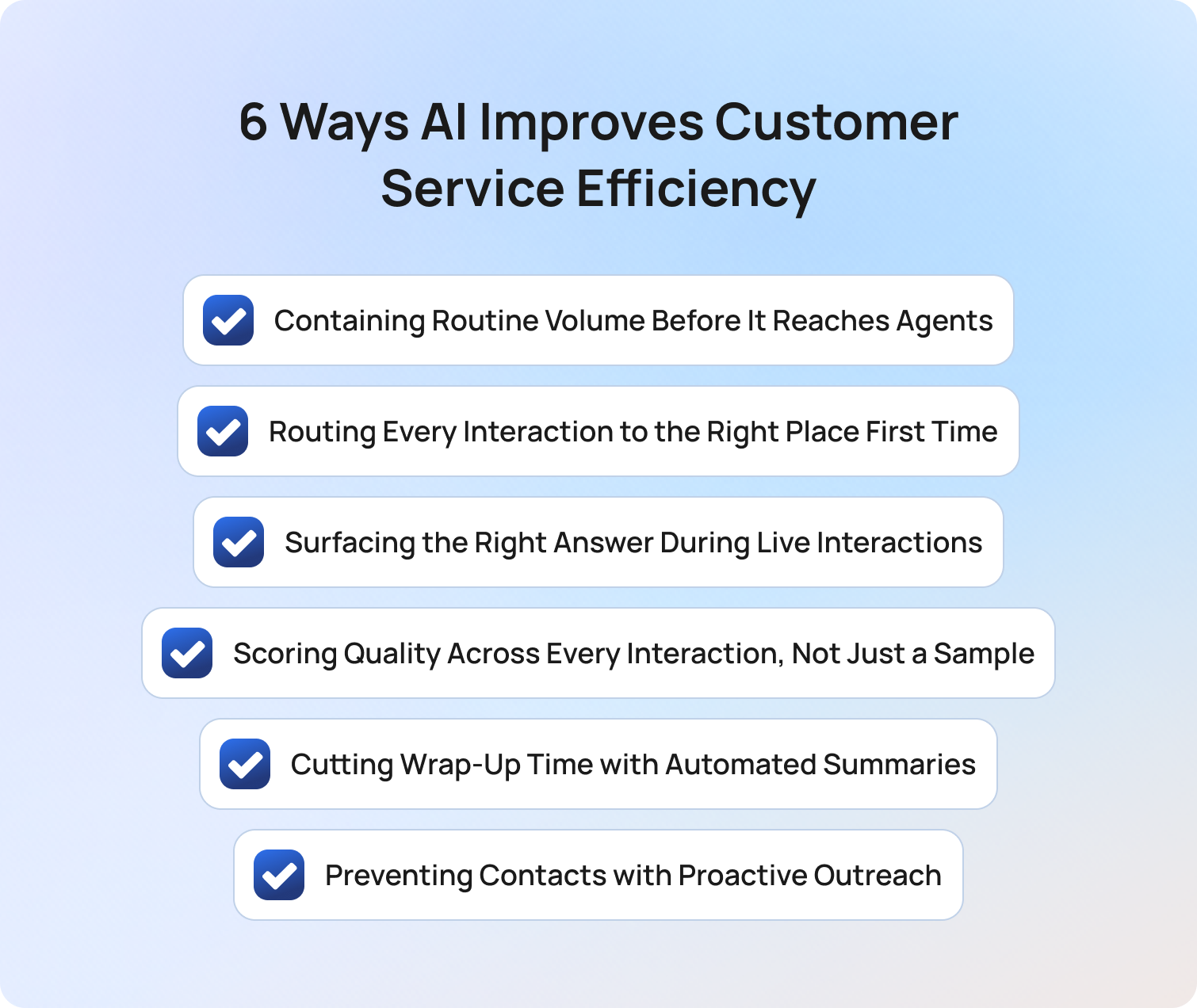
Each of the six capabilities below targets a different friction point in the customer interaction lifecycle. The efficiency gains are real, individually. They compound when the tools work together.
1. Containing Routine Volume Before It Reaches Agents
The single biggest efficiency drain in most customer service operations is agents spending time on interactions that do not require human judgment. Password resets, order status queries, billing inquiries, and account updates are routine inquiries with definitive answers. They are also the interactions that fill queues, extend response times, and push complex customer issues to the back of the line.
Conversational AI handles these tier-1 customer queries end-to-end. The customer gets an accurate, instant response. The agent never sees the interaction. Every contained contact is the time a support agent spends on something that actually requires problem-solving skills and human judgment.
The efficiency metric that matters here is containment rate, not deflection rate. Deflection counts sessions that ended in the bot. Containment counts customer inquiries that reached a full resolution without a follow-up contact. A well-scoped conversational AI deployment handling initial customer inquiries typically achieves a 55–70% containment rate at 90 days.
Artificial intelligence built on natural language processing means customers do not need to navigate rigid menus or interactive voice response trees or phrase queries precisely. They describe their issue in their own words, and the customer service AI understands their intent accurately enough to resolve it. This is one of the clearest ways AI in customer service can enhance customer service quality alongside efficiency.
2. Routing Every Interaction to the Right Place First Time
Misrouted contacts are one of the most expensive efficiency failures in customer support operations. An interaction sent to the wrong team adds handle time, reduces first contact resolution, generates repeat contacts, and creates customer frustration before a human agent has said a word.
Rules-based routing breaks when customers phrase their requests in ways the rules do not anticipate. AI routing uses natural language processing and machine learning to classify intent, urgency, and required skill from every customer question in real time. Customer support teams no longer need to maintain manual rule sets or rebuild routing logic every time a new product launches or a new query type emerges.
AI Ticket Triage routes customer requests to the right team and skill level on the first touch. For customer service teams handling volume across multiple channels, the compound effect on response times, handle time, and first contact resolution is significant. Misrouting is not a minor inconvenience. It is a repeating cost that AI routing eliminates.
3. Surfacing the Right Answer During Live Interactions
Human support agents spend a significant portion of every interaction searching for information: checking the knowledge base, switching between tools, consulting colleagues. This is not a performance problem. It is a tooling problem. The information exists. Retrieving it during a live customer conversation takes time the customer is waiting for.
AI suggested replies solve this. The AI reads the customer's message and the customer's history, retrieves the relevant knowledge base content, and drafts a response that the agent can review, edit, and send. The agent does not search. They evaluate and approve.
This improves efficiency in three directions simultaneously. Handle time falls because agents stop searching. Service quality rises because responses are grounded in verified content rather than recall. Consistency improves because every support agent gives the same accurate answer regardless of their tenure or expertise. A new agent and a five-year veteran provide the same quality of personalized service when both are drawing from the same AI-surfaced content.
Consistent service across all agents is one of the most direct ways AI in customer service addresses the quality variation that manual QA and ongoing training alone cannot fix. Enhancing customer interactions with AI-assisted responses does not remove the human interaction from the conversation. It improves it. Human customer service teams using AI tools deliver more personalized interactions because they are spending their cognitive capacity on the customer's actual problem rather than on information retrieval. Customer preferences for fast, relevant, accurate answers are met more consistently. Improving customer satisfaction at this level is what customer service offers as a genuine business differentiator rather than a cost centre.
4. Scoring Quality Across Every Interaction, Not Just a Sample
Manual QA reviews 5–15% of interactions. The rest are invisible. Patterns in customer sentiment, recurring compliance risks, coaching opportunities for specific agents, all of it exists in the 85–95% of customer conversations that no one ever reviews.
AI quality assurance scores 100% of interactions automatically. This is not just a coverage gain. It is a data gain. With full coverage, support teams can identify patterns they could never see in a sample: which query types generate the most customer frustration, which agents need coaching on which interaction types, which customer service strategies are producing better outcomes on specific channels.
Sentiment analysis runs alongside QA scoring, flagging interactions where customer sentiment shifted negatively during the conversation. These flags give team leaders actionable data for coaching rather than anecdotal impressions from the interactions they happened to review.
The feedback loop between QA data and model improvement is where AI customer service efficiency gains compound over time. Customer feedback captured through CSAT surveys and post-interaction scores integrates with QA data to help teams gain insights into what is driving satisfaction and what is driving churn. Teams that understand customer behavior patterns from this data can make the adjustments that improve customer retention. Every QA flag is a training signal. Every pattern identified is an opportunity to close a gap in the knowledge base or refine automation scope.
5. Cutting Wrap-Up Time with Automated Summaries
After-contact work is a hidden operational cost. Agents summarising interactions, tagging topics, and updating records after every customer conversation add minutes per interaction. Across a team handling hundreds of contacts per day, that is a material share of total capacity.
AI ticket summaries generate a structured record automatically: what the customer asked, what was resolved, what actions were taken, and what the next step is if the issue remains open. Agents do not write the summary. They review it and confirm.
The efficiency gain is straightforward: agents move to the next interaction faster. The secondary gain is data quality. AI-generated summaries are structured consistently, which means the customer data they produce is usable for analytics, reporting, and predictive analytics in ways that free-text agent notes rarely are. Analyzing customer data from consistent summaries gives operations teams visibility into customer behavior patterns, repeat contact drivers, and resolution quality across teams.
6. Preventing Contacts with Proactive Outreach
The most efficient contact is one that never happens. Most customer service operations are reactive by design: the customer experiences a problem and contacts support. But the trigger events for most inbound customer inquiries are predictable. Order delays, payment failures, service outages, and billing events are known, and they are coming.
AI-triggered workflow automation sends proactive messages to customers before they need to ask. The customer gets the update they were about to request. The inbound contact never arrives. Customer satisfaction improves because customers feel informed rather than ignored. Inbound volume on predictable trigger events falls.
When you anticipate customer needs before customers feel the need to reach out, the efficiency gain extends beyond the contact prevented. It shows up in customer retention, in customer satisfaction scores, and in the customer engagement that comes from a support experience that feels thoughtful rather than reactive. Generative AI is increasingly used in these proactive workflows to draft personalised messages at scale, adapting tone and content to individual customer preferences and history. Proactive outreach is one of the customer service strategies with the clearest compound return: every prevented contact is also a strengthened customer relationship.
How Efficiency Gains Compound When AI Works Across the Full Platform
Individual AI tools improve efficiency at specific points. The largest efficiency gains come when AI capabilities work together across the full customer interaction lifecycle, and each one informs the others.
Follow a single interaction through a unified AI customer service platform:
The customer sends a message. The AI system classifies intent using natural language processing and machine learning. If it is a routine inquiry the conversational AI can handle, it is contained end-to-end. No agent involvement. The customer gets a relevant response in seconds.
If the query requires human support, AI routing sends it to the right team and skill level immediately, with full customer context attached. The human agent opens the interaction with the customer's history, previous contacts, and a suggested reply already drafted. They spend their time on the substance of the customer's issue rather than on setup.
The interaction is QA scored automatically. If the customer conversation is flagged for negative sentiment, the team lead sees it in the dashboard before the customer sends a follow-up complaint. The wrap-up summary is generated without agent input. The customer data feeds back into analytics.
If the interaction was triggered by a predictable event, the next similar customer query is pre-empted by a proactive outreach workflow.
Each step saves minutes. Together, they reduce cost per resolved contact, improve first contact resolution, and improve customer satisfaction simultaneously. Operational costs fall because the same volume is handled with less agent time. Cost savings compound as containment rate improves and handle time falls across more interaction types. This is how AI improves customer service efficiency at scale: not by optimising one metric in isolation, but by removing friction at every stage of customer support processes and letting the gains compound. Service professionals who would previously spend their shift on repetitive queries are now handling the complex issues where their skills generate real value. AI-powered tools make that possible without adding headcount.
The question we hear most often is whether AI will improve efficiency for agents or for customers. The answer is both, and the two are connected. When agents have the right context, the right answer, and the right routing from the start, they resolve faster. When customers get accurate, immediate, consistent service, they do not follow up. The efficiency gain shows up in the cost data and in the satisfaction data at the same time.
What AI Cannot Fix on Its Own
Implementing AI improves customer service efficiency within the boundaries of the process and data it works with. Three things AI cannot fix without human decisions:
Knowledge Base Quality
AI-powered tools that retrieve and generate responses are only as accurate as the content they draw from. A knowledge base that is incomplete, outdated, or inconsistently structured produces inaccurate responses. Inaccurate responses reduce containment, generate repeat contacts, and damage service quality faster than efficiency gains offset the cost. Customer service agents using AI tools that draw from a weak knowledge base will give worse answers than agents working without them. The team provides comprehensive training and maintains the KB before expanding the AI scope, not after.
Deployment Scope
AI deployed on complex customer issues that it cannot handle reliably will generate more customer frustration and more repeat contacts than it prevents. The efficiency case for AI is built on tier-1 automation of repetitive tasks and routine tasks. Human agents remain the right answer for complex issues that require empathy, judgment, and problem-solving skills. Scope decisions are human decisions, and they determine whether AI customer service delivers cost savings or creates new operational costs.
Escalation Design
When AI agents escalate to human support agents, the handoff quality determines whether the escalation is an efficiency gain or a loss. A clean handoff with full context passed to the human agent takes seconds. A poor handoff, where the agent must re-read an incomplete transcript or ask the customer to repeat themselves, adds minutes to every escalation and damages the customer service experience at the moment it matters most. Human-in-the-loop AI done well reduces the cost of every escalation. Done poorly, it offsets the savings from every automated interaction that preceded it.
How BlueTweak Improves Customer Service Efficiency Across Teams and Channels
BlueTweak brings all six efficiency capabilities into one platform so the feedback loops between them work. Most AI tools for customer service add one capability to an existing stack. BlueTweak is designed on the premise that efficiency gains compound when automation, routing, quality oversight, and analytics share the same data.
The conversational AI contains tier-1 customer requests across chat and voice. AI Ticket Triage routes what escalates to the right place immediately. Proposed Reply surfaces the right answer to the right agent during live customer interactions. The QA module scores every interaction and feeds the data back into the platform. AI Ticket Summary automates wrap-up. Workflow automation handles proactive outreach.
The analytics and reporting layer makes the compound efficiency visible: containment rate, cost per resolved contact, FCR by channel, and CSAT by interaction type in the same dashboard, tracked over the 30, 90, and 180-day horizons that customer service operations teams actually report against.
Transforming customer service with AI technology does not require replacing your existing customer support processes wholesale. It requires deploying the right AI systems against the right customer service functions, measuring what actually changes, and expanding scope as performance data confirms the model is ready. Read how AI improves customer support for the full operational picture.
Final Thoughts
How can AI improve customer service efficiency? By removing friction at every stage of the customer interaction lifecycle: before the contact arrives, during the interaction, and after it closes. The gains are measurable individually and significant together.
The teams seeing the strongest results are not the ones with the most sophisticated AI technology. They are the ones who scoped their deployment correctly, maintained their knowledge base, and measured the right things from the start. AI customer service efficiency is a discipline as much as a technology.
Start your free trial and see how BlueTweak improves customer service efficiency across your teams and channels from day one.
Start your free trial and see how BlueTweak improves customer service efficiency
Start Now
AI Chatbot Customer Service Cost Reduction: How to Lower Costs Without Hurting CX
AI Chatbot Customer Service Cost Reduction: The Statistics
Before the mechanics, the scale. These are the numbers that define where AI chatbots' cost reduction in customer service actually stands in 2026.
According to IBM, AI chatbots can reduce the operational costs of contact centers by up to 30%. McKinsey data shows AI-enabled self-service can cut incidents by 40–50%, with cost-to-serve reductions of more than 20%. Companies are seeing average returns of $3.50 for every $1 invested in AI customer service, with top-performing organisations achieving up to 8x ROI.
Gartner's 2025 research predicts that agentic AI will autonomously resolve 80% of common customer service issues by 2029, with a corresponding 30% reduction in operational costs. Businesses using AI-driven routing have already achieved 30% faster average response times compared to manual triage.
Those numbers are real. They are also averages across deployments that range from excellent to deeply counterproductive. Customer service chatbots and the AI technologies and AI tools that power them are capable of delivering significant cost savings. The headline figure, 30% cost reduction, is broadly accurate for well-implemented deployments and largely unachievable for poorly scoped ones. Understanding why is what this article is about.
What AI Chatbot Cost Reduction Actually Looks Like
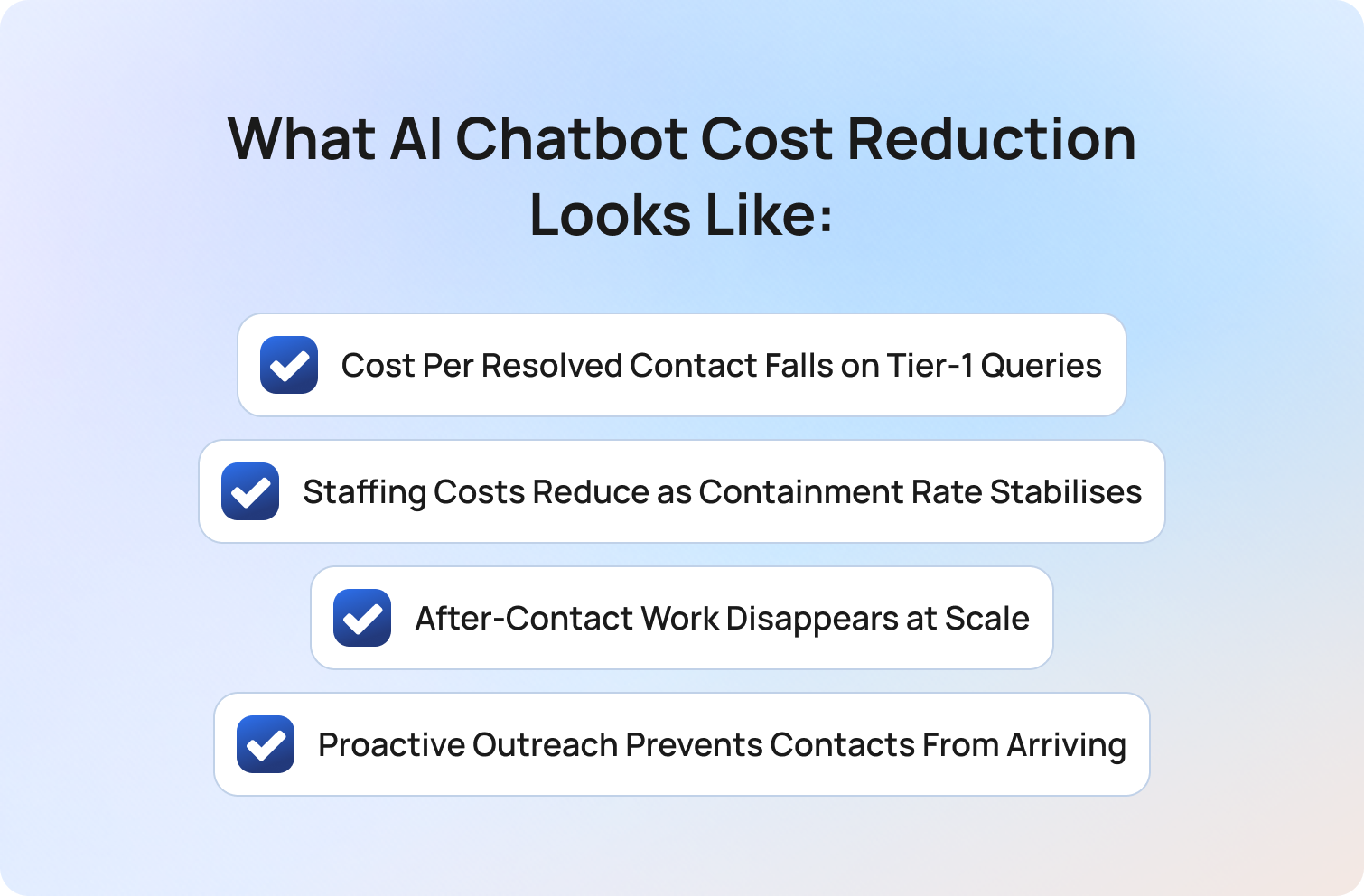
AI chatbots reduce customer service costs and lower support costs through four distinct mechanisms. Each is measurable. Each has a condition attached. Customer support costs fall in different ways depending on which mechanism is working, and the largest reductions come when all four operate together.
Cost Per Resolved Contact Falls on Tier-1 Queries
The unit cost of a human-handled support interaction, including agent time, tooling, and overhead, typically runs between €6 and €12, depending on complexity and channel. The unit cost of an automated resolution handled end-to-end by a well-scoped AI chatbot runs between €1.50 and €3. The difference is where the cost reduction in customer service originates.
At volume, this compound quickly. A support team handling 40,000 contacts per month, where 60% are tier-1 queries, achieving 62% containment on those queries, removes roughly 14,880 contacts from the agent queue per month. The direct savings on those interactions alone represent a material reduction in monthly operational costs before any other efficiency is counted.
Use the BlueTweak ROI calculator to run this against your own contact volume and cost per resolution.
Staffing Costs Reduce as Containment Rate Stabilises
Reduce customer service costs at the contact level, and the staffing implications follow, but on a lag. The capacity freed by automation at a 90-day containment rate steady state either offsets planned hiring, absorbs volume growth without additional headcount, or reduces overtime costs during peak periods. None of those outcomes is instant. Teams that count staffing savings on day one and measure them at day 30 will find the numbers do not match. Teams that build staffing ROI into the 180-day projection will find it arrives reliably.
After-Contact Work Disappears at Scale
Every resolved interaction generates wrap-up work: summary, tagging, and CRM update. Support tickets handled manually require agents to write that record from scratch. For human agents, that is 3–5 minutes per interaction. AI ticket summaries generate a structured record automatically, reducing agent wrap-up to a 20–30 second review and confirmation. Across a team handling 200 interactions per day, the time saving compounds into a significant share of daily capacity that can be redirected to complex issues. Operational efficiency at the team level rises because agents are doing work that requires their judgment rather than work that a summary generator handles better and faster.
Proactive Outreach Prevents Contacts From Arriving
The contact that never happens costs nothing to handle. AI-triggered workflow automation sends proactive messages on predictable trigger events, order delays, payment failures, shipping updates, and billing events before customers need to reach out. Inbound volume on those event types typically falls by 20–40% for well-implemented proactive workflows, generating direct savings that do not require a single automated resolution to count.
The Three Deployment Mistakes That Turn Cost Reduction Into Cost Generation
This is what most AI chatbot cost reduction articles do not cover. The reason many teams cannot show chatbot ROI at 180 days is not that chatbots do not save money. It is because three deployment mistakes systematically offset the savings. 40% of customers abandon chatbots due to poor experiences, and every abandoned interaction is a failed self-service attempt that generates a follow-up contact that costs more to handle than the original interaction would have.
Deploying on Interaction Types the Chatbot Cannot Reliably Resolve
Scope creep is the most common and most damaging mistake. Unlike human agents who can apply critical thinking and adapt to unexpected queries, an AI chatbot scoped beyond its reliable range will misclassify complex issues, escalate poorly, and generate repeat contacts from customers who received an inaccurate or incomplete response.
Each failed resolution costs more than a single human-handled interaction would have, because the customer arrives at the agent queue frustrated, and the agent must start from scratch without useful context. Customer frustration from a failed chatbot experience is harder to recover from than customer frustration from a slow initial response. The perception of being passed between systems after a bad automated experience is one of the fastest drivers of customer loyalty erosion.
The fix is straightforward: scope chatbot deployment to automating routine tasks, repetitive queries, and routine inquiries where the correct answer is definitive and the resolution path is short. Billing balance checks, order tracking, password resets, account updates, FAQ queries, shipping status, these are the routine queries where AI chatbots generate cost savings reliably across all customer services and channels. Complex complaints, escalation requests, and emotionally sensitive interactions are not. Protecting the customer experience on complex interactions by keeping human agents responsible for them is what makes the cost reduction on tier-1 queries sustainable.
Measuring Deflection Rate Instead of Containment Rate
Deflection rate counts sessions that ended in the chatbot without escalating to a human agent. Containment rate counts contacts that reached full resolution without a follow-up on any channel within 24 hours. The gap between the two numbers is the gap between what gets reported and what actually happened.
A team reporting 70% deflection and 45% containment has a large population of customers who appeared resolved and then sent a follow-up email or called back. Those follow-up contacts generated double the interaction cost of a single human-handled resolution. Deflection rate is not a cost reduction metric. Containment rate is the only accurate measure of AI chatbots' cost reduction in customer service.
Most AI support vendor dashboards report deflection by default. It is not a better metric. It is an easier one.
Launching Without a Current, Accurate Knowledge Base
RAG-grounded chatbots retrieve answers from the knowledge base. A knowledge base with outdated pricing, discontinued products, or incorrect policy information produces inaccurate chatbot responses. Inaccurate responses reduce containment rate, generate complaint contacts from customers who acted on wrong information, and damage customer trust in the self-service channel.
The cost of rebuilding that trust, in repeat contacts, escalation volume, and churn, exceeds the cost savings from automation in most cases where this mistake is made. The hidden costs of inefficient customer support systems apply here too: a chatbot grounded in poor content does not reduce support costs. It transfers them downstream.
How AI Chatbots Reduce Customer Service Costs Without Hurting CX

Traditional customer support operations were built on a trade-off: quality costs money, and speed is expensive. AI-powered customer service breaks that trade-off when deployed correctly. Here is how each capability delivers cost reduction while maintaining high service quality.
Containing Tier-1 Volume End-to-End
Conversational AI chatbots built on natural language processing handle customer queries across chat and voice without requiring customers to navigate rigid menus or interactive voice response trees. The customer describes their issue in natural language. Machine learning classifies intent accurately. The AI system retrieves the relevant knowledge base content and delivers a relevant, accurate response.
Support agents never see these interactions. Every contained contact is time support agents spend on complex issues that require judgment, empathy, and critical thinking, the customer interactions where human agents add irreplaceable value. Agent productivity rises not because agents are working faster but because the queue they are working from contains fewer interactions that should never have reached them.
Maintaining high service quality alongside cost reduction comes from this separation. AI handles routine tasks consistently and at scale. Human agents handle complex issues with the full attention they deserve. Neither is doing the other's job.
Reducing Handle Time on Escalated Interactions
When the chatbot escalates to a human agent, the handoff quality determines whether the escalation is a cost-saving or a cost addition. A clean handoff, full customer data, interaction history, intent classification, and a structured summary of what was already attempted means the agent opens the interaction knowing exactly what the customer needs. Handle time on escalated interactions falls. Repeat contacts from poorly handled escalations fall.
Human-in-the-loop AI minimises human intervention to the interactions that genuinely require it, and reduces the cost of every escalation that does. Done poorly, with incomplete context, missing history, or no summary, it adds minutes to every interaction and forces customers to repeat themselves, generating customer frustration that damages customer satisfaction scores most visibly.
Automating After-Contact Work
AI ticket summaries eliminate manual wrap-up for both automated and human-handled interactions. For human-handled contacts, agents confirm a pre-generated summary rather than writing one from scratch. For automated contacts, the record is complete before the interaction closes. The time saving per interaction is modest. Across a team handling hundreds of contacts per day, it is material, and the data quality improvement is significant, because consistent AI-generated summaries produce customer data that is usable for predictive analytics and customer behavior analysis in ways that free-text agent notes rarely are.
Enabling Proactive Outreach on Predictable Events
AI-driven predictive analytics identifies the trigger events that generate predictable inbound volume: order delays, payment processing failures, service outages, and subscription renewal issues. AI-powered agents send tailored solutions and personalised proactive messages to affected customers before they need to ask, meeting customer expectations for immediate support without requiring the customer to initiate contact. Personalized service delivered proactively is a higher standard of customer care than reactive resolution. The inbound contact never arrives. Customer loyalty strengthens through the experience of being anticipated rather than reacted to.
This is transforming customer service at the operational level: shifting from a reactive model that waits for customer frustration to build, to a proactive model that prevents it. The cost savings are direct, fewer inbound contacts on predictable event types, and indirect, through the customer retention impact of a support experience that feels attentive rather than transactional.
Protecting CX While Reducing Costs: Three Practices That Matter
The "without hurting CX" part of AI chatbot cost reduction is not guaranteed. It is a design choice. Efficient customer service at lower cost requires that support quality is actively protected, not assumed. When you automate routine inquiries correctly and route everything else to human agents via clean escalations with full context, customer service agents are working on the interactions where their skills matter most. These three practices separate deployments that reduce costs and maintain CX from those that reduce costs at CX's expense.
Set Confidence Thresholds Before Launch
An AI chatbot without calibrated confidence thresholds will attempt to answer queries it cannot handle reliably, producing low-confidence automated responses that damage customer trust. Setting per-intent confidence thresholds before go-live determines which interactions get automated responses and which escalate to human agents. This is a pre-launch decision that determines whether consistent support is delivered at scale or whether CX is variable depending on how confidently the model handles each query type.
Track CSAT on Chatbot-Handled Interactions Separately
Blended CSAT hides chatbot performance behind human-handled performance. Improved customer satisfaction on human-handled interactions can mask declining satisfaction on automated interactions for months before the signal reaches aggregate scores. Tracking CSAT specifically on chatbot-handled interactions from day one makes CX degradation visible early enough to act on.
The QA module scores 100% of interactions and tracks customer sentiment separately for automated and human-handled contacts. Sentiment analysis flags interactions where customer sentiment shifted negatively during a chatbot conversation. These flags arrive before the churn data confirms the problem.
Close Knowledge Base Gaps Before Expanding Scope
The relationship between KB quality and CX protection is direct. A chatbot retrieving from a complete, current knowledge base produces accurate, relevant responses. Accurate responses build customer trust in self-service options. Customer trust in self-service increases willingness to use it again, which is what sustains containment rate improvement over time. Every scope expansion before a KB audit is a risk to service quality that the efficiency gains may not offset.
What Realistic Cost Reduction Looks Like at 30, 90, and 180 Days
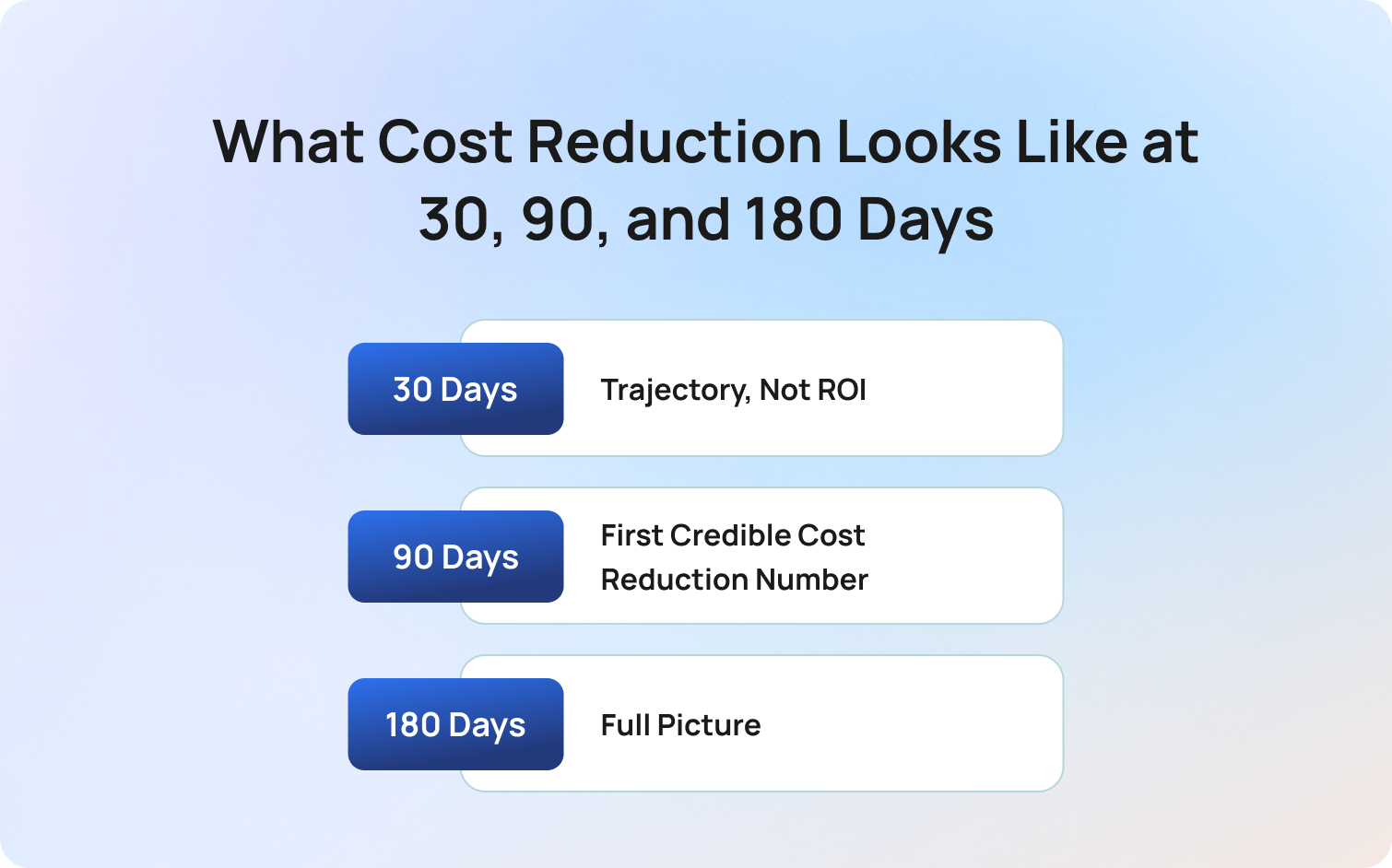
30 Days: Trajectory, Not ROI
At 30 days, the model is calibrating. Containment rate is below the steady state. CSAT on chatbot interactions may dip before it recovers. This is normal. What to track: is the containment rate improving week on week, is the escalation rate within the expected range, and what percentage of queries is the chatbot unable to answer? These are leading indicators of the cost reduction that follows, not cost reduction itself. Do not report staffing savings at 30 days.
90 Days: First Credible Cost Reduction Number
For well-scoped tier-1 deployments, 90-day benchmarks are: 55–70% containment rate, 30–40% reduction in cost per resolved contact on automated interaction types. McKinsey found that businesses implementing conversational AI saw a 25% increase in customer satisfaction scores alongside a 35% decrease in handling costs. At 90 days, the cost per resolved contact is trackable against the pre-deployment baseline, and the number is credible enough to present to leadership.
180 Days: Full Picture
At 180 days, churn rate change by interaction type is meaningful and attributable. Customer lifetime value impact is traceable through retention data. AI capabilities improve through the feedback loop between QA scoring, customer feedback, and knowledge base updates. A system built for continuous improvement shows steady containment rate gains between 90 and 180 days rather than a plateau. Support costs on affected query types continue to fall as the model gets better and KB coverage expands to new interaction types.
How BlueTweak Delivers AI Chatbot Customer Service Cost Reduction Without CX Compromise
Most AI chatbot customer service cost reduction failures share a root cause: the platform running the automation is not the same platform measuring it. Customer support costs cannot be accurately attributed when chatbot session data, support tickets, and email follow-up data live in different tools. Containment rate cannot be calculated. CSAT on chatbot interactions is blended with human-handled CSAT because the reporting layer does not distinguish between them. Knowledge base gaps are identified manually, slowly, and reactively.
BlueTweak is designed so that automation, measurement, and quality oversight run in the same workspace.
The conversational AI handles tier-1 customer interactions across chat and voice, grounded in the Smart Knowledge Base that feeds accurate, verified content into every automated response. Confidence thresholds are configured before launch. Low-confidence interactions go to human agents, not customers.
The QA module scores every interaction and tracks CSAT and sentiment separately for automated and human-handled contacts. KB gaps surfaced by QA flags are closed without manual audits. The feedback loop between quality data and content quality is automated.
The analytics and reporting layer reports containment rate, not deflection rate, alongside cost per resolved contact, FCR by channel, and CSAT by interaction type, giving support teams the measurement infrastructure to report AI support ROI credibly at 30, 90, and 180 days.
Seamless integration with existing CRM and ticketing tools means customer data flows into the platform rather than being duplicated across systems. Support operations retain full visibility of every interaction, automated or human-handled, in one workspace.
The teams that report genuine cost savings from chatbot deployment are almost always the ones that were honest about scope from the start. They deployed on the interactions the chatbot could reliably resolve, maintained their knowledge base, and measured containment rather than deflection. Those three decisions are not technical. They are operational. And they are the difference between a chatbot that cuts support costs at 180 days and one that looked good at 30 days and quietly generated more costs than it saved.
Final Thoughts
AI chatbot customer service cost reduction is a competitive advantage that is becoming a competitive necessity. The teams that have built AI-powered support infrastructure today will be at 60–70% containment by 2029. The teams that have not started will be at 20–25%, facing a competitive cost disadvantage that will be very difficult to close.
The savings are real, and the benchmarks are well-established. But saving money while maintaining high service quality is a design choice, not a default outcome. It requires the right scope, the right measurement model, and a knowledge base that is maintained as a first-class operational asset.
Teams that get those three right do not just cut support costs. They build a support operation that improves continuously and scales efficiently. That is the return that justifies the investment, not the first 30-day deflection rate, but the 180-day cost per resolved contact trend and the customer retention data that comes with it.
Run your own numbers with the BlueTweak ROI calculator, or start your free trial and build the measurement infrastructure alongside the automation from day one.
Start your 14-day free BlueTweak trial
Start Trial
AI Support Automation: Where It Delivers Value in 2026
What Is AI Support Automation?
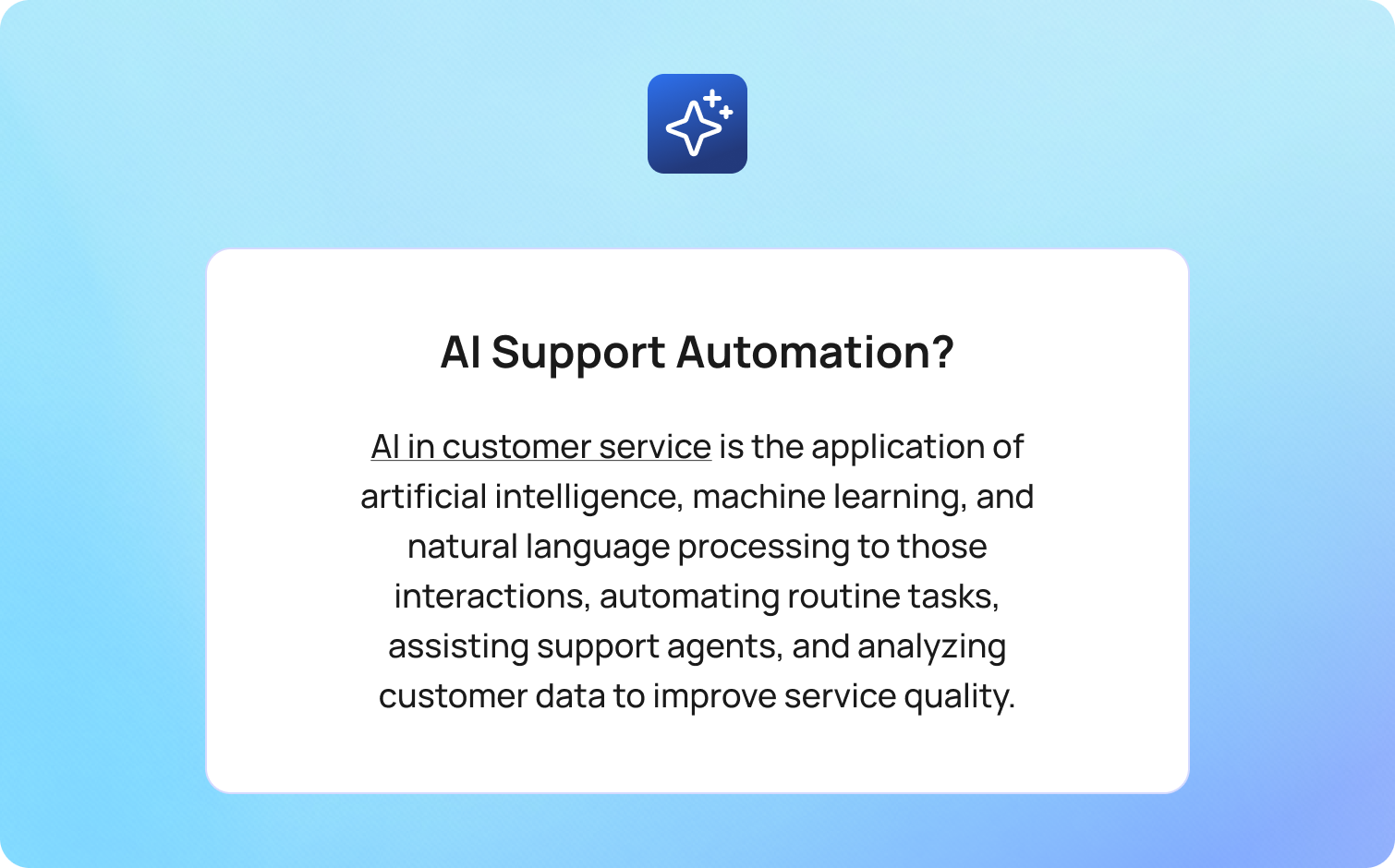
Customer service refers to the full range of support interactions a business provides to resolve customer issues, answer customer questions, and maintain customer relationships. AI in customer service is the application of artificial intelligence, machine learning, and natural language processing to those interactions, automating routine tasks, assisting support agents, and analyzing customer data to improve service quality.
AI support automation specifically covers the use of AI systems to handle, route, assist with, and score customer service interactions without requiring human involvement at each step. It ranges from automating repetitive tasks like ticket routing and post-interaction summarisation to enabling autonomous resolution of customer inquiries end-to-end.
Generative AI and conversational AI are the two technologies most actively reshaping customer service processes in 2026. Generative AI powers response generation, personalised support, and post-interaction summarisation. Conversational AI powers the chatbots, voicebots, and virtual assistants that handle customer conversations across chat, voice, and messaging channels.
The distinction that matters most for implementing AI in customer service is between two deployment modes:
AI that assists human agents: suggested reply, knowledge base retrieval, sentiment analysis, and automated support workflows that reduce cognitive load for support agents during live interactions.
AI that replaces human agents: autonomous resolution, where AI agents handle the customer service interaction end-to-end with no human in the loop.
Both have strong use cases. Both have clear performance boundaries. Customer service teams that understand those boundaries before deploying get the efficiency gains without the CX damage.
AI Support Automation: Value vs. Oversight at a Glance
BlueTweak AI Support Automation Table
| Automation Type | Where It Delivers Value | Where Oversight Is Required |
|---|---|---|
| AI chatbot / autonomous resolution | Tier-1 routine tasks: FAQs, order status, password resets | Emotionally distressed customers; complex issues; trust recovery |
| Intelligent routing and triage | High-volume intent classification; skill-based assignment | Novel query types; ambiguous intent signals |
| Real-time agent assist | Suggested reply, KB retrieval, sentiment flagging during live interactions | Final response approval on sensitive or high-stakes topics |
| Post-interaction summarisation | All interaction types — low risk, high efficiency gain | None — summarisation is safe to fully automate |
| AI QA scoring | All interaction types — enables 100% QA coverage | Final coaching decisions; performance management actions |
| Proactive outreach | Order updates, delivery alerts, and appointment reminders | Personalised judgment required for complaints, VIP accounts |
Where AI Support Automation Delivers Value

AI in customer service delivers measurable results across six interaction types and workflow stages. The value is most consistent when customer service automation is applied to high-volume, low-complexity customer inquiries with a clear, correct answer, and when the AI is grounded in a well-maintained knowledge base that reflects current products and policies.
Tier-1 Query Resolution: Containment at Scale
AI customer service chatbots and AI voicebots handle customer service FAQs, order status queries, password resets, and account updates end-to-end without human agents. This is the clearest ROI case in AI support automation. When grounded in a maintained knowledge base, AI agents resolve routine tasks at scale, improve agent productivity, and reduce operational costs without increasing headcount.
Automating support deflection using AI in products requires tracking the right metric. The correct measure is containment rate, not deflection rate. Deflection means the customer did not reach a human agent. Containment means the customer issue was fully resolved without a follow-up contact. AI customer service that deflects without resolving transfers the cost rather than eliminating it.
Well-implemented customer support automation deployments achieve 40 to 70 percent containment on tier-1 customer queries.
Key metrics: containment rate, cost per interaction, agent productivity.
Intelligent Routing and Triage
AI in customer service classifies incoming support tickets by intent, customer sentiment, urgency, and required skill before any support agents see them. Automated support workflows assign each interaction to the right team based on customer needs, not just the channel used.
This is meaningfully different from rules-based ticket routing. Rules break when customers phrase requests in unexpected ways. AI handles paraphrase, multi-intent customer queries, and new query types without manual updates. Customer service teams that implement intelligent routing reduce misrouting and the repeat contacts it generates.
Support teams that implement AI in customer service routing report measurable improvements in first contact resolution and average handle time.
Key metrics: FCR, AHT, misroute rate, repeat contact rate.
Real-Time Agent Assist: Reducing Cognitive Load
AI in customer service at its safest and most immediately ROI-positive does not replace support agents. It removes friction from customer service interactions. Proposed reply surfaces relevant responses based on the customer's message. Knowledge base retrieval pulls relevant articles into the agent workspace. Sentiment analysis flags shifts in customer emotions so support agents can adjust their approach in real time.
Human support agents make every final decision. AI customer service tools enable teams to respond faster, more consistently, and with less cognitive load. Customer service automation in this mode delivers personalised support at scale because agents have better information, not because AI replaces the human touch.
Key metrics: AHT, FCR, CSAT variance, agent efficiency.
Post-Interaction Summarisation: The Safest Full Automation Win
AI ticket summary generates structured summaries of every interaction immediately after it ends. Issue, actions, resolution, follow-up. The customer has already left. There is no live decision to make. The output is internal. This makes post-interaction summarisation the customer support automation use case with the highest ROI-to-risk ratio.
Automating routine tasks like note-writing eliminates wrap-up time, improves customer data quality in the CRM, and gives QA reviewers better context from past interactions. Customer service teams implementing AI support automation should prioritise this early. The risk is near zero, and the impact on agent efficiency is immediate.
Key metrics: AHT wrap-up, customer data accuracy, QA review efficiency.
AI QA Scoring: 100% Coverage Without 100% Headcount
Traditional QA reviews 5 to 15 percent of customer service interactions. AI-powered QA reviews 100 percent, applying the same framework to every customer service interaction, AI-handled and human-handled alike. This enables customer service teams to analyze customer data at full scale, gauge customer sentiment across all service interactions, and surface compliance risks that sampling misses.
The coaching decision remains with human agents and supervisors. The data collection is automated. This is how customer service automation enables support teams to improve service quality without proportional increases in QA headcount.
Key metrics: QA coverage, coaching efficiency, improving customer satisfaction rate, and compliance risk reduction.
Proactive Outreach: Resolving Issues Before Customers Contact
AI in customer service triggers outbound messages before customers need to contact support. Order updates, delivery alerts, outage notifications, and appointment reminders. The goal is to anticipate customer needs and address customer concerns before they become support tickets. Customer feedback consistently shows that proactive communication improves customer satisfaction more than a faster response to reactive contacts.
This self-service and proactive outreach approach reduces operational costs by eliminating avoidable inbound volume. It works best on transactional notifications. It requires human judgment for personalised support scenarios such as complaints or high-value account communications.
Key metrics: inbound contact volume, customer satisfaction, repeat contact rate.
Where Teams Need Human Oversight and Why
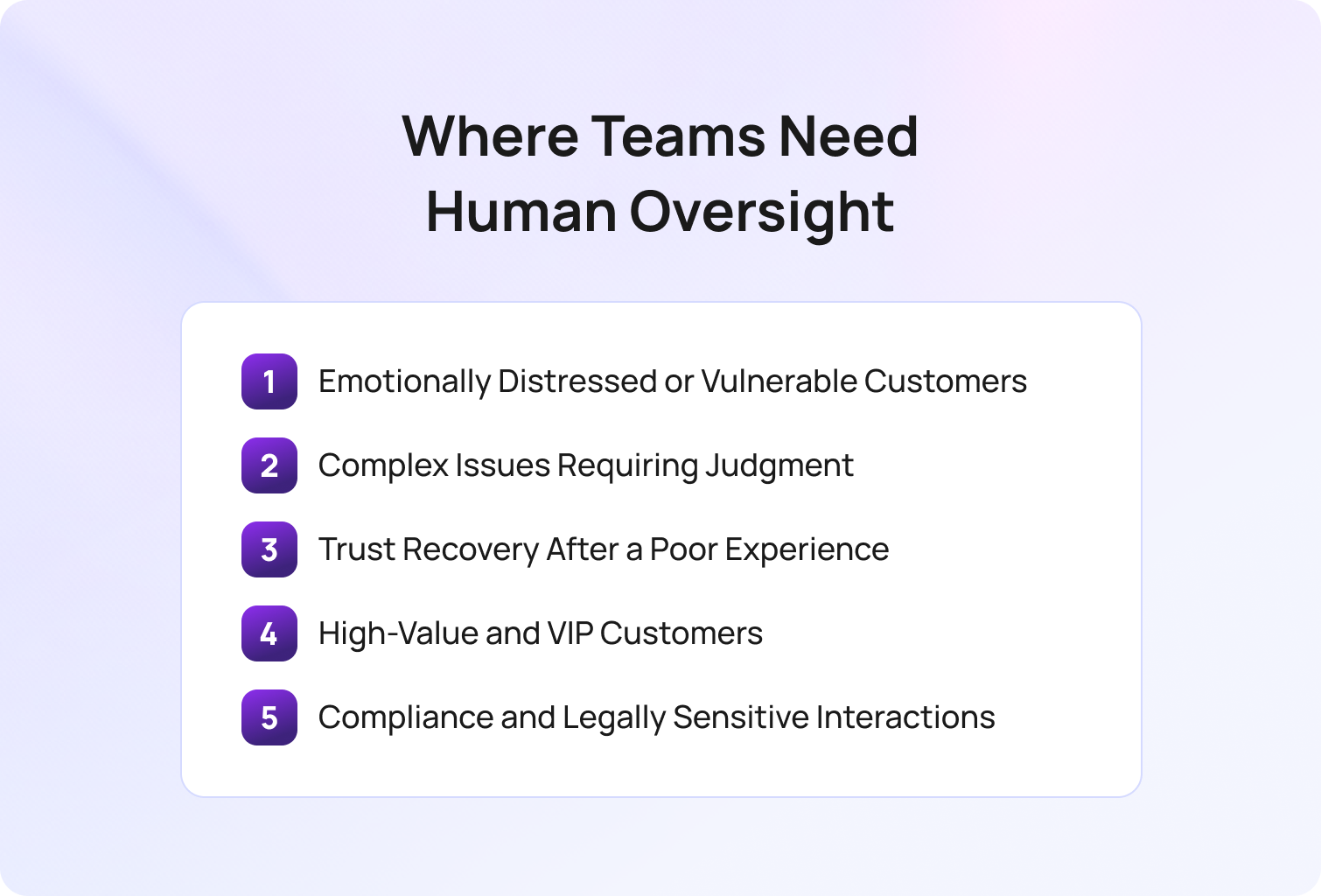
AI support automation has clear performance boundaries. Deploying customer service automation beyond them does not just fail to deliver value. It actively damages customer experience and customer relationships. The five scenarios below are where human intervention is not optional.
The same AI tools that improve customer service on routine customer requests produce poor outcomes on complex, emotional, or high-stakes service interactions. Identifying these boundaries before implementing AI, not after a complaint spike, separates customer service teams that scale AI successfully from those that scale it recklessly.
Emotionally Distressed or Vulnerable Customers
AI in customer service can detect customer emotions and analyze customer sentiment during interactions. Sentiment analysis can flag distress signals. But the response to a distressed customer requires human empathy that ai systems cannot safely replicate in 2026.
Customer service interactions involving grief, financial hardship, or any form of vulnerability should route to human support regardless of AI confidence score. An ai customer service response that misreads the emotional register causes trust damage disproportionate to the cost of the interaction. Escalation triggers that detect customer emotions should be configured before launch, not after the first incident.
Complex Issues Requiring Judgment
Customer service automation handles tier-1 customer queries well because the correct answer is definitive. Complex issues are different. Billing disputes that involve policy interpretation, technical faults that require diagnosis across backend systems, and complaints that require discretionary resolution all demand judgment that AI systems cannot reliably provide.
The failure mode is not an incorrect answer; the customer rejects. It is a confident, incorrect answer that the customer accepts, leading to a repeat contact or an escalated complaint. That is more expensive than routing the interaction to human agents from the start.
Trust Recovery After a Poor Experience
When a customer has already had a poor experience, particularly one where ai customer service contributed to it, the recovery requires human acknowledgement. An AI apology after an AI failure is perceived as insincere. Customer service teams that flag trust recovery scenarios in their automated support workflows should route those customers directly to human support with full context from past interactions.
High-Value and VIP Customers
High-value accounts and VIP customers expect human engagement at key moments regardless of query type. This is a customer service strategy decision, not a complexity decision. Configure routing rules that guarantee a human touch for these segments. The customer relationship requires it.
Compliance and Legally Sensitive Interactions
Customer service interactions involving data access requests, regulatory complaints, or policy exceptions require human review before any response is sent. AI in customer service carries legal and regulatory risk in these categories. Even AI-powered customer service responses in these categories require human approval. Configure intent-based escalation triggers before deployment, not as a post-incident fix.
The customer service teams that get into trouble with AI support automation are almost never the ones who deployed too cautiously. They are the ones who expanded the scope without updating their oversight model. The boundary between what AI agents should handle and what human agents should handle shifts as your product and your customers change. If you are not reviewing it quarterly, it is already out of date.
How to Build the Right Balance Between Automation and Oversight
1. Map your interaction types by automation suitability. Categorise your volume: which customer inquiries are tier-1, definitive, and high-confidence? Which involve emotional complexity, compliance risk, or relationship value? Start automating routine tasks only in the first category.
2. Configure confidence thresholds conservatively. Set escalation thresholds that produce a slightly higher-than-target human handoff rate. Tune down as QA data accumulates. Never set thresholds based on vendor demos. Set them based on your own customer service interactions and query mix.
3. Define the five oversight triggers before go-live. Emotional distress, complex issues, trust recovery, VIP routing, compliance queries. Every ai support automation deployment should have explicit escalation logic for each before the first customer interaction.
4. Measure containment rate, not deflection rate. A deflected customer who follows up is a cost transfer, not a resolution. Track containment separately from deflection from day one.
5. Review oversight triggers quarterly. As customer behavior and customer needs change, the boundary between safe customer service automation and required oversight shifts. Most modern customer service solutions allow teams to implement AI workflows without writing code, reducing the friction of quarterly updates. Build the review into your support operations calendar.
How BlueTweak Delivers AI Support Automation With Built-In Oversight
BlueTweak delivers automated AI customer support solutions across all six value use cases in a unified platform, with configurable oversight controls built into each.
AI in customer service starts before the interaction. Customer support automation routes incoming support tickets to the right team based on intent and customer sentiment. The AI chatbot and AI voicebot handle tier-1 customer queries autonomously. Suggested reply enables real-time agent assist for support agents during live customer conversations. AI ticket summary eliminates post-interaction wrap-up. The QA module enables 100% interaction scoring across AI and human agents to improve customer service processes at scale.
Built-in oversight means customer service analytics surfaces containment rate, CSAT delta, and repeat contact rate per interaction type, giving customer service teams the data to manage the automation boundary continuously. Configurable confidence thresholds and escalation triggers route customer service interactions to human agents when automation limits are reached. Human approval workflows on sensitive interactions ensure support agents review before sending.
Final Thoughts
AI in customer service delivers strong, measurable value across tier-1 resolution, intelligent routing, agent assist, post-interaction summarisation, QA scoring, and proactive outreach. It requires human oversight for emotionally distressed customers, complex issues, trust recovery scenarios, VIP accounts, and compliance queries.
Customer service teams that scale AI support automation successfully are not those who automate the most. They are those who deploy customer service automation precisely, measure containment rather than deflection, and maintain explicit oversight controls at the boundaries. AI improves customer service outcomes when the boundaries are respected. Reducing operational costs through AI automation is achievable without damaging customer experience when the right service strategies are in place.
Start your free BlueTweak Trial
Start Now
8 Ways to Prevent Customer Service Agent Burnout in 2026
What Causes Agent Burnout in Customer Service and Why It's a Performance Problem

Agent burnout is not just a well-being issue. It is a business metrics problem. Call center burnout and employee burnout cost contact centers significantly in recruitment, ongoing training, and lost institutional knowledge. CSAT drops when burned-out agents handle customer interactions. FCR falls when fatigued agents take shortcuts. When many employees are experiencing center burnout simultaneously, the entire customer experience suffers.
Three causes of contact center agent burnout stand out specifically.
High repetitive task volume. Answering the same tier-1 questions hundreds of times per shift drains cognitive capacity with no intellectual reward. Agents dealing with an endless queue of identical customer requests quickly lead to disengagement, then exhaustion.
Inadequate tools. Agents who have to toggle between systems, manually search for answers mid-interaction, or handle calls without customer context are carrying unnecessary cognitive load during every workday. Feeling unsupported by the tools the company provides is a fast path to feeling overwhelmed. Poor work-life balance between high-demand calls and recovery time compounds this further.
Unpredictable volume and poor scheduling. Understaffing during peak periods creates acute stress. Overstaffing during lows creates boredom and disengagement. Both extremes affect the agent's well-being and quickly lead to declining quality scores.
According to Insignia Resources, contact center agent turnover averages 30 to 45 percent annually in many organizations, with burnout cited as a leading cause. The cost of replacing a single agent ranges from 50 to 150 percent of the annual salary. Separately, research shows that employees who feel they have adequate support from management are approximately 62% less likely to experience burnout. That is a performance and cost problem, not just a people problem.
Agent Burnout vs. Performance at a Glance
BlueTweak Agent Burnout and Performance Table
| Burnout Driver | Performance Impact | Prevention Strategy | KPI Recovered |
|---|---|---|---|
| High repetitive task volume | AHT inflation, CSAT drop | AI automation of tier-1 queries | AHT, agent concurrency |
| Poor tool access during interactions | FCR drop, handle time extension | KB-grounded agent assist | FCR, AHT |
| Unpredictable scheduling and peaks | Error rate, absenteeism | WFM forecasting and flexible scheduling | SLA compliance, CSAT |
| No escalation path for complex cases | Frustration, disengagement | Clear escalation logic and HITL controls | Agent satisfaction, FCR |
| QA used punitively, not for coaching | Disengagement, defensive behaviour | Coaching-led QA with positive reinforcement | Quality scores, CSAT |
8 Ways to Prevent Customer Service Agent Burnout Without Hurting Performance
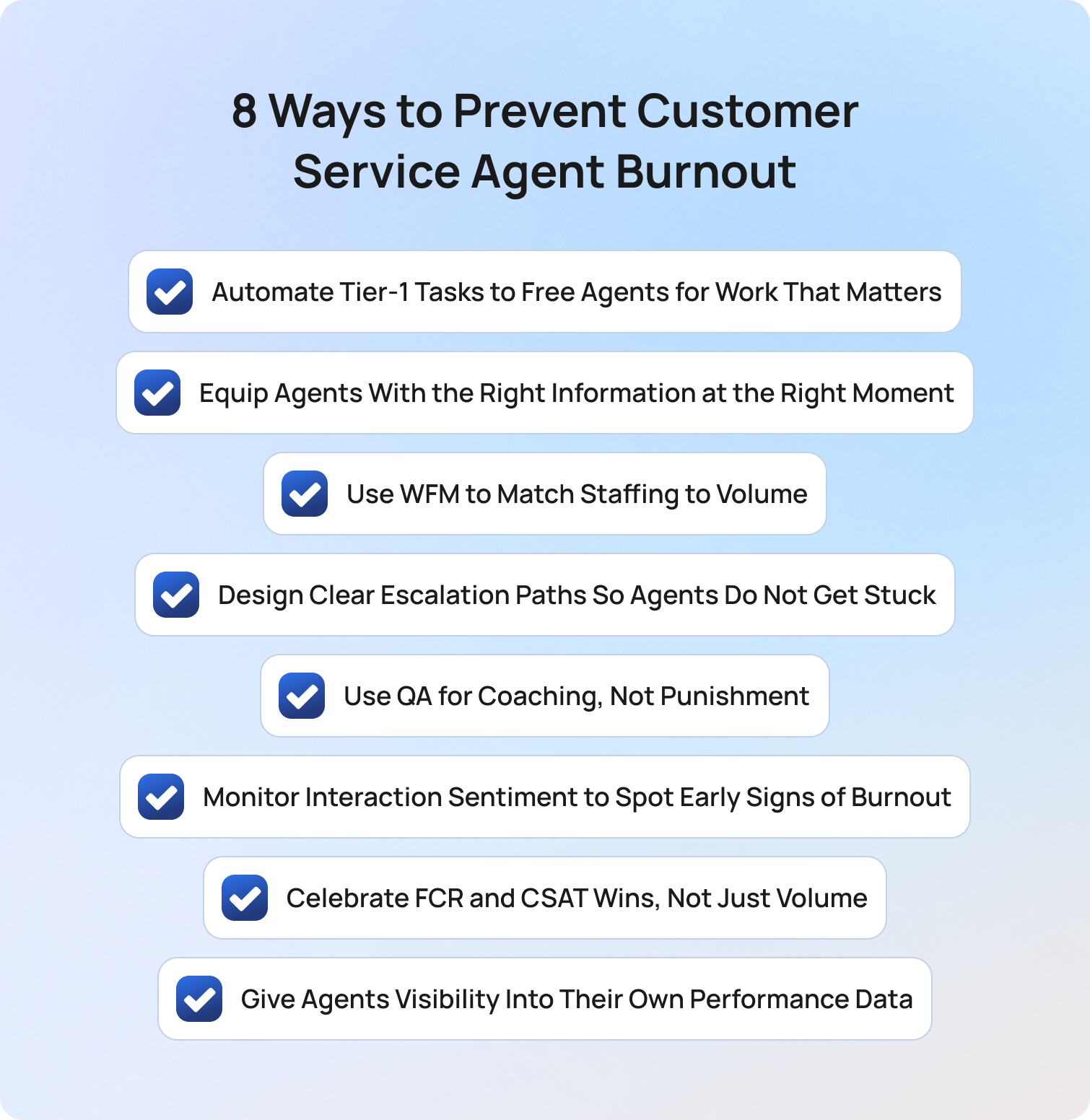
Every strategy below addresses a root cause of burnout and a corresponding performance metric. Where the strategy involves technology, the performance benefit is direct and measurable. Where it involves culture or management practice, the performance benefit operates through reduced attrition and improved engagement.
1) Automate Tier-1 Tasks to Free Agents for Work That Matters
Deploying an AI chatbot and AI voicebot to handle high-volume, low-complexity interactions removes the most repetitive tasks from agent queues. FAQs, order status, password resets, and account updates. When AI handles routine inquiries, agents focus on complex, escalated, and high-value customer interactions that require judgment. That shift is more engaging and less exhausting in equal measure.
This is one of the most effective ways to prevent burnout at the structural level and to genuinely empower agents to do their best work. You are not asking employees to manage stress better. You are removing the source of it. That difference matters both to the agents and to the numbers.
Performance benefit: containment rate improves, agents are available for complex tasks, and AHT on agent-handled interactions typically drops.
2) Equip Agents With the Right Information at the Right Moment
Agents who manually search for answers during live customer interactions carry unnecessary cognitive load on every call and chat. Toggling between tabs, searching knowledge bases, and asking colleagues mid-interaction is friction that compounds across an entire shift. Proposed reply and real-time KB retrieval surfaces the right answer directly in the agent workspace, reducing friction and helping agents feel supported rather than left to fend for themselves.
Supervisors who want to reduce friction quickly should prioritise this before expanding AI autonomy. Maintaining a strong, updated knowledge base and enabling real-time AI coaching directly empowers agents to handle customer interactions with confidence rather than uncertainty. The impact is immediate, and the risk is low. Agents who spend a few minutes less per interaction searching for answers accumulate hours of recovered capacity across a week.
Performance benefit: AHT drops, FCR improves, and agents report higher confidence in their ability to handle customer interactions.
3) Use WFM to Match Staffing to Volume
Understaffing during peak periods forces contact center agents to handle unsustainable volumes under time pressure. That is one of the most reliable triggers for acute burnout in a call center. Overstaffing during slower periods creates disengagement. AI-powered WFM forecasting schedules the right number of agents for predicted volume and supports flexible scheduling that reduces both extremes.
Workload adjustments driven by data rather than gut feel create a more predictable work day for agents. When the workload is predictable, stress is manageable. Scheduling regular breaks into shifts also matters. Enforcing short, frequent breaks during shifts helps agents reset from intense customer interactions, reducing the cumulative emotional strain that builds across a full day.
Performance benefit: SLA compliance improves during peaks, abandon rate falls, and agent satisfaction scores typically improve when workloads are consistent.
4) Design Clear Escalation Paths So Agents Do Not Get Stuck
Agents who cannot resolve a complex interaction because there is no escalation path, no authority to act, and no human-in-the-loop option experience acute frustration and helplessness. Feeling stuck is one of the fastest paths to feeling burnt out. Designing clear escalation triggers and handoff paths removes this failure mode. Agents need to know that when a situation exceeds their scope, there is a clear route forward.
This is equally important for the customer experience. Complex issues and escalating complaints routed to the right person are resolved faster, with less customer frustration on both sides of the interaction.
Performance benefit: FCR improves on escalated interactions, and agents report higher confidence when they know complex cases have a clear path.
5) Use QA for Coaching, Not Punishment
QA programmes that agents experience as surveillance or punishment increase disengagement and anxiety. When the QA module is framed as coaching, it fosters psychological safety and open communication. Recognising strong interactions, identifying development opportunities, and giving agents visibility into their own performance builds confidence rather than eroding it.
Regular one-on-one sessions between managers and agents to discuss workload, feedback, and development goals extend this further, creating a structured cadence for checking in before problems become burnout. Team meetings that share insights from QA reviews, rather than singling out poor performers, build a sense of camaraderie and shared purpose.
Managers who shift QA from a compliance function to a coaching function consistently report improvements in both agent experience and service quality. Giving employees a safe space to talk through performance data with their supervisor, without fear of punishment, is one of the most practical ways to make a difference in both engagement and results.
Performance benefit: quality scores improve when agents understand expectations and receive actionable coaching. CSAT follows.
6) Monitor Interaction Sentiment to Spot Early Signs of Burnout
AI sentiment analysis can flag interactions where agent stress signals are present before they become a burnout event. Tense language, shortened responses, and declining quality scores across a shift. Supervisors who recognize these early signs can intervene proactively, such as a check-in, a regular break, or a workload adjustment, rather than reacting after disengagement has already set in.
Proactive manager intervention is far more effective than any amount of mental health resources offered after the fact. The goal is to prevent burnout, not manage it once it has happened.
Performance benefit: catching early signs reduces absenteeism and attrition. Early coaching improves quality before scores deteriorate.
7) Celebrate FCR and CSAT Wins, Not Just Volume
Contact centers that measure and celebrate only volume metrics, such as calls handled and tickets closed, inadvertently incentivise speed over quality. Agents who are measured primarily on throughput feel like throughput. Shifting recognition in team meetings and one-to-ones to quality metrics such as FCR, CSAT, and positive customer feedback creates a customer-centric culture where agents feel valued for what they achieve, not just how fast they move.
Offering recognition and clear opportunities for career growth also combats feelings of being undervalued, which research consistently identifies as one of the most significant contributors to agent burnout. Creating an environment that encourages collaboration among employees enhances skill development and builds the kind of team culture that serves as a practical buffer against stress.
Employers who make this shift consistently report lower attrition, higher engagement, and stronger quality scores.
Performance benefit: FCR and CSAT improve when agents are motivated to resolve well, not just fast. Attrition falls when agents feel the job recognises their contribution.
8) Give Agents Visibility Into Their Own Performance Data
Agents who have no visibility into their own performance data cannot self-correct or take pride in their own improvement. Real-time dashboards showing individual FCR, CSAT, and AHT, framed as personal development tools, not management surveillance, give agents a sense of agency over their own work. The ability to see improvement over time is one of the most underrated drivers of job satisfaction in a contact center.
Performance benefit: self-awareness of metrics correlates with quality improvement. Agents who see their own progress report higher job satisfaction and are less likely to leave.
How BlueTweak Helps Prevent Agent Burnout Without Sacrificing Performance
BlueTweak applies the capabilities that matter most for agent well-being in a unified platform. Agents work in one workspace rather than toggling between collaboration tools and systems, which itself reduces cognitive load throughout the shift.
AI chatbot and AI voicebot automate tier-1 volume so agents handle work that requires their skills. Proposed reply and KB-grounded responses reduce in-interaction cognitive load. The WFM module forecasts volume and supports flexible scheduling that reduces the peaks-and-troughs stress cycle. The QA module enables coaching-led quality review rather than punitive monitoring. Customer service analytics gives agents visibility into their own performance data as a development tool.
The fastest way to burn out a good agent is to give them bad tools and call it a support role. When agents have what they need, the right information, the right workload, the right feedback, both their well-being and your metrics move in the same direction.
Try BlueTweak for yourself with a 14-day free trial
Try NowFinal Thoughts
Preventing agent burnout and maintaining performance are not competing goals. They are the same goal approached from two different directions. The teams that solve burnout by removing repetitive tasks, improving tools, fixing scheduling, and building coaching-led QA consistently report improvements in both agent retention and CX metrics.
The work day does not have to be a choice between protecting your agents and protecting your numbers.



