



Why Personalization is the Key to Exceptional Customer Service

Consumers are becoming increasingly selective about where they spend their money. They expect more than just products or services; they want personalized experiences that make them feel valued and understood. Personalization has become a cornerstone of exceptional customer service, allowing businesses to build deeper connections with their customers and increase loyalty.
What is exceptional customer service
Exceptional customer service is the best kind of customer support. It's when you provide a positive, helpful, and timely experience for your customers. It happens when a company goes above and beyond what its customers expect. This is often done through the use of exceptional communication skills, superior knowledge of products or services, and an overall sense of sincerity.
The Importance of Personalization for Exceptional Customer Service
- Building Emotional Connections with Customers
At its core, personalization is about making customers feel seen and valued. When customers receive tailored service that acknowledges their unique preferences, behaviors, and history with the brand, it creates an emotional connection. This connection is crucial in building long-term loyalty and turning one-time buyers into repeat customers.
For example, addressing customers by name and remembering their previous service interactions can make them feel like they are not just another number. Customer service personalization shows that a business is paying attention to the individual needs of each customer, fostering a sense of trust and care that leads to stronger relationships.
- Enhancing the Customer Experience
Personalization plays a key role in exceptional customer service, improving the overall customer experience. When customers interact with a business that tailors its offerings to their preferences, they feel like their time is respected and that they are receiving value.
With the help of data and AI, businesses can better understand their customers and anticipate their needs. This knowledge enables companies to offer the right product or solution at the right time, improving customer satisfaction and creating a more positive experience overall.
- Increased Customer Retention and Loyalty
Personalized customer service is a powerful driver of customer retention. Research shows that customers are more likely to remain loyal to brands that provide personalized experiences. By consistently offering personalized interactions, businesses can foster a sense of connection and loyalty that goes beyond transactional relationships.
Read more about: How to Transform Your Customer Service: Best Practices
How to Implement Personalization in Customer Service
- Leverage Customer Data to Understand Preferences
Personalized customer service begins with data. By gathering insights from customer interactions, purchase history, feedback, and browsing behaviors, businesses can better understand their customers' preferences and needs. This data can be used to create personalized experiences, from product recommendations to customized customer support.
However, it’s important to use data responsibly. Customers need to feel confident that their information is being used ethically and securely. Transparent data usage policies and secure systems are critical to maintaining customer trust.
- Use AI for Smarter Personalization
AI plays a crucial role in enabling personalized customer service at a scale. AI-driven tools can analyze large volumes of customer data in real-time, helping businesses deliver personalized recommendations, responses, and support. For example, AI-powered chatbots can remember previous conversations and provide tailored assistance based on the customer’s history with the company.
Automation can also help businesses receive relevant information at the right time. When done correctly, AI and automation can provide personalized experiences without losing human touch.
Read more about: Superior Customer Support – Best Practices & AI Transparency
- Offer Multi-Touchpoint Customer Service Personalization
Customer service personalization should extend across all customer interactions. Integrating all communication channels into a unified system ensures that customer data is accessible to support agents, sales teams, and marketing departments. This enables businesses to deliver a consistent and personalized experience at every stage of the customer’s journey.
Read more about: Choosing the Right Customer Support Platform: A Comprehensive Guide
Personalization is the key to exceptional customer service. By understanding customer needs, leveraging data, and integrating personalized interactions across multiple touchpoints, businesses can create deeper connections, improve satisfaction, and foster long-term loyalty. As personalization becomes more accessible through AI and data analytics, businesses of all sizes can harness its power to stand out in an increasingly crowded marketplace.

The Role of AI in Monitoring and Improving Customer Satisfaction in Real Time: A Step-by-Step Guide
In a highly competitive business environment, customer satisfaction is one of the most critical factors for success. Monitoring and improving customer satisfaction in real-time allows businesses to proactively ensure a high level of service while addressing issues as they arise. AI (Artificial Intelligence) has become a powerful tool in this process, enabling companies to collect, analyze, and act on customer feedback more efficiently and effectively than ever before.
1. Implementing AI-Powered Sentiment Analysis
The first step in using AI for real-time customer atisfaction monitoring is deploying AI-powered sentiment analysis tools. These tools analyze customer interactions—whether via email, chat, social media, or voice calls—to determine the emotional tone and underlying sentiment of the communication.
How to Set it Up:
- Choose an AI-driven sentiment analysis platform that supports multi-channel customer interactions.
- Integrate the platform with your CRM, social media accounts, and customer service systems to capture interactions from all touchpoints.
- Train the AI model using historical customer interaction data to improve accuracy.
- Set up real-time monitoring dashboards that highlight customer sentiments, enabling your team to respond to negative interactions promptly.
Benefits:
- Continuous monitoring of customer sentiment.
- Immediate detection of dissatisfaction for rapid intervention.
- Aggregated sentiment data provides insights into trends over time, guiding strategic improvements.
2. Using AI for Predictive Analytics
After real-time data is captured, AI can be applied for predictive analytics to identify emerging trends in customer satisfaction. These insights help businesses proactively address potential issues before they escalate and improve overall customer experience.
Steps to Follow:
- Gather customer interaction and behavior data from all channels (web, mobile apps, customer support, etc.).
- Apply AI algorithms to identify patterns in the data that correlate with customer satisfaction (e.g., response times, product usage, interaction tone).
- Use predictive models to identify customers at risk of dissatisfaction or churn.
- Develop strategies to address predicted issues before they become larger problems.
Benefits:
- Anticipate customer needs and address potential pain points early.
- Take preventative measures such as offering discounts or optimizing support.
- Effectively allocate resources to manage high-risk customers or interactions.
Read more about: Enhancing Customer Satisfaction and Reducing Costs
3. AI-Driven Personalization to Improve Satisfaction
Personalization is a key factor in improving customer satisfaction and customer service satisfaction. AI plays a crucial role in delivering tailored experiences based on individual customer preferences, behaviors, and history.Steps for Implementing AI-Driven Personalization:
- Collect customer data from all interactions, including browsing behavior, purchase history, and feedback.
- Utilize machine learning algorithms to analyze this data and generate personalized recommendations, email content, or support options.
- Adjust marketing, customer service, and product offerings in real-time based on AI-driven insights.
Key Areas for Personalization:
- Product recommendations: AI predicts which products or services a customer is likely to be interested in based on their past behavior.
- Customer support: AI-powered systems route customers to the most appropriate support agent or service based on interaction history.
- Content delivery: Tailor messages, offers, or support based on customer preferences, enhancing satisfaction and loyalty.
Read more about: The AI Revolution in Customer Support Platforms. Boosting Customer Satisfaction
4. Deploying AI Chatbots for Immediate Customer Support
In many industries, real-time customer support is essential for maintaining satisfaction. AI chatbots provide instant assistance by answering common queries, resolving basic issues, and escalating complex cases to human agents when necessary.
Advantages:
- 24/7 support availability.
- Instant resolution for simple queries reduces wait times and improves customer experience.
- The ability to escalate complex issues to human agents ensures that customer needs are met efficiently.
Key AI Tools for Monitoring and Improving Customer Satisfaction
AI offers a wide range of tools that can be used to monitor and improve customer satisfaction in real time. Below are some of the most effective tools and their specific applications for customer service satisfaction:
- Real-Time Sentiment Analysis: AI analyzes customer interactions across channels—such as chat, email, or social media—in real-time, providing immediate feedback on customer emotions. This allows businesses to address dissatisfaction as soon as it arises, ensuring proactive responses.
- Predictive Analytics: AI uses historical data and trends to forecast potential issues before they occur. This enables companies to identify customers who are likely to become dissatisfied and take preemptive action to mitigate these concerns.
- Efficient Resource Allocation: AI-driven insights help businesses allocate their resources—such as support agents or marketing efforts—where they are most needed. By analyzing customer sentiment and workload in real-time, AI ensures that human agents are deployed efficiently, leading to better response times and customer outcomes.
- Automated Ticketing and Routing: AI can automatically categorize and route customer issues to the most appropriate teams based on the nature of the query. This streamlines the customer support process, speeding up response times and improving resolution rates.
- Proactive Support: AI can detect early signs of customer frustration by analyzing real-time data and triggering alerts. This allows businesses to offer timely interventions, preventing negative experiences from escalating.
- Chatbots: These AI-driven systems provide instant support by handling common customer queries or complaints, while also ensuring that more complex issues are routed to human agents. This allows for faster response times and more effective resource management.
- Speech Analytics: AI can analyze voice calls, extracting data points related to customer satisfaction, tone, and potential issues. This insight is invaluable for customer service teams looking to improve communication and resolve problems efficiently.
Read more about: Customer Satisfaction: Top 5 Must-Have Features for Support Software
Best Practices for Real-Time AI Monitoring and Improvement
- Centralized Dashboard: Use a unified dashboard that consolidates data from all channels—email, social media, support tickets, and more—into one view.
- Regular Training of AI Models: Continuously train AI models with updated data to improve accuracy in predictions and sentiment analysis.
- Proactive Approach: Actively reach out to customers identified as dissatisfied or at risk of churn rather than waiting for them to initiate contact.
- Continuous Feedback Loop: Ensure AI insights are shared across departments to drive improvements in products, marketing, and customer service.
Case Studies: Transforming Quality and Customer Satisfaction with BlueHub in Packaging Industry
AI offers companies unprecedented capabilities to monitor and improve customer satisfaction in real time. By implementing AI for sentiment analysis, predictive analytics, feedback automation, and personalization, businesses can enhance service quality while addressing issues proactively. When deployed effectively, AI becomes a cornerstone of superior customer experiences that drive business success.

Improving Customer Loyalty Through Fast and Effective Support
Customer loyalty is the cornerstone of any successful business. In a highly competitive market, retaining customers is often more cost-effective than acquiring new ones. One of the most powerful drivers of customer loyalty is providing fast and effective support.
Customer Retention and Loyalty Strategies
1. Improve your customer loyalty with Speedy Responses
Quick problem resolution plays a crucial role in earning customer trust. When customers encounter issues, they expect a prompt response from the support team. Delays in resolving problems can lead to frustration and, eventually, churn.
- Set Response Time Goals: Establish clear response time goals for your support team. For example, aim to respond to emails within one hour, and resolve live chat queries within minutes.
- Use Automation: Implement automation tools, such as chatbots, for simple inquiries. This allows human agents to focus on more complex issues, while routine questions are handled instantly.
- Monitor Performance: Regularly track the response and resolution times of your team. Use analytics tools to identify bottlenecks and make necessary adjustments.
2. Consistency Across All Platforms
Consistency in customer support ensures that customers receive the same quality of service regardless of the platform they use to contact you. This fosters confidence and builds customer loyalty.
- Unified Communication Channels: Integrate all support channels (email, phone, social media, chat) into a single platform. This ensures that all customer interactions are centralized, and agents can provide seamless support.
- Standardize Processes: Develop standard operating procedures for your support team to follow across all channels. This ensures consistency in how issues are addressed, regardless of which agent or platform is used.
- Training and Knowledge Sharing: Regularly train your support team and encourage them to share knowledge across departments. Well-informed and consistent responses will leave a lasting positive impression on customers.
Read more about: How to Boost Customer Satisfaction: Top 5 Must-Have Features for Support Software
3. Proactive Outreach
Waiting for customers to report issues can be reactive. Instead, adopting a proactive approach helps prevent problems before they occur and shows that your business cares about its customers' experiences.
- Check-in With Customers: Regularly reach out to customers, especially after product updates or major releases, to ensure they are satisfied and not facing any challenges.
- Offer Assistance Before It's Needed: Send proactive notifications to alert customers of potential issues or updates that may affect them. This demonstrates a commitment to their success.
- Monitor Customer Behavior: Use analytics tools to track customer behavior and usage patterns. Identify potential issues before they escalate, and offer support early on.
4. Personalized Support
Generic responses can make customers feel undervalued. Tailoring your support to individual customer needs ensures a more meaningful interaction and makes the customer feel appreciated.
- Understand Customer History: Use a CRM system to track customer interactions, preferences, and past issues. This allows your agents to offer more personalized solutions based on the customer’s history.
- Segment Your Audience: Categorize customers based on their needs, behavior, and product usage. This allows your support team to tailor responses that are relevant to each segment.
- Empower Support Teams to Personalize Solutions: Give your agents the autonomy to offer custom solutions based on the customer's unique situation. This level of care increases customer satisfaction and loyalty.
Read more about: The Role of Soft Skills in Customer Support: Training for Empathy and Communication
5. Ongoing Engagement
Customer loyalty is not a one-time achievement. Continuous engagement through follow-ups and feedback loops is necessary to keep improving the customer experience and ensuring satisfaction.
- Follow-Up After Resolving Issues: After resolving a support ticket, follow up with the customer to ensure they are satisfied with the solution. This shows that your team is committed to their success.
- Use Feedback to Improve: Gather feedback from customers on their support experiences. Analyze this data to identify areas of improvement and address recurring issues.
- Reward Engagement: Acknowledge loyal customers by offering them special benefits, such as discounts or priority support, based on their feedback and ongoing engagement.
How to Implement These Strategies for Customer Retention and Loyalty
Implementing the above strategies for customer retention and loyalty requires a structured approach. Below are some steps businesses can take to improve their customer support processes and, consequently, customer loyalty.
1. Assess Current Support Systems
Before making any changes, evaluate your current support systems. Identify bottlenecks in response times, inconsistencies across platforms, and opportunities for more personalized support. This assessment will provide a baseline for improvement.
2. Invest in the Right Tools
To effectively manage and streamline customer support, invest in tools that enhance your support team's efficiency:
- Customer Relationship Management (CRM) Software: Allows for tracking customer interactions and personalizing responses.
- Help Desk Software: Enables ticket management and better organization of support requests.
- Live Chat and Chatbot Tools: Offer immediate assistance and automate basic customer inquiries.
Read more about: The Crucial Role of User-Friendly Platforms in Customer Service Support Excellence
3. Regularly Train and Educate Support Teams
Continuous training is essential for maintaining a high level of customer service. Ensure your support team is familiar with the latest product updates, company policies, and tools they need to provide fast and consistent support.
4. Monitor Performance and Adapt
Track the effectiveness of your support strategies by monitoring metrics such as customer satisfaction scores, response times, and ticket resolution times. Use this data to make ongoing improvements.
Customer Loyalty
- Increased Customer Retention: Fast and efficient support directly impacts customer satisfaction, leading to higher retention rates.
- Enhanced Brand Reputation: Consistent, personalized, and proactive support strengthens your brand’s reputation as customer centric.
- Higher Customer Lifetime Value (CLV): Loyal customers tend to purchase more often and spend more overtime, increasing their overall lifetime value to your business.
Read about BlueHub customer support platform that benefit!
Providing fast, consistent, and personalized customer support is key to building long-term customer loyalty. By proactively reaching out, ensuring uniformity across platforms, and personalizing each interaction, businesses can create lasting relationships with their customers. Moreover, continuous follow-ups and feedback mechanisms ensure that support systems remain adaptive, and customer satisfaction continues to improve.
By implementing these strategies for customer retention and loyalty, businesses will not only improve their customer support but also cultivate loyal customers who are more likely to stick around and advocate for the brand.

How to Transform Your Customer Service: Best Practices
Transforming your customer service into a powerful driver of customer satisfaction and loyalty requires a comprehensive approach.
Best Practices to Transform Your Customer Service
- Implement Omnichannel Support
Today’s customers expect to interact with brands across various channels like social media, live chat, email, and phone. One of the best practices to delivering seamless customer service is an omnichannel approach that allows customers to move between these channels effortlessly.
How to implement:
- Use customer service software that integrates multiple communication channels into one platform.
- Ensure agents have access to the full customer history across all channels, so they can provide consistent and informed responses.
- Use Automation and AI to Improve Efficiency
Automation and AI can significantly reduce the response time for customer queries, especially for common questions. AI-driven tools like chatbots help handle routine inquiries, while more advanced tools can assist agents by suggesting responses and prioritizing tickets.
How to start:
- Automate repetitive tasks such as order tracking, FAQ responses, and password resets.
- Implement AI tools that analyze past interactions to predict customer needs and suggest solutions.
- Train Your Team for Continuous Improvement
Investing in continuous training ensures your customer service team remains up-to-date with the latest trends, tools, and product knowledge. Training should encompass both soft skills (like empathy and communication) and technical skills.
How to improve training:
- Develop an ongoing learning and development program that combines formal training with hands-on learning.
- Regularly update training modules to align with new product features or service offerings.
Read more about: Superior Customer Support – Best Practices & AI Transparency
How to Optimize Your Customer Service Workflow
After addressing the core strategies for transforming customer service, it's critical to optimize the workflow to enhance both efficiency and effectiveness. Here's how:
How to Improve Response Time
- Implement a Ticketing System: Use software that prioritizes tickets based on factors such as urgency, complexity, and customer tier. This ensures critical issues are addressed promptly.
- Set Realistic Service-Level Agreements (SLAs): Establish clear response time expectations with your customers. Ensure your agents understand the importance of adhering to these SLAs to avoid delays.
- Monitor Peak Hours: Use historical data to identify when support demand is highest and adjust staffing levels accordingly.
Read about BlueHub - Helpdesk software features: Workflow Automation Software Enables Rapid Delivery of Support Services
How to Personalize Every Customer Interaction
- Leverage CRM Tools: Ensure your customer service team uses a CRM system to access the full history of a customer's interactions with your business, enabling personalized responses.
- Segment Your Audience: Use data to segment customers by behavior, preferences, and purchase history, and tailor interactions to each group accordingly.
Critical Areas to Focus on for Enhanced Customer Service
- Enhanced Customer Satisfaction and Loyalty
By actively seeking and addressing customer feedback, businesses can enhance overall customer satisfaction. Satisfied customers are more likely to become loyal patrons, contributing to long-term business growth and positive brand advocacy.
- Agile Adaptation to Customer Needs
Customer preferences and expectations evolve over time. The survey feature allows businesses to stay agile and adapt to these changes. Continuous feedback ensures that businesses can proactively align their strategies with shifting customer needs, staying ahead in a competitive landscape.
- Building a Customer-Centric Culture
The integration of feedback mechanisms fosters a customer-centric culture within organizations. When every team member recognizes the value of customer feedback, it becomes a shared responsibility to deliver excellence. This cultural shift is instrumental in creating a sustainable foundation for long-term success.
Best Practices for Measuring and Improving Service Quality
Once your customer service transformation is underway, it's essential to measure performance and make ongoing improvements. These metrics and tools will guide you.
- Customer Satisfaction Score (CSAT): Measure how satisfied customers are after each interaction using surveys or follow-up emails. Consistently high scores indicate you're meeting customer expectations.
- Net Promoter Score (NPS): This metric measures how likely your customers are to recommend your company to others. A high NPS score reflects strong customer loyalty and satisfaction.
- Average Resolution Time: Track how long it takes to resolve each customer inquiry. A shorter resolution time usually translates into happier customers.
- First Response Time: Monitor how quickly your team responds to initial inquiries. Faster first responses can significantly impact customer perceptions of your service.
- Agent Utilization Rate: Measure how efficiently your agents are spending their time. This helps to ensure your team is neither overworked nor underutilized.
Read more about: The Role of UX in Customer Support: Enhancing user experiences
Best practices checklist for Sustaining Exceptional Customer Service
- Use customer feedback to identify trends and areas for improvement.
- Regularly review and update your training materials to keep agents up-to-date.
- Implement AI tools that help analyze customer data and predict future issues.
- Ensure customer support tools are integrated across all channels for consistency.
- Maintain open communication between departments to ensure smooth service.
- Continuously monitor performance metrics like CSAT and NPS.
- Optimize workflows to improve response time and resolution rates.
Read more about: Communication Mastery: Best Practices for Agents in Customer Support Interactions
Transforming your customer service isn’t a one-time task but an ongoing process of improvement. By implementing these best practices in customer service —such as omnichannel support, leveraging AI, personalizing interactions, and focusing on key metrics—you’ll be well on your way to creating a world-class customer service operation. Focus on optimizing your workflow, gathering feedback, and maintaining a data-driven approach to keep your service efficient and customer-centered.

Customer Experience vs. Customer Service: Understanding the Difference
The business world thrives on understanding customers. Two crucial aspects that go together are customer experience (CX) and customer service (CS). While often used interchangeably, these terms hold distinct meanings.
Customer Experience: The Grand Journey
Imagine your customer's interaction with your brand as an extensive journey. It starts with initial awareness, progresses through discovery and consideration, and culminates in purchase and post-purchase interactions.
Customer experience (CX) encompasses every touchpoint along this path. It's the sum of all impressions a customer forms about your brand – from marketing materials and website navigation to product quality, ease of use, and interactions with your team.
Customer Service: A Crucial Touchpoint
Customer service (CS), on the other hand, is a specific segment within the broader CX landscape. It focuses on the interactions that address a customer's specific needs or questions. This could involve resolving product issues, providing technical support, answering inquiries, or handling returns. Essentially, CS ensures customers receive the assistance they need during their journey.
Why Both CX and CS Matter
While distinct, CX and CS are inextricably linked. Exceptional customer service is a critical component of a positive customer experience. When customers receive prompt, efficient, and friendly assistance, it significantly enhances their overall perception of your brand.
Building a Winning CX Strategy
Here are some key considerations for building a winning CX strategy:
- Map the customer journey: Identify all the touchpoints and understand your customer's needs at each stage.
- Gather customer feedback: Actively seek feedback through surveys, reviews, and direct interactions.
- Invest in employee training: Empower your team to deliver exceptional service with empathy and knowledge.
- Embrace a customer-centric approach: Make customer satisfaction a core value across all departments.
Defining Customer Experience (CX) and Customer Service (CS) and their Interrelation
Customer experience (CX) encompasses the entire customer journey, from initial awareness to post-purchase interactions. It's the sum of all the impressions a customer forms about your brand. Customer service (CS), on the other hand, is a specific touchpoint within CX that focuses on addressing customer needs and resolving issues. Exceptional CS is a cornerstone of a positive CX.
Read more about: The Role of UX in Customer Support: Enhancing user experiences
How Customer Service Impacts Overall Customer Experience
Positive customer service interactions significantly elevate a customer's perception of your brand. Conversely, negative service experiences can leave a lasting negative impression. By prioritizing empathy, proactive problem solving, and omnichannel support, businesses can ensure CS strengthens the overall CX.
Strategies for Aligning Customer Service Efforts with Broader CX Goals
- Empathy-Driven Service: Train representatives to prioritize empathy and understanding.
- Proactive Problem Solving: Anticipate and address potential problems before they escalate.
- Omnichannel Support: Offer support through various channels (phone, chat, email, social media).
Read more about: Customer Support Strategies for High-Volume Periods: Managing Peaks Effectively
Metrics and Measurements to Evaluate Both Customer Service and Experience
- Customer Satisfaction Score (CSAT): Measures satisfaction after a specific interaction.
- Net Promoter Score (NPS): Gauges customer loyalty and likelihood to recommend.
- Customer Effort Score (CES): Evaluates ease of resolving issues and completing tasks.
- Customer Lifetime Value (CLV): Measures the total revenue a customer generates over their relationship.
By prioritizing both customer experience and customer service, businesses can create a winning formula for building strong customer relationships and achieving long-term success.
BlueHub Helpdesk software - check our omnichannel helpdesk software with advanced features!

Customer Effort Score (CES): Simplifying the support experience
Customers today crave simplicity. They shouldn't have to navigate a maze to get help. This is where reducing customer effort becomes your secret weapon. Customer Effort Score (CES): by streamlining the support experience, you boost satisfaction, loyalty, and ultimately, your business's success.
Designing a Frictionless Journey
Imagine a customer facing an issue. Their ideal scenario? A support process that's as smooth as possible. Your platform can help create this reality by:
- Simplifying ticket submission: Make it easy for customers to submit tickets through various channels (website, mobile app, etc.) with clear instructions and pre-filled forms where possible.
- Intelligent routing: Automatically route tickets to the most qualified agents based on issue type and agent expertise. This reduces wait times and ensures customers get the right help quickly.
- Seamless omnichannel support: Allow customers to switch seamlessly between support channels (phone, chat, email) without losing context or repeating information.
Empowering Your Support Heroes
Your agents are the frontline of your support experience. Equip them with the tools and information they need to be customer heroes:
- Comprehensive knowledge base: A well-organized knowledge base with articles, tutorials, and FAQs empowers agents to answer common questions quickly and efficiently.
- Contextual information: Provide agents with real-time customer data and past interaction history so they can personalize support and avoid asking repetitive questions.
- Automated solutions: Utilize features like canned responses and self-service tools to streamline repetitive tasks and free up agents' time for complex issues.
Read more about: The Perfect Duo: AI Chatbots and Human Agents in Harmony for Customer Support
Understanding Your Customers
Reducing customer effort isn't a one-time fix. It's an ongoing process of improvement. Here's how your platform can help you listen to your customers:
- Feedback surveys: Gather valuable insights through post-interaction surveys to understand customer pain points and areas for improvement.
- Sentiment analysis: Analyze customer interactions to identify frustrations and areas of confusion that might be causing extra effort.
- Support ticket trends: Monitor ticket volume and type to identify recurring issues and proactively address them through knowledge base updates or improved product design.
Read more about: The Crucial Role of Feedback Integration in Omnichannel AI-Driven Platforms
Self-Service and Proactive Communication
Empower your customers to help themselves with robust self-service options:
- Interactive knowledge base: Make your knowledge base searchable and user-friendly with features like search filters, step-by-step guides, and even video tutorials.
- Community forums: Create a space where customers can connect with each other, share knowledge, and find solutions from their peers.
- Chatbots: Utilize chatbots for basic troubleshooting and frequently asked questions, freeing up agents for more complex issues.
Proactive communication is key to reducing customer effort. Keep your customers informed about product updates, service outages, or potential issues they might encounter, so they're not left wondering.
Read more about: Navigating the Future: Customer Support Trends for 2024
Elevating Customer Support to Unprecedented Heights
Finally, track your progress in reducing customer effort by measuring your Customer Effort Score (CES). This metric helps you understand how much effort customers perceive they need to exert to get their issues resolved. Your platform can help you collect CES data through surveys and use it to identify areas for further improvement.
By implementing these strategies with the help of your customer support platform, you can create a frictionless support experience that delights your customers and keeps them coming back for more. Remember, happy customers are loyal customers and reducing customer effort is a surefire way to achieve that.

The Role of Soft Skills in Customer Support: Training for Empathy and Communication
Technical knowledge is a cornerstone of customer support, but there's another, often underestimated, set of tools: soft skills for customer support. These interpersonal abilities are the foundation for positive customer interactions, leading to the ultimate goals – satisfaction and loyalty.
Identifying the soft skills for customer support All-Stars: Empathy, Active Listening, and Problem-Solving
- Empathy: Stepping into the customer's shoes is key. Understanding their frustration with a bug or disappointment with a product builds rapport and shows you care.
- Active Listening: It's more than just waiting to talk. Pay close attention to their concerns, ask clarifying questions, and acknowledge their emotions. Let them know you're hearing them.
- Problem-Solving: Be quick! Analyze the situation, identify potential solutions, and guide the customer toward a resolution that leaves them feeling heard and valued.
Read more about: The Art of Proactive Customer Service: Enhancing the Customer Journey
Building the Perfect Team: Training Programs for Success
Investing in soft skills training empowers your team to navigate customer interactions with confidence.
- Interactive Workshops: Engage your team in workshops that explore communication techniques, conflict resolution strategies, and emotional intelligence. It's learning by doing, not just listening.
- Scenario-Based Learning: Present real-world customer situations and have agents role-play different approaches. This allows them to practice active listening, empathy, and problem-solving in a safe space.
- Mentorship Programs: Pair experienced agents with newcomers to share best practices and provide ongoing feedback. It's a win-win – knowledge transfer and skill development.
Read more about: Communication Mastery: Best Practices for Agents in Customer Support Interactions
Practice Makes Perfect: Role-Playing and Simulations
Take training to the next level with role-playing exercises and simulations.
- Test their communication skills: Practice clear and concise explanations, avoiding technical jargon and focusing on active listening to customer concerns.
- Develop emotional intelligence: Simulations can expose agents to frustrated or angry customers, allowing them to hone their de-escalation skills and respond with empathy.
- Sharpen problem-solving muscles: Scenario-based simulations let agents test different approaches to resolving issues, building their confidence in tackling complex situations.
Feedback for Growth: Integrating Soft Skills Assessment
Don't let development stop at training. Integrate soft skills assessment and feedback into performance evaluations. This can involve:
- Peer Reviews: Have team members observe interactions and provide constructive feedback on communication skills, empathy, and problem-solving techniques. Peers see things differently, offering valuable insights.
- Customer Satisfaction Surveys: Include questions that gauge customer perception of agent helpfulness, attentiveness, and overall interaction experience. The customer's voice matters most.
Read more about: Elevating Customer Support Excellence: The Crucial Role of Feedback Integration in Omnichannel AI-Driven Platforms
The Empathy Edge: Cultivating Customer Loyalty
By fostering soft skills within your customer support team, you unlock a powerful formula for exceptional customer experience. When agents excel at empathy, active listening, and problem-solving, positive interactions become the norm. Customers feel valued, trust is built, and loyalty flourishes.
Imagine this winning formula at work: a customer frustrated with a technical glitch encounters an agent who listens attentively, empathizes with their situation, and guides them towards a swift resolution. This positive interaction strengthens the customer's perception of your brand, making them more likely to return and recommend your services.
The key to unlocking this potential lies in a two-pronged approach: investing in soft skills for customer support training and development for your team and equipping them with a robust customer support platform. When these elements come together, your customer service operation transforms into a well-oiled machine, fostering enduring customer loyalty and propelling your business forward.

Why Customer Service Communication Makes or Breaks Your Brand
Communication That Defuses, Resolves, and Retains
A customer reaches out, frustrated about a billing issue. Your agent responds with a copy-paste template that feels robotic and dismissive. The customer gets angrier. The situation escalates.
Eventually, they leave and take their business elsewhere.
Now imagine a different outcome. The same frustrated customer gets a response that acknowledges their concern, uses friendly language, and walks them through a solution. They feel heard. The problem gets solved. They stay and may even tell their friends about the excellent customer service they received.
That's the difference between customer service that works and communication that falls flat. And it's why the importance of communication in customer service can't be overstated.
Below, we break down customer service communication, explain why it's essential, and show how to master it so your team becomes the voice your brand deserves.
What Is Customer Service Communication?
Customer service communication is every interaction between your team and your customers. That could be through calls, live chat, email, social media, or messaging apps. It's how you communicate with customers across multiple communication channels to answer customer inquiries, resolve issues, and build strong customer relationships.
However, it's not just about what you say. It's about how you say it.
The role of communication in customer service goes way beyond exchanging information. It shapes how customers feel about your brand, whether they trust you, and whether they come back, ultimately leading to excellent customer service.
Good communication in customer service includes:
- Clear communication that customers understand immediately
- Active listening so customers feel heard
- Positive communication that keeps interactions constructive
- Proactive communication that anticipates customer needs before problems arise
When you nail these communication skills, you create positive customer experiences that drive good customer relationships, loyalty, and repeat business.
Why Is Communication Important in Customer Service?
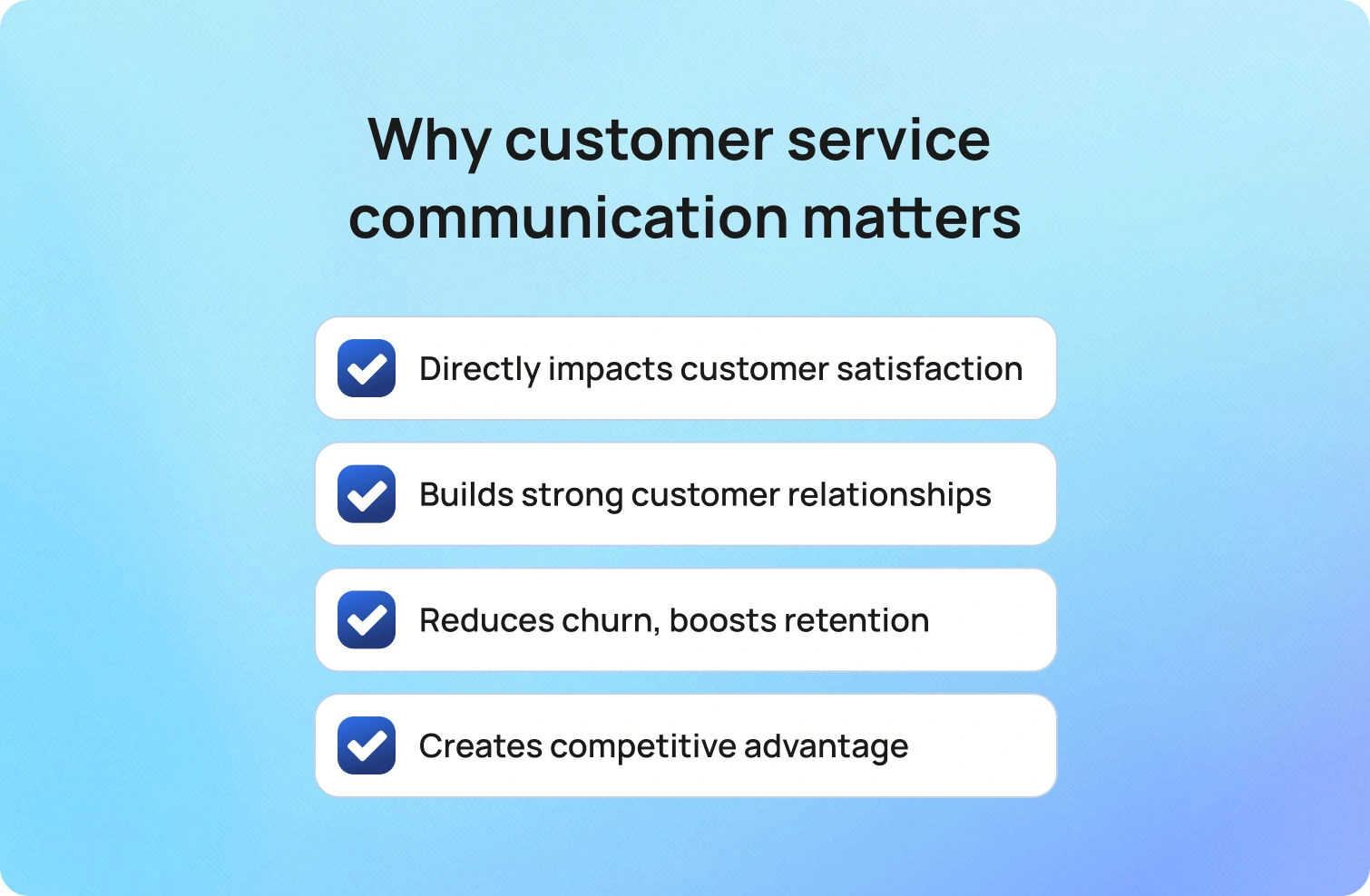
Practical communication matters in customer service because it is the foundation for everything else you aim to achieve.
1. It Directly Impacts Customer Satisfaction
Customers don't remember every feature of your product. But they absolutely remember how your support team made them feel. When your team communicates effectively, customer satisfaction scores go up. When communication breaks down, you get bad customer service experiences that tank your brand reputation.
Clear, empathetic communication makes customers feel valued. And when customers are heard, they're more willing to work with you to find a solution.
2. It Builds Strong Customer Relationships
Customer relationship management is a mindset. Every interaction is a chance to strengthen (or weaken) your relationship with that person. Excellent customer service communication turns transactional exchanges into meaningful conversations. When you communicate with customers in a way that's personal, helpful, and respectful, you solve problems and build trust.
3. It Reduces Churn and Increases Customer Retention
Companies with strong customer communication strategies have higher customer retention rates. That’s because customers stick with brands that make them feel understood.
When your team masters effective communication techniques in customer service, you reduce frustration, resolve issues faster, and give customers fewer reasons to leave.
That translates directly to business growth.
4. It Creates Competitive Advantage
Exceptional customer service is one of the few real differentiators left when enhancing the overall customer experience. Your communication efforts can set you apart from competitors who are still sending robotic, unhelpful responses.
When customers consistently have positive experiences with your support team, they become loyal advocates who spread positive word-of-mouth and social media feedback.
Choosing the Right Customer Service Communication Methods
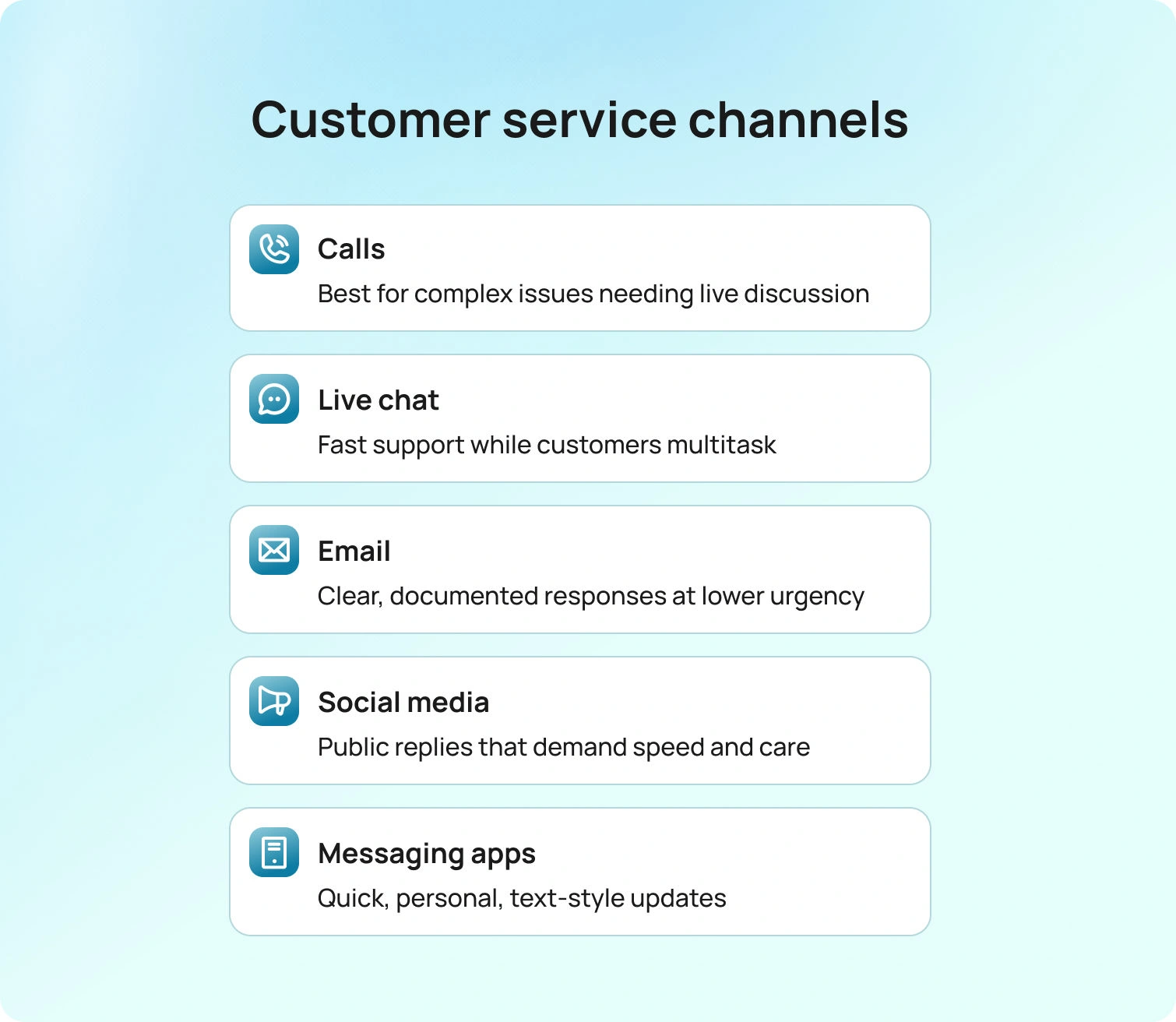
Not all communication channels are created equal. Different customers have different preferences, and your customer service team needs to meet them where they are.
Here are the primary communication methods in customer service and when to use them:
1. Calls
Phone interactions are important for complex issues that require back-and-forth communication. They enable immediate problem-solving and help service professionals pick up on tone and emotion. But they're also time-intensive, and not everyone wants to be on hold.
2. Live Chat
Chat is fast, convenient, and increasingly expected. Customers can multitask while waiting for responses, and your team can handle multiple conversations simultaneously. AI-powered chatbots can handle routine customer queries while human agents focus on complex issues.
3. Email
Email works well for detailed explanations and when customers need documentation of the conversation. It's less urgent than chat or phone, but requires strong written communication skills to avoid misunderstandings.
4. Social Media
Social media communication is public, which means every response is visible to potential customers. It requires quick turnaround and careful messaging, since you're essentially providing customer service on stage.
5. Messaging Apps
Platforms like WhatsApp and Facebook Messenger offer the convenience of texting with the professionalism of business communication. They're perfect for quick updates and personalized messages. The best customer service communication strategy uses multiple channels and lets customers choose their preferred method. An omnichannel customer support platform makes this seamless by unifying all customer communication channels in one place.
6 Customer Service Communication Techniques That Work
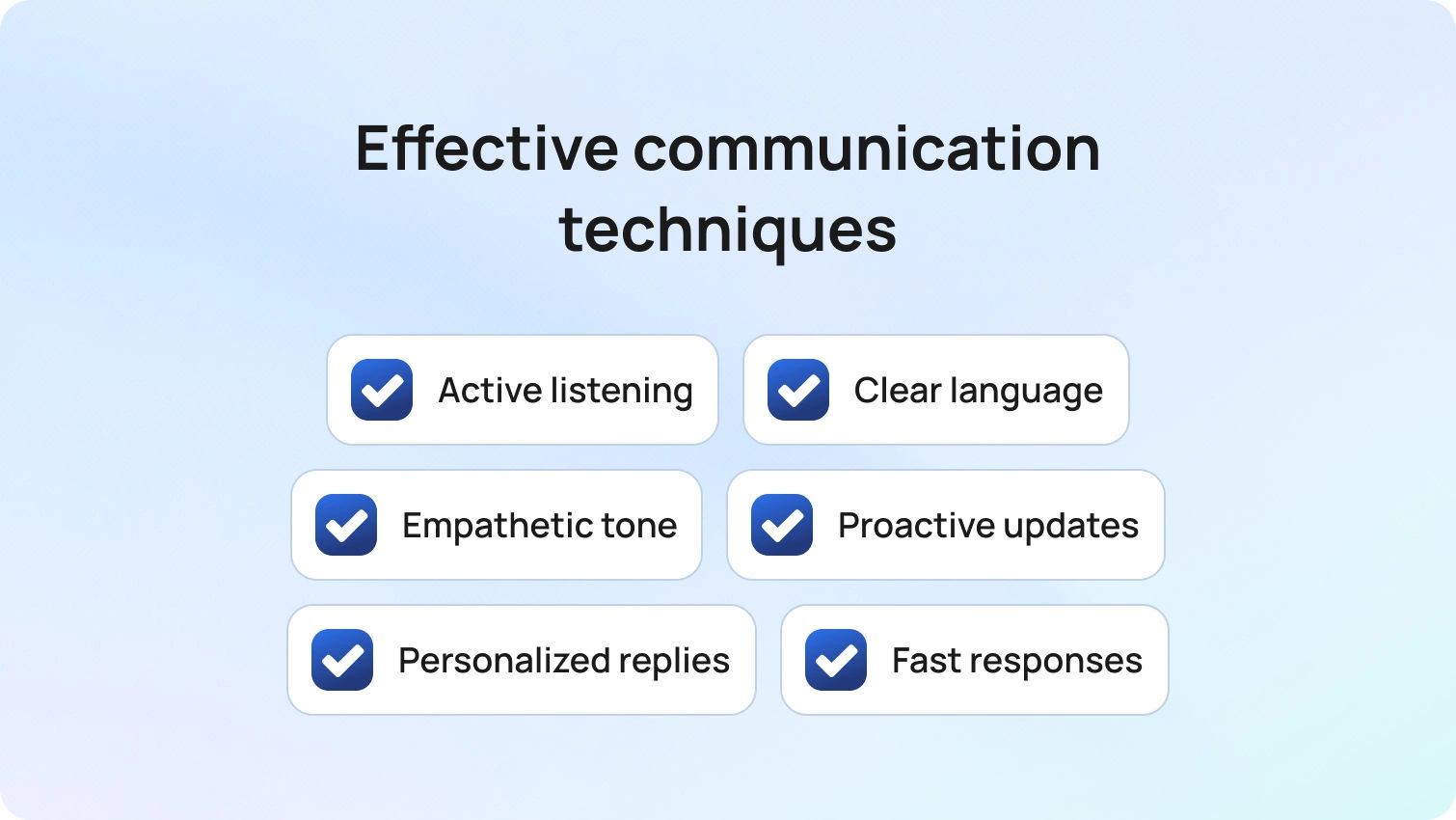
Here are the communication techniques in customer service that separate good teams from great ones:
1. Practice Active Listening
Active listening means truly hearing what customers are saying instead of waiting for your turn to respond. Read (or listen to) the whole message before crafting your reply. Ask clarifying questions. Repeat back what you've heard to confirm understanding.
When customers are heard, half the battle is already won.
2. Use Clear Communication
Avoid jargon, technical terms, or vague language. Your job is to make sure customers understand every step of the process. Break complex explanations into simple steps. Use short sentences. Be specific.
Bad: "We'll escalate this to the backend team for resolution."
Good: "I'm sending this to our technical team. You'll hear back within 24 hours with a solution."
3. Master the Right Tone
Written words in customer service are tricky because you don't have vocal cues to convey warmth. That's where tone matters.
- Start every interaction with empathy
- Acknowledge the customer's frustration or concern
- Use friendly language that feels human, not robotic
- Always maintain a positive attitude, even when dealing with difficult situations
Check out our guide on customer service best practices for more on tone and messaging.
4. Be Proactive, Not Just Reactive
Don't wait for customers to reach out with problems. Proactive communication means anticipating issues and reaching out first:
- Send updates on known issues
- Follow up after resolutions to make sure everything's still working
- Share tips that help customers get more value from your product
Proactively engage with customers, and you'll see customer engagement and satisfaction scores climb, leading to more positive feedback.
5. Personalize Every Interaction
Not every customer is the same, so you can’t treat them all the same way. Use customer data to understand their history, preferences, and past interactions. Reference previous conversations. Use their name. Tailor messages to their specific situation.
Personalized communication makes customers feel valued as individuals and not just ticket numbers.
6. Respond Fast
Speed matters. Customers expect quick responses, especially on channels like chat and social media. Set clear expectations about response times and stick to them. Use canned responses for common questions to speed up the process without sacrificing quality.
When you combine fast responses with clear, empathetic communication, you create exceptional customer service experiences.
Practical Customer Service Communication Examples
Let's look at some real examples to see these principles in action.
Example 1: The Robotic Response (Bad)
"Your ticket has been received. Reference number: 847392. Expected resolution time: 24-48 hours."
What's wrong here? Zero empathy. No acknowledgment of the customer's issue. No human touch. This is the kind of customer service that makes people feel like just another number.
Example 2: The Human Response (Good)
"Hi Sarah, I see you're having trouble with your billing. That's frustrating, especially when you're trying to get things sorted quickly. I've reviewed your account and identified the issue. It was a duplicate charge processed in error. I've issued a refund, and you'll see the credit within 2-3 business days. I'm really sorry for the inconvenience. Let me know if you need anything else!"
This works because it:
- Uses the customer's name
- Acknowledges the frustration
- Explains what happened clearly
- Provides a specific timeline
- Apologizes genuinely
- Offers continued support
That's effective communication and customer service working together.
How to Build a Customer Service Communication Plan
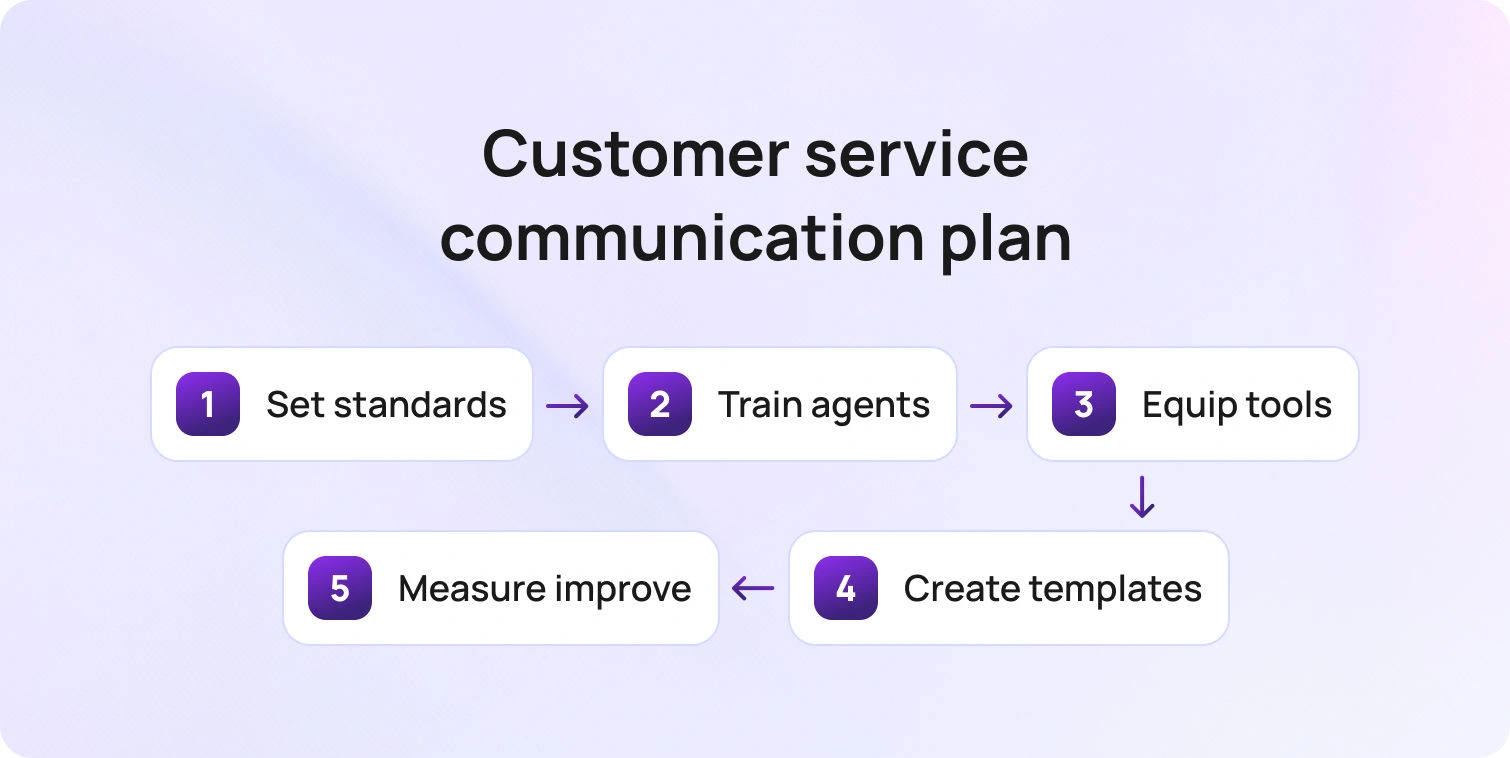
This plan is your roadmap for consistent, high-quality interactions. Here's how to create one:
1. Define Your Communication Standards
What does excellent customer service communication look like for your brand? Document your expectations around:
- Response time targets for each communication channel
- Tone guidelines (formal vs. casual, technical vs. simple)
- Language to use (and avoid)
- Escalation protocols
- Follow-up procedures
2. Train Your Team
Communication skills aren't innate. They are learned. Invest in training that covers:
- Listening techniques
- Written best practices
- Handling difficult customers
- Using support tools effectively
- Understanding customer expectations
Regular coaching and feedback help your customer service team improve communication skills over time.
3. Equip Your Team with the Right Tools
Your support team needs tools that enable effective communication across multiple channels. That means:
- A unified inbox that brings together email, chat, social media, and calls
- AI-powered features like proposed replies and ticket summaries that speed up responses
- Knowledge base tools so agents can find answers fast
- Real-time chat translation for customers who speak different languages
- Analytics to track communication performance and customer satisfaction
BlueHub (by BlueTweak) brings all of this together on a single platform, making it easier for your team to deliver consistent, high-quality communication across every channel.
4. Create Communication Templates
Templates save time and ensure consistent messaging. Build a library of customer service communication examples for:
- First response acknowledgments
- Common questions and solutions
- Escalation notifications
- Follow-up messages
- Thank you, and feedback requests
Just make sure your team personalizes these templates. Because nobody likes feeling like they're talking to a robot.
5. Measure and Improve
Track key metrics like:
- Customer satisfaction scores (CSAT)
- First response time
- Resolution time
- Customer feedback sentiment
- Retention rates
Use this data to identify communication gaps and refine your customer service communication strategy over time.
How BlueHub Strengthens Customer Service Communication
BlueHub (by BlueTweak) brings every channel into a single omnichannel workspace across voice, chat, email, SMS, and social. Agents see the full context and history, which helps keep tone consistent and replies accurate. AI assistance suggests replies that align with your brand, produces instant ticket summaries that make handoffs seamless, and provides translation so language is never a barrier. A searchable knowledge base sits beside every conversation to help teams deliver clear answers the first time. Leaders gain the insight needed to coach and improve. Journey-aware analytics track response time, resolution time, CSAT, sentiment, and first-contact resolution across brands. Quality assurance tools and audit trails surface conversations that need review. Integrated workforce management helps you meet SLAs, and native multitenant routing lets one team support multiple brands with clear separation and shared visibility. The result is communication that defuses tension, resolves issues faster, and retains customers at scale.
Make Top-Notch Communication Your Competitive Edge
Most companies still get this wrong. They're sending automated responses, making customers repeat themselves across channels, and treating support as a cost center rather than a relationship builder.
That's your opportunity.
When you master customer service, you stand out. You create exceptional customer service experiences that turn first-time customers into lifelong advocates.
In a world with endless options, such lasting relationships and customer loyalty are worth their weight in gold.
See how BlueHub (by BlueTweak) makes it easy to deliver consistent, high-quality support across every channel, from phone calls to social media to messaging apps. Request a demo to see it in action.

The Role of UX in Customer Support: Enhancing user experiences
The role of User Experience (UX) in customer support is pivotal, especially with the integration of advanced technologies like AI. Companies are transforming their support platforms into seamless, intuitive, and highly efficient systems.
Customer Support Experience: Designing Intuitive Self-Service Portals and Knowledge Bases
A well-designed self-service portal is the cornerstone of effective customer support. These portals empower users to find solutions independently, reducing the need for direct interaction with support agents. Key elements of intuitive design include:
- Clear categorization: Information should be categorized logically, making it easy for users to navigate through topics.
- Effective search functionality: A search bar that predicts and auto-completes queries can drastically reduce the time users spend looking for information.
- Visual aids: Incorporating videos, infographics, and screenshots can help users understand solutions more quickly and effectively.
Optimizing Navigation and Search Functionalities
A seamless navigation experience is critical for users seeking support. Optimizing navigation and search functionalities involves implementing breadcrumb navigation to allow users to track their location within the portal and easily backtrack if needed.
Advanced filters can help users narrow down search results to find relevant information faster. Leveraging AI to provide personalized search results based on user behavior and query context enhances the relevance of information retrieved.
Read more about: Superior Customer Support – Best Practices & AI Transparency
Integrating Support Seamlessly Within the Product Interface
Support should be easily accessible without disrupting the user’s workflow. Seamless integration within the product interface can be achieved by embedding chatbots or help widgets directly within the application to provide instant access to support.
Offering contextual help such as tooltips, FAQs, and guides within the context of the application’s features helps users understand functionalities without leaving the interface. Real-time assistance, such as live chat or AI-driven bots, can offer immediate support, improving customer experience by resolving issues on the spot.
Gathering User Feedback and Conducting UX Testing for Continuous Improvement
Continuous improvement of the support platform is essential for maintaining high levels of customer satisfaction. This can be accomplished through incorporating feedback options such as surveys, ratings, and comment sections within the support portal to provide valuable insights.
Regular UX testing with real users helps identify pain points and areas for enhancement. Using analytics to track user behavior and interactions with the customer support portal can also inform improvements.
Read more about: How to Handle Customer Complaints and Turn Complaints into Opportunities
Advantages for Customer Satisfaction
Focusing on UX in customer support platforms offers numerous advantages for customer satisfaction:
- Increased efficiency: Intuitive design and easy navigation reduce the time customers spend searching for help, leading to quicker resolutions.
- Higher engagement: Seamless integration and accessible support options keep customers engaged with the product, enhancing their overall experience.
- Greater autonomy: Well-designed self-service portals empower customers to solve problems independently, increasing their confidence and satisfaction.
- Personalized experience: AI-driven search and support tools provide tailored assistance, making customers feel valued and understood.
- Continuous improvement: Regularly gathering and acting on user feedback ensures that the support platform evolves with customer needs, maintaining high satisfaction levels.
Read more about: The Crucial Role of User-Friendly Platforms in Customer Service Support Excellence
Incorporating UX principles into customer support platforms is not just about making interfaces look good; it's about creating an environment where users can effortlessly find the help they need.
By designing intuitive self-service portals, optimizing navigation, integrating seamless support within the product, and continuously gathering user feedback, companies can greatly enhance the user experience. The result is not only increased customer satisfaction but also a more efficient and effective support system.



