



TL;DR
Improving customer satisfaction scores starts with serving people in their own language, fast and with empathy. This guide shows how multilingual AI enhances daily operations with automatic routing, real-time translation, ticket summaries, and proposed replies that keep answers accurate and on-brand. BlueTweak unifies chat, voice, and email so you can apply these steps in one workspace and track CSAT, FCR, sentiment, containment, and deflection in a single view.
Why satisfaction drops when language gets in the way
Customer satisfaction is a judgment made right after an interaction. Did you meet the need with low effort and a human tone? In multilingual customer support, that judgment swings faster. Each handoff, mistranslation, or repeat increases effort. Dissatisfied customers leave negative feedback, and your customer satisfaction score falls.
Scale is the constraint. Volume hits all communication channels at once. Research from Salesforce’s 2025 State of Service reports that AI now handles about 30% of service cases and is expected to handle half by 2027. Leaders are using artificial intelligence to reduce effort where it most harms the customer experience.
This guide focuses on improving customer satisfaction scores in multilingual operations. You will see where scores slip and how to fix the causes with language-aware routing, real-time translation, AI summaries, AI suggested replies, and an AI customer support knowledge base. You will also learn how to measure customer satisfaction with CSAT and customer sentiment, how to run a quick rollout, and how to keep gains compounding.
What customer satisfaction measures are, and how AI helps
Define customer satisfaction clearly. CSAT captures how a customer felt about one customer service interaction. It answers a simple question right after a ticket, chat, or call. Did we solve the problem with low effort and a human tone? Net Promoter Score tracks customer loyalty over time. Use both, but rely on CSAT to tune day-to-day service across the customer journey.
AI helps reduce effort and maintain consistent answers across languages and communication channels. The core pieces are:
- Classification that detects intent and urgency
- Routing that reaches the right skill group the first time
- AI ticket summaries that condense long threads into key facts and the next step
- Suggested reply that drafts an on-brand answer from your knowledge base
- Real-time translation so any queue can reply in the customer’s language
Each piece cuts waiting, reduces repeats, and protects tone. That is how to improve customer satisfaction without extra headcount. BlueTweak brings these capabilities together across a multilingual chatbot, AI voicebot, and email and surfaces CSAT scores, FCR, customer sentiment, transfer, containment, deflection, abandonment, and concurrency in one dashboard.
Multilingual AI building blocks that move your score
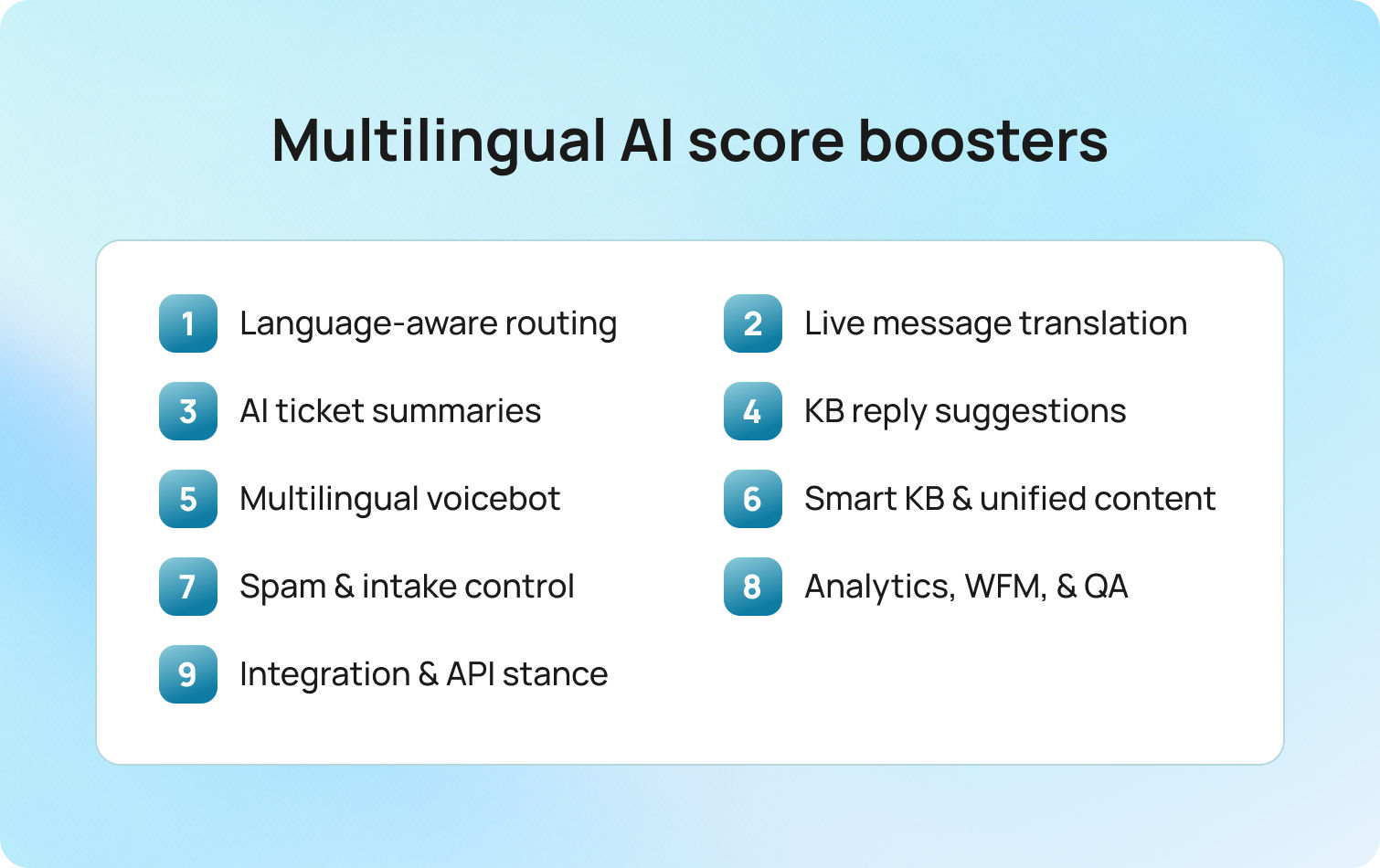
These are the practical levers that raise customer satisfaction levels. Each item explains what it is, how it works, and how BlueTweak helps customer service teams and customer service agents execute.
Language-aware routing
What
Detect language and intent on first contact and route to the right skill group and SLA.
How
Define skills by language and topic. Map top intents to queues. Set clear escalation rules for sensitive cases. Review misroutes weekly and adjust skills, SLAs, and hours.
How BlueTweak helps
Automatic language and intent classification across chat, voice, and email. Skills, queues, and SLAs in one admin view. Transfer rate and FCR by queue and language on the standard dashboard, with an audit trail for routing changes.
Real-time translation in chat and email
What
Translate messages inline so agents reply in the customer’s language without leaving the thread.
How
Create a glossary for brand and product terms. Allow fluent agents to opt out. Log edits for QA. Use translation on first touch, then bring in a fluent specialist for complex cases.
How BlueTweak helps
Translation in the compose pane. Per queue enablement and role-based opt-out. Edit logs for QA. SLA and CSAT comparisons for translated versus native replies.
AI ticket summaries
What
Condense long threads into key facts, the requested outcome, prior commitments, and the next step.
How
Enable summaries on high-volume queues. Require agents to confirm the next action before sending. Attach the summary to the case record. Use summaries in handoffs to preserve context.
How BlueTweak helps
Summaries appear beside composition and classification. Handle time, re-open rate, and sentiment are visible before and after rollout.
Suggested reply from the knowledge base
What
Draft an on-brand answer pulled from approved articles, ready for agent approval or edit.
How
Link templates and macros to specific knowledge base articles. Require article IDs in each suggestion. Localize articles before suggestions go live in that language.
How BlueTweak helps
The suggested reply draws on the smart knowledge base. Compare CSAT, FCR, and time to first response for suggested versus manual replies. Version history and approval flow for article changes.
Multilingual voicebot with clean handoff
What
Resolve common intents in the caller’s language and pass the full context to an agent when escalation is needed.
How
Start with the top-volume intents. Keep prompts short. Confirm key details. Always offer a human option. Send the transcript and captured fields to the agent on handoff.
How BlueTweak helps
Voicebot supports multiple languages and live language selection. Handoff includes a transcript. Containment, call deflection, abandonment, concurrency, sentiment, and FCR are tracked in one place.
Smart knowledge base and unified content
What
One source of truth that powers agent replies and conversational AI answers in every language.
How
Assign owners. Set a review cadence. Require version notes. Collect customer input and agent feedback on each article. Use templates for policies, troubleshooting, and refunds to maintain a consistent structure.
How BlueTweak helps
The articles feed includes both suggested replies and conversational AI flows. Link intents, templates, and articles. Usage analytics by queue and language. Search success rate and article feedback are visible to content owners.
Spam detection and intake quality
What
Filter spam and malformed requests so agents focus on real customer interactions.
How
Enable spam detection for email and web forms. Route uncertain items to a low-priority review queue. Validate order IDs and contact data at intake to reduce negative experience loops.
How BlueTweak helps
Spam filtering at channel intake with safe-list and block-list controls. Impact on time to first response and agent occupancy tracked without external BI.
Analytics, WFM, and QA in one place
What
A single view of experience quality and staffing needs in real time.
How
Standardize a weekly KPI pack. Track CSAT, FCR, transfer, containment, deflection, abandonment, concurrency, and sentiment. Align schedules and coaching to language- and channel-specific patterns. Use transcripts for targeted QA.
How BlueTweak helps
All metrics are standard. No separate BI build. Forecasting and scheduling live next to queues. QA review pulls transcripts and sentiment without exports.
Integration and API stance
What
Bring order data, billing status, and identity into the conversation so the first reply is accurate.
How
Expose key customer fields in the compose pane. Pass metadata to bots and suggestions. Log access for audit. Use webhooks to update tickets when upstream systems change.
How BlueTweak helps
API open with integration points for in-use system/legacy systems/tool stack. Customer context is visible during compose. Reduction in back-and-forth and higher FCR, both measurable on the same dashboard.
Where multilingual support usually loses CSAT, and how to fix it
A typical pattern looks like this. A customer writes in Spanish, lands in an English queue, gets transferred twice, and has to repeat the issue. On voice, a caller selects French, waits, and hears a generic apology that does not answer the question or says that no agent is available. Effort rises. Trust falls. Customer satisfaction levels drop.
The root cause is fragmentation. Ticketing, telephony, translation, and knowledge live in separate tools. Context is lost between systems, macros diverge by channel, and agents copy text rather than solve the problem. Handoffs multiply because language and intent are detected late. Even when the final answer is correct, the path feels slow and impersonal.
Move effort out of the conversation:
- Route by language and intent on first contact
- Preserve context so the next agent sees what was asked and what was promised
- Draft replies from approved articles to keep content accurate across languages
- Use inline translation for thinly staffed languages without leaving the thread
- In voice, keep prompts short, offer a human path, and pass the full transcript on escalation
BlueTweak supports this model in one workspace. Automatic classification and routing apply across chat, voice, and email. AI ticket summaries keep context intact. Suggested reply grounds answers in the knowledge base. Real-time translation sits in the compose pane with opt-outs and logs for QA. The impact shows up in standard KPIs you can read together, including CSAT, first contact resolution, transfer rate, sentiment, containment, deflection, abandonment, and concurrency.
Rollout you can complete in weeks
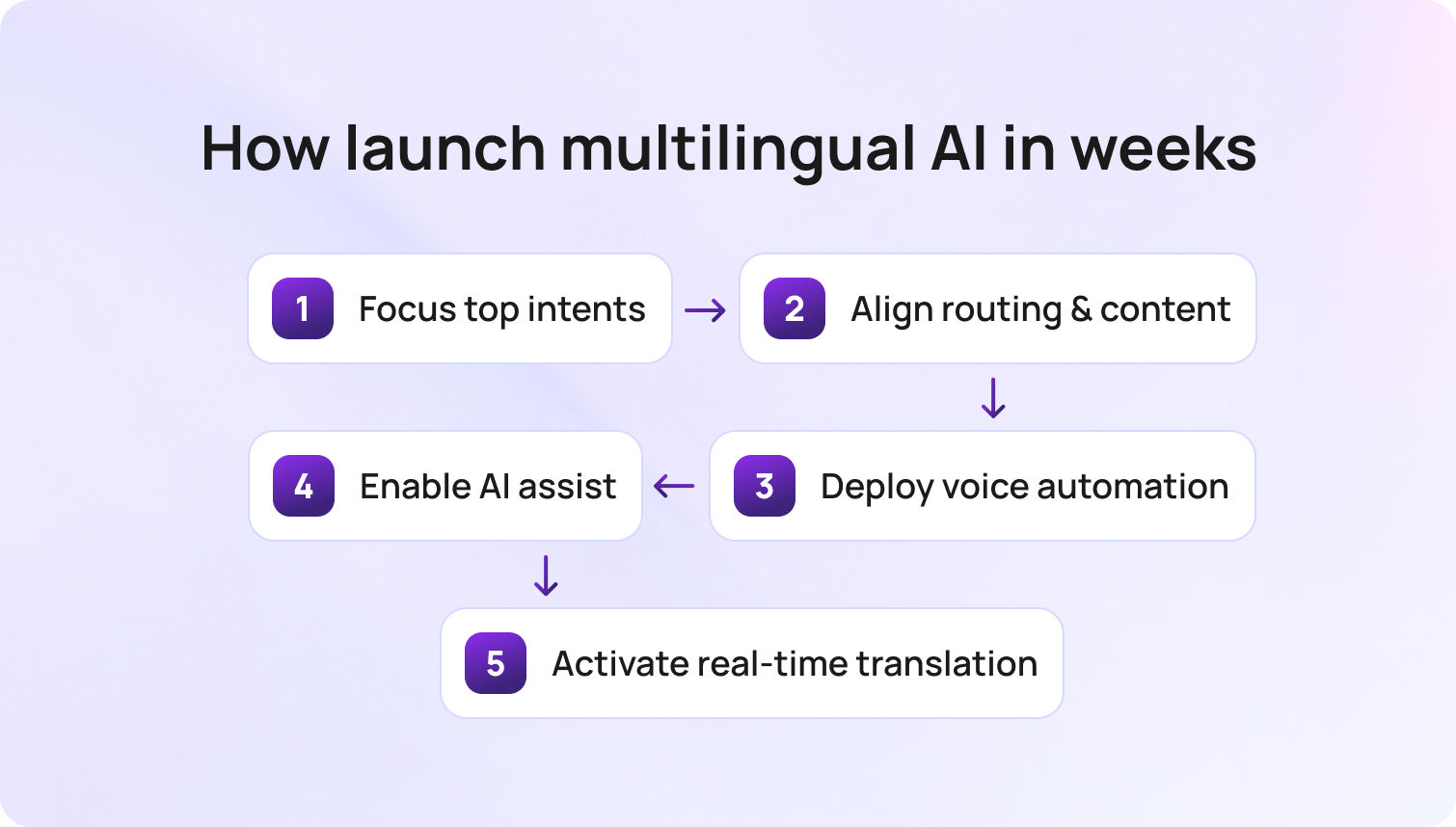
Volume concentrates in a few intents and a few languages, so start there. Map your top twenty requests and the languages where SLAs slipped. Link each intent to a queue and the exact article that should power the first reply. In BlueTweak, connect intents, queues, and articles so classification, routing, and suggestions point to the same source from day one.
Turn on language-aware routing and read early signals. Transfers should fall, and FCR should rise, especially in thinly staffed languages. If results stall, revisit skills, SLAs, and escalations. BlueTweak places transfer, abandon, and sentiment side by side so you can see speed and tone together and adjust quickly.
Introduce a multilingual voicebot for predictable requests. Order status, returns, appointment changes, and password resets are reliable starters. Keep a human path visible. After the first week, check containment, deflection, and abandonment. If callers exit early, shorten prompts, confirm details more clearly, or escalate sooner. BlueTweak surfaces these metrics without a separate BI project.
Enable AI summaries and suggested replies in your busiest queue. Pilot one language, confirm tone, then expand. If first response time improves but CSAT does not, the issue is usually content. Fix the article behind the suggestion and let the next proposed reply inherit the change. BlueTweak links articles to suggestions, so updates flow into both agent replies and bot answers.
Switch on real-time translation where coverage is thin. Use it to meet the SLA on first touch, then loop in a fluent specialist for nuance. Because translation lives in the compose pane with opt-outs and QA logs, customers experience a continuous thread rather than a handoff.
Weekly checklist:
- Adjust skills and escalations based on misroutes and reopens
- Review transfer, FCR, and sentiment by language
- Inspect bot containment and abandonment on top flows
- Update the articles that drive the most suggestions
Quick wins that raise CSAT fast
Older setups spread work across ticketing, telephony, translation, and a standalone bot. Effort leaks at every handoff. The fastest gains come from removing effort from high-volume points and measuring the change in a single view.
Start with the basics:
- Send customer satisfaction surveys in the same language as the conversation, right after resolution
- Ask one open question, then fix the two articles that show up most in survey responses
- Use the suggested reply for the first draft and coach on edits that repeat
- Track transfer rate and FCR together and reward queues that lift FCR without a CSAT dip
- In voice, review calls where containment failed and tighten the exact step where callers exit
BlueTweak links suggestions to articles, keeps translations in the compose pane, and shows CSAT, FCR, transfer, containment, and abandonment on a single dashboard. Small changes quickly yield actionable insights for the customer support team.
Measurement that proves lift
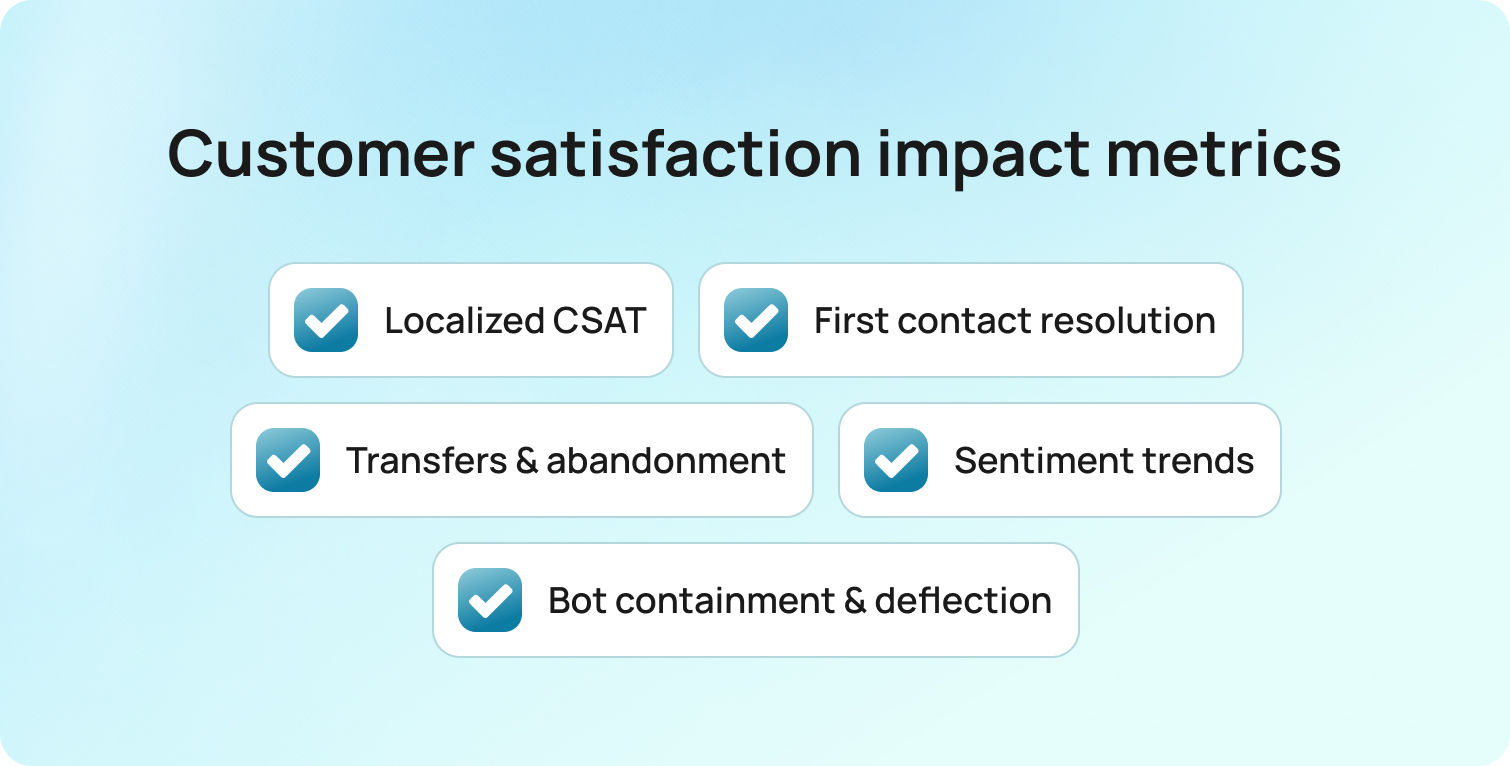
Teams used to export data and stitch reports. A cleaner approach is to make CSAT the anchor and pair it with a short set of signals that tell a consistent story about customer satisfaction goals and overall satisfaction.
Track every week:
- CSAT in the customer’s language, sent immediately after the interaction
- First contact resolution
- Transfer rate and abandonment by language and channel
- Sentiment over time
- For bots, containment, call deflection, and concurrency
Read these together. If FCR rises and CSAT is flat, the answer is correct but cold. If CSAT rises and FCR stays low, scope control is weak. Update the article behind the reply and check next week’s numbers. BlueTweak centralizes these metrics so customer service teams can review them weekly without a heavy BI project.
CFO view of consolidation and multilingual ROI
In fragmented stacks, cost hides in rework. Reopens, callbacks, escalations, and customer churn grow when language forces repeats and transfers. Consolidation lowers that cost by bringing tickets, voice, chat, knowledge, and analytics into one place and by letting one customer service representative handle more conversations in more languages with fewer handoffs.
Keep the math simple. Fewer transfers and higher FCR cut handle time. Better self-service and respectful containment reduce volume. CSAT steadies, and churn risk drops. Report those shifts using the same KPIs leadership already follows. BlueTweak supports this model with an omnichannel workspace, proposed replies grounded in the knowledge base, and a single view of the financial signals behind quality.
Monthly optimization loop
Quarterly reviews are too slow for multilingual work. Replace them with a short loop that turns customer feedback into better answers.
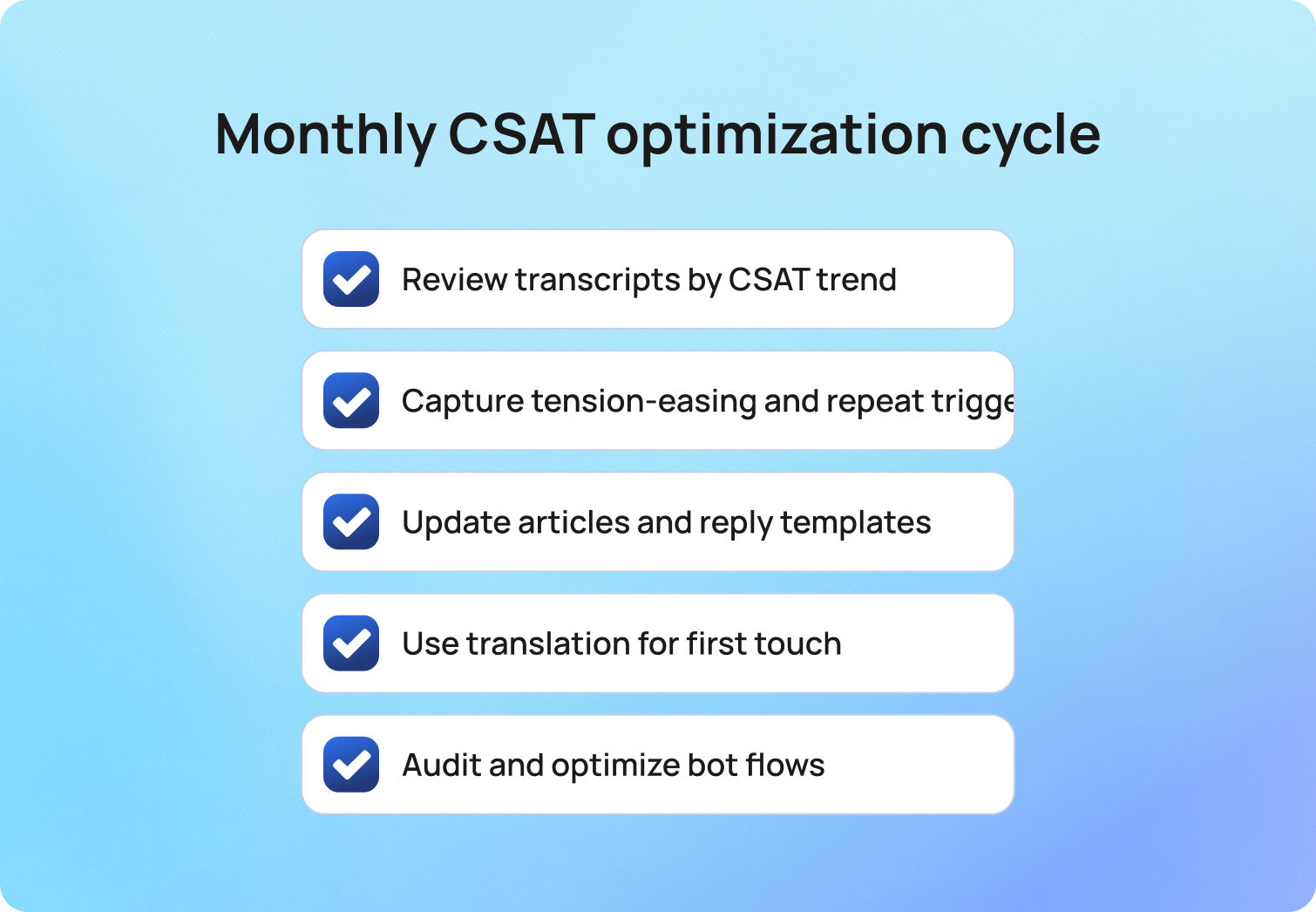
Run this every month:
- Pull transcripts per top language where CSAT dipped and where it surged
- Capture phrases that eased tension and phrases that triggered repeats
- Update the articles and proposed reply templates so the next draft reflects what worked
- Treat translation as an accelerator for first touch, then bring in a fluent specialist when nuance matters
- Audit bot flows with the same rigor used for agents. If abandonment climbs, offer a human path sooner. If containment is high and CSAT slips, adjust tone and confirmations
BlueTweak makes this loop practical by linking articles to suggestions, logging translation edits for QA, and surfacing bot and channel metrics in the same place agents work.
2026 outlook for multilingual CSAT
Messaging and voice keep growing as primary communication channels while multi-brand operations and privacy expectations get stricter. Adoption trends point the same way. Salesforce’s 2025 report shows AI handling about 30% of cases today and moving toward 50% by 2027, which concentrates attention on quality, governance, and proactive multi-channel support.
Privacy capabilities are improving to support that shift. European data residency and clearer controls over processing and retention are becoming the norm, making multilingual automation realistic for regulated teams.
Priorities for 2026
- Native multilingual capability across voice and text
- Answers grounded in the knowledge base to prevent drift
- Transparent privacy posture with auditability and data residency options
- Unified analytics across the full customer journey from bot to agent to post-purchase follow-up
- End-to-end handling without custom middleware, including bot deflection, seamless agent escalation, suggested replies, and post interaction analysis
BlueTweak aligns with this direction by unifying chat, voice, and email in one workspace, grounding automation in a smart knowledge base, and exposing standard KPIs in a single view.
What to do next
Improving customer satisfaction scores with multilingual AI is a practical way to reduce effort. Fix the points where language, handoffs, and slow replies create friction. Keep the loop tight. Measure, adjust, and repeat so existing and new customers both have positive experiences.
Start here, then expand
- Map the top intents and the languages where SLAs slipped
- Route by language and intent on first contact
- Enable AI summaries and suggested replies so agents start from context and approved content
- Add real-time translation for thinly staffed languages, then bring in fluent specialists for nuance
- In voice, introduce a multilingual bot for predictable requests and keep a clear human path
- Track CSAT, FCR, sentiment, transfer, containment, and deflection in one view
- Update the two most used articles each week based on survey respondents and agent edits
BlueTweak brings these steps into a single workspace across chat, voice, and email, with a smart knowledge base, proposed replies, translation, routing, and summarization tied to the same KPIs. That makes it easier to increase customer satisfaction, build loyal customers, and maintain good customer satisfaction across teams. Request a demo to see the workflow end to end.

As Head of Digital Transformation, Radu looks over multiple departments across the company, providing visibility over what happens in product, and what are the needs of customers. With more than 8 years in the Technology era, and part of BlueTweak since the beginning, Radu shifted from a developer (addressing end-customer needs) to a more business oriented role, to have an influence and touch base with people who use the actual technology.



