


Proactive vs Reactive Customer Service: How AI Helps Brands Stay Ahead

Why Proactive Customer Service Matters More Than Ever
Proactive customer service is a customer support approach focused on identifying and resolving issues before the customer initiates contact. Instead of waiting for complaints, businesses anticipate customer behavior, customer concerns, and customer needs to create smoother customer interactions and better outcomes.
Customer expectations have fundamentally changed; today’s customers expect fast responses, personalized experiences, and seamless communication across every touchpoint in the customer journey. Businesses that fail to provide proactive customer support risk falling behind competitors that are already using AI and automation to stay ahead.
According to a 2025 global customer experience study by PwC, customers increasingly rank speed, personalization, and convenience among the most important factors influencing brand loyalty and repeat business. Organizations that proactively address customer pain points are significantly more likely to retain loyal customers and increase customer trust.
The reality is simple: reactive service alone is no longer enough. As businesses scale digital operations, customer support teams face growing pressure to manage more customer queries, more channels, and rising expectations simultaneously. That is why proactive customer service strategies with AI are becoming a critical competitive advantage.
“The companies leading customer experience transformation are no longer waiting for problems to happen. They are using AI and operational insight to predict friction points, personalize engagement, and resolve issues before customers even need to ask for help”

Understanding Reactive vs Proactive Customer Service

Proactive vs. reactive customer service refers to two fundamentally different approaches to customer support and customer communication. Reactive customer service responds after a customer issue has already occurred. Proactive customer service aims to prevent poor customer service experiences before they happen.
The difference between the two approaches has a direct impact on customer satisfaction, operational efficiency, and long-term customer loyalty.
What Is Reactive Customer Service?
Reactive customer service waits for the customer to initiate contact before support teams take action. This approach focuses on resolving customer complaints, answering customer inquiries, and managing customer issues after they arise.
Reactive customer service remains necessary for many support situations, but relying on it entirely can create several operational challenges:
- Increased customer frustration
- Longer resolution times
- Higher support volumes
- Repeated customer contacts
- Missed opportunities to improve customer relationships
Reactive customer service responds effectively in urgent situations, but it rarely addresses the root causes behind recurring customer concerns.
What Is Proactive Customer Service?
Proactive customer service involves using customer data, behavioral signals, predictive analytics, and automation to anticipate customer needs and prevent friction before it escalates.
Businesses implementing proactive customer service often:
- Notify customers about issues before they are impacted
- Deliver proactive outreach during critical moments
- Monitor customer sentiment in real time
- Offer proactive self service options
- Use AI to identify customer pain points early
- Personalize support based on customer behavior
Unlike reactive customer service, proactive support creates experiences where customers feel valued, informed, and supported throughout the customer journey. This proactive approach helps businesses exceed customer expectations while reducing unnecessary support volume.
How AI Enables Proactive Customer Service Strategies
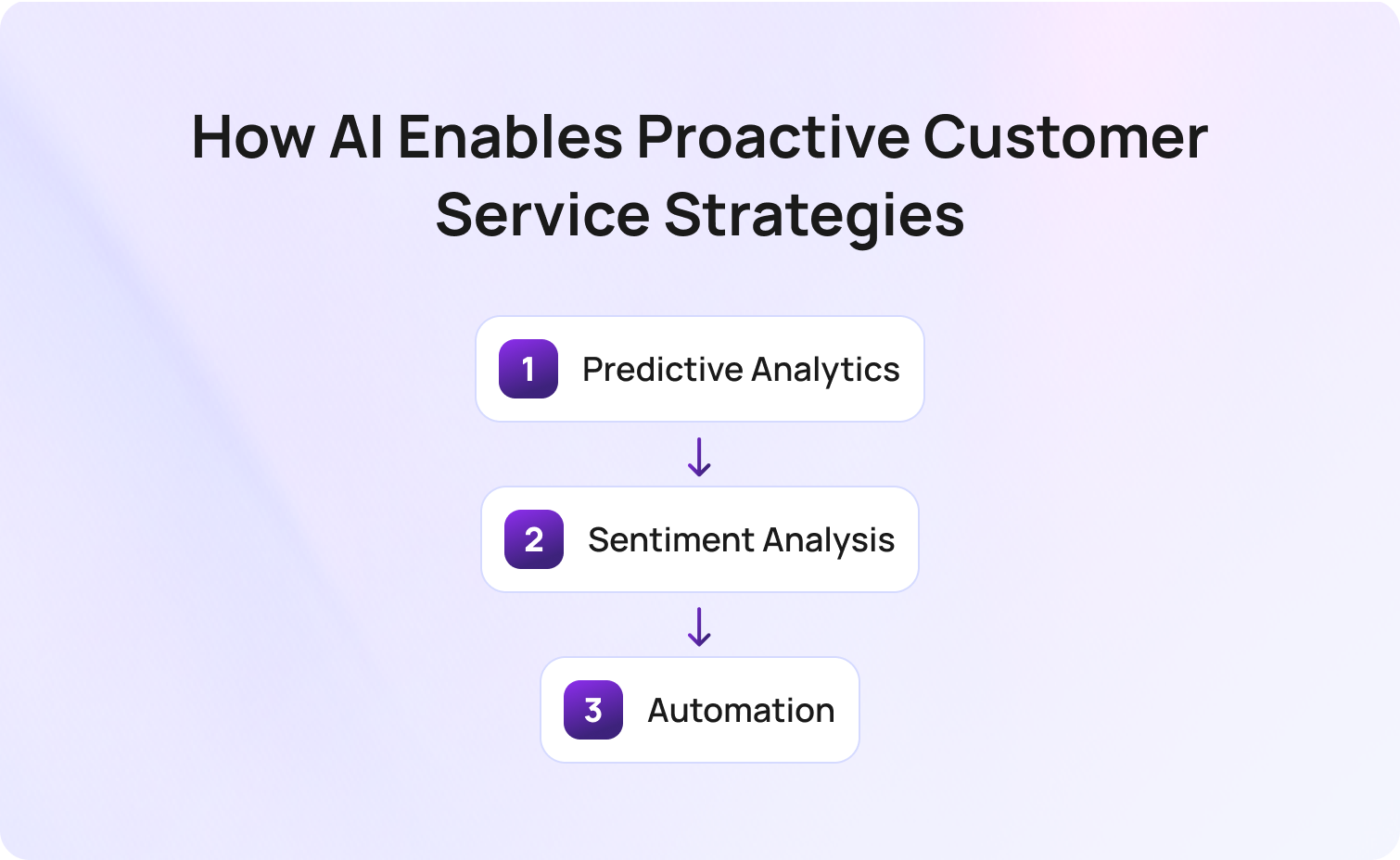
Proactive customer service strategies with AI use automation, predictive analytics, and sentiment analysis to help businesses anticipate customer concerns before they escalate into larger issues.
AI has changed how organizations deliver proactive customer care because it allows support teams to move from reactive to proactive decision-making at scale.
Without AI, identifying customer sentiment patterns or predicting customer issues across thousands of interactions would require enormous manual effort. With AI-powered systems, businesses can continuously monitor customer interactions in real time and take immediate action.
Predictive Analytics Helps Businesses Anticipate Customer Needs
Predictive analytics uses historical customer data and behavioral trends to forecast likely outcomes or customer actions. For example, AI can identify:
- Customers at risk of churn
- Frustration signals during support conversations
- Delays likely to trigger customer complaints
- Repeated product issues across customer segments
- Opportunities for proactive outreach
This enables businesses to address customer concerns before they negatively affect customer satisfaction.
Sentiment Analysis Improves Customer Understanding
Sentiment analysis allows organizations to monitor customer sentiment across voice calls, chat, email, surveys, and social channels. Instead of relying solely on post-interaction customer feedback, businesses can continuously evaluate how customers feel during live customer interactions.
This provides valuable insights into:
- Escalation risks
- Customer frustration trends
- Emerging customer pain points
- Support quality gaps
- Opportunities for continuous improvement
By monitoring customer sentiment proactively, support teams can intervene earlier and protect customer relationships before dissatisfaction grows.
Automation Enables Scalable Proactive Support
Automation plays a central role in proactive customer support strategies because it helps businesses deliver timely communication at scale.
Examples of proactive customer service powered by automation include:
| Proactive Service Example | Customer Benefit |
|---|---|
| Shipping delay notifications | Reduces inbound customer inquiries |
| AI-powered self service resources | Faster issue resolution |
| Automated outage alerts | Builds customer trust |
| Personalized onboarding journeys | Improves customer experience |
| Proactive renewal reminders | Increases repeat business |
These proactive strategies help organizations provide proactive customer support without increasing operational complexity.
The Business Benefits of Proactive Customer Service
The benefits of proactive customer service extend far beyond support efficiency. Organizations that successfully implement proactive customer service strategies often improve both operational performance and customer loyalty simultaneously.
Businesses that proactively address customer concerns can reduce friction across the entire customer journey while improving brand perception.
Increased Customer Loyalty and Retention
Customers are more likely to remain loyal to businesses that consistently anticipate customer needs and resolve issues quickly.
When customers feel valued and supported proactively, they are more likely to:
- Continue purchasing
- Recommend the brand to others
- Trust the business long term
- Engage positively across future customer interactions
This creates stronger customer relationships and increased customer loyalty over time.
More Efficient Resource Allocation
Proactive support reduces repetitive customer contacts and prevents avoidable escalations.
By addressing customer issues early, businesses can:
- Reduce pressure on the customer service team
- Lower operational costs
- Improve agent productivity
- Focus resources on higher-value customer interactions
This leads to more efficient resource allocation and stronger operational scalability.
Stronger Competitive Advantage
Organizations that deliver proactive customer service differentiate themselves in crowded markets.
Many businesses still rely heavily on reactive customer service models. Companies that successfully transition from reactive to proactive support can create a measurable competitive advantage by delivering faster, smoother, and more personalized customer experiences.
Real-World Examples of Proactive Customer Service
Examples of proactive customer service can be found across industries, particularly among organizations investing heavily in AI, automation, and customer experience transformation.
The most effective proactive customer support strategies combine technology with operational visibility. For example, businesses may:
- Notify customers about service interruptions before complaints begin
- Recommend solutions based on previous customer behavior
- Automatically route at-risk customer interactions for escalation
- Trigger proactive outreach after negative sentiment detection
- Deliver proactive self service options during peak support periods
At BlueTweak, organizations use AI-powered automation and analytics to improve visibility across customer operations and support workflows. One example comes from the packaging industry where a transformation enabled a BlueTweak customer to improve operational reporting visibility and accelerate issue resolution processes across customer support operations. The result was faster identification of recurring customer pain points, improved cross-team collaboration, and a more proactive approach to maintaining service quality and customer satisfaction at scale.
This type of proactive operational insight helps businesses identify customer issues earlier and improve overall customer satisfaction.
Want to move from reactive to proactive customer support? Start a free BlueTweak trial and discover how AI-driven insights, automation, and analytics can help you prevent issues before they impact your customers.
How to Implement Proactive Customer Service Successfully
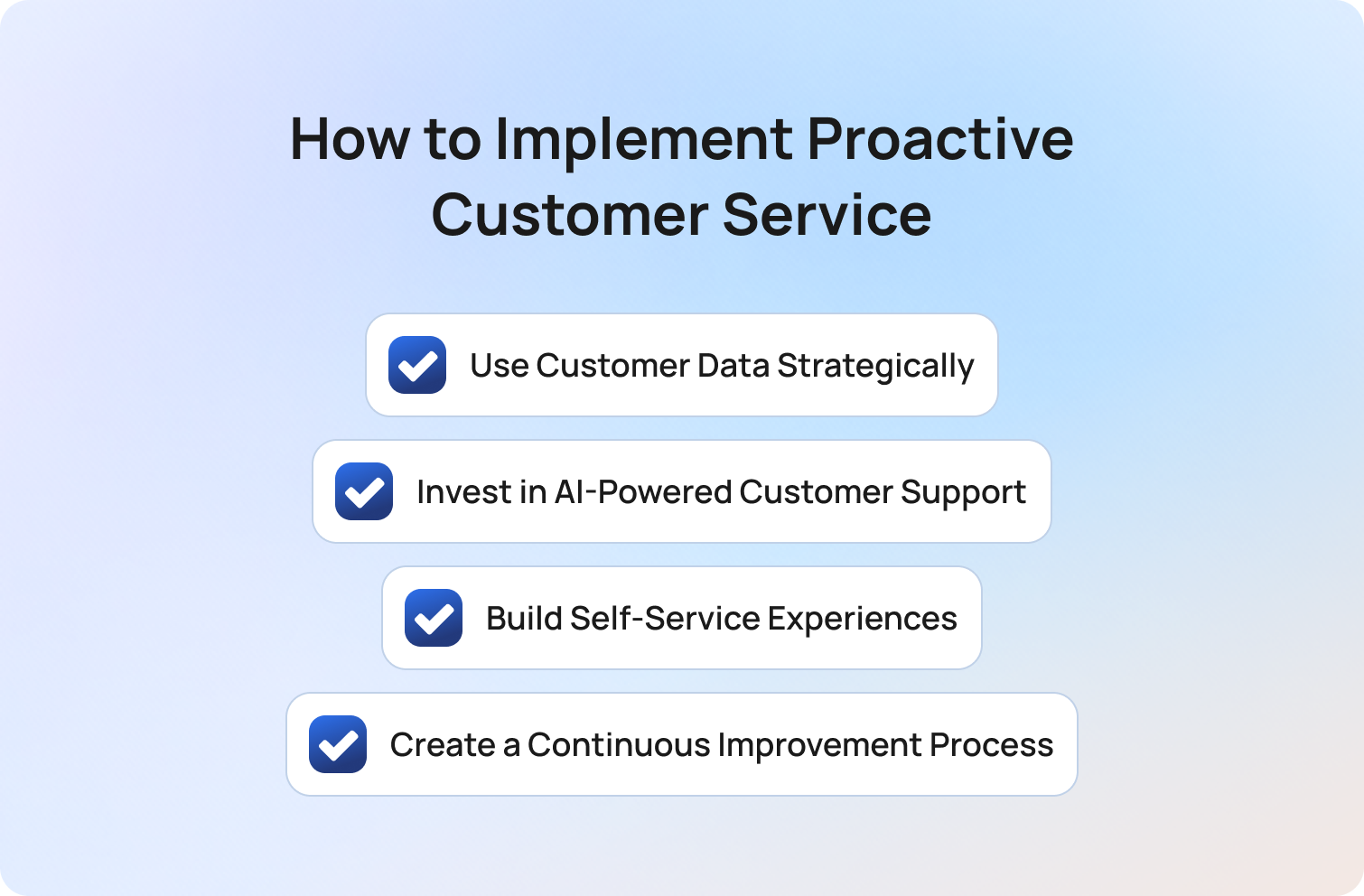
Implementing proactive customer service means businesses need a connected strategy that combines technology, operational alignment, and customer-centric thinking. Organizations looking to deliver proactive customer service effectively should focus on several core areas.
Use Customer Data Strategically
Customer data is the foundation of every proactive customer service approach. Businesses should unify customer interactions, customer feedback, behavioral signals, and operational data to create a clearer understanding of customer needs and customer behavior.
This enables more accurate predictive analytics and more personalized proactive outreach.
Invest in AI-Powered Customer Support
AI helps businesses monitor customer sentiment, identify customer pain points, and automate repetitive support processes. For the most successful proactive customer support strategy, use AI to support human agents rather than replace them entirely.
This balance allows businesses to improve speed while maintaining empathy and personalization.
Build Self-Service Experiences
Proactive self-service options help customers solve problems independently before they escalate into support tickets.
Knowledge bases, intelligent FAQs, guided workflows, and AI chat assistants all contribute to a stronger proactive customer service approach.
Create a Continuous Improvement Process
Proactive service requires ongoing optimization, so businesses should regularly review customer feedback, monitor customer sentiment trends, and analyze support outcomes to identify new opportunities for improvement.
Continuous improvement ensures proactive strategies remain aligned with evolving customer expectations.
Final Thoughts: Why Businesses Are Moving From Reactive to Proactive Customer Support
The shift from reactive to proactive customer support reflects a broader change in how businesses think about customer experience.
Reactive customer service lies at the center of traditional support models. However, modern organizations increasingly recognize that waiting for customer complaints creates unnecessary friction, operational inefficiency, and lost loyalty.
Proactive customer service differs significantly because the goal is prevention, not simply resolution. Businesses that successfully provide proactive customer service use proactive strategies to prevent poor customer service experiences, helping reduce friction, improve customer satisfaction, and strengthen long-term customer loyalty.
These businesses can:
- Reduce customer frustration
- Improve customer satisfaction
- Strengthen customer trust
- Increase repeat business
- Build more loyal customers
- Improve customer communication
- Enhance operational efficiency
As AI capabilities continue to evolve, proactive customer service strategies with AI will become an even more important differentiator for organizations focused on long-term customer experience leadership.
If you're ready to see what proactive customer support could look like in your organization, start a free 14-day BlueTweak trial, no credit card required, or book a personalized demo with one of our specialists. Discover how AI-powered automation, analytics, and customer insights can help you anticipate customer needs, improve customer satisfaction, and stay one step ahead of customer expectations.
How to Handle Customer Complaints & Turn Negative Experiences Into Customer Loyalty
Why Customer Complaint Handling Matters More Than Ever
Customer complaint handling is the process of identifying, managing, resolving, and learning from customer grievances across every touchpoint in the customer journey.
Every business receives complaints. What separates excellent customer service organizations from struggling ones is how they respond when something goes wrong. An upset customer is not simply expressing frustration; they are offering insight into gaps in communication, service quality, processes, or customer expectations.
Today’s customers expect immediate responses, seamless communication, and personalized resolutions. If companies fail to meet those expectations, dissatisfied customers can quickly share negative experiences publicly across review sites and social media platforms. This is particularly important in industries with high interaction volumes, such as retail, telecommunications, financial services, and contact centers, where handling customer complaints effectively directly impacts customer loyalty and retention.
Customer complaints should not be viewed as operational failures alone. They are real-time indicators of friction within the customer journey. Organizations that combine empathy with AI-powered insight can resolve issues faster, reduce repeat complaints, and strengthen long-term customer trust.
Understanding the Root Cause Behind Customer Complaints
Customer complaints are valuable feedback signals that help businesses identify operational weaknesses and improve the overall customer experience.
Before resolving complaints effectively, customer service representatives must fully understand why the customer is unhappy in the first place. Common customer complaints often stem from:
- Long wait times
- Poor communication
- Incorrect information
- Delayed refunds
- Product or service issues
- Lack of personalization
- Repeating information across channels
- Failure to manage customer expectations
There is usually a deeper root cause behind the complaint itself. An angry customer may not simply be frustrated about a delayed delivery or billing issue. More often, the frustration comes from feeling ignored, unheard, or forced to repeat the same request multiple times.
This is where active listening becomes a key part of complaint handling. When customer service teams listen carefully and acknowledge the customer’s frustration early, they can often de-escalate situations before they worsen.
Businesses that treat customer feedback as operational intelligence, rather than isolated incidents, are far more likely to improve service quality over time.
How to Handle Customer Complaints Effectively
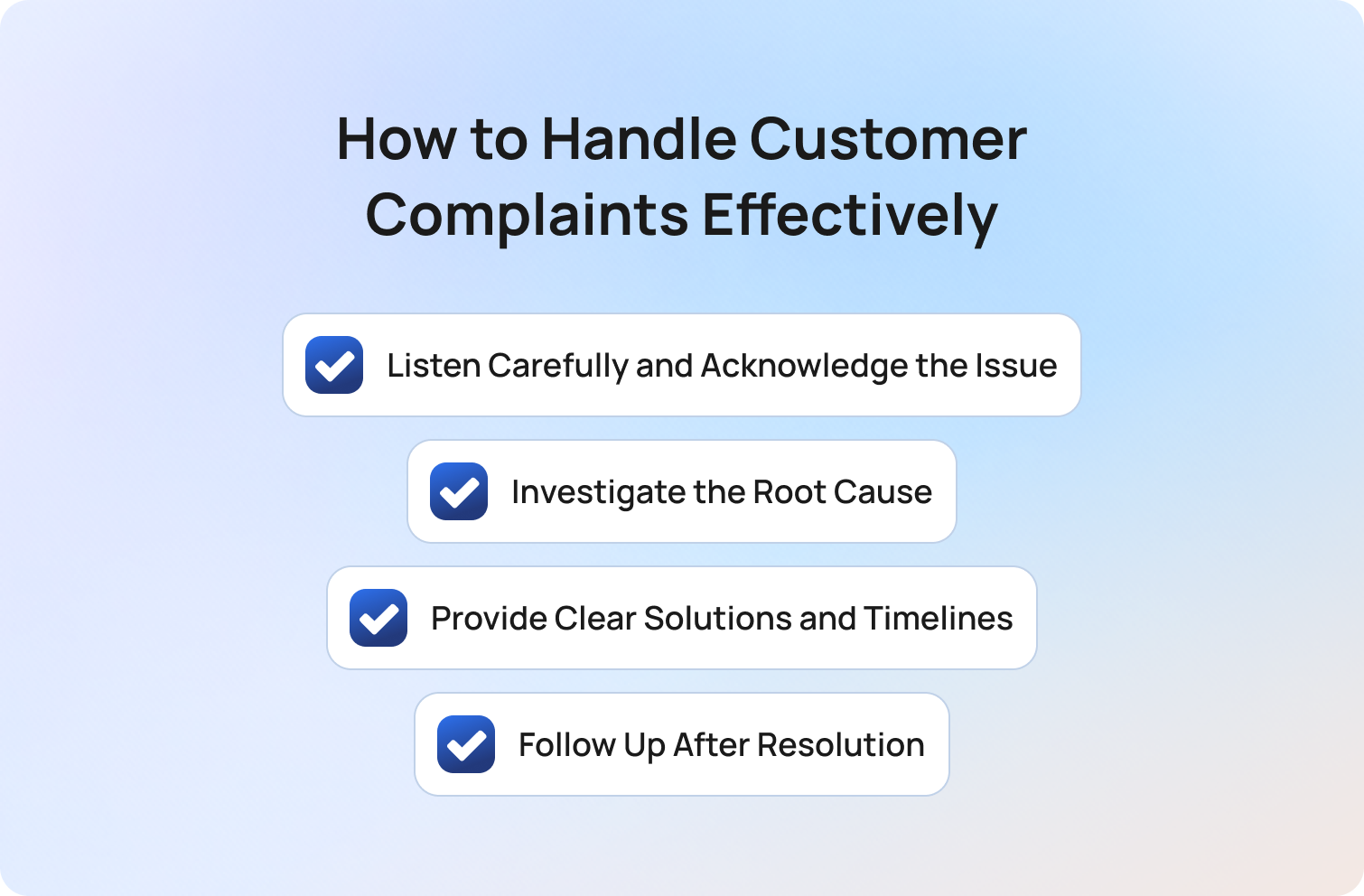
Handling customer complaints effectively requires a structured, empathetic, and consistent resolution process.
Many businesses struggle because their complaint handling process is reactive and inconsistent. Great customer service comes from creating repeatable systems that empower employees to resolve issues confidently while still delivering personalized support.
Listen Carefully and Acknowledge the Issue
The first step in how to handle a customer complaint is allowing the customer to explain the issue fully without interruption. Customers want to feel heard before they want solutions. Active listening demonstrates empathy and helps customer service representatives gather the detail needed to resolve issues accurately.
Acknowledging the issue early also helps reduce tension. Simple phrases like “I understand why that would be frustrating” or “Thank you for bringing this to our attention” can make all the difference.
Investigate the Root Cause
Complaint handling should go beyond surface-level fixes. Teams should identify whether the issue was caused by a process failure, communication breakdown, technology limitation, or training gap. This helps businesses prevent similar complaints from recurring.
For example, if customers repeatedly complain about long wait times, the problem may not be staffing alone. It could indicate poor workforce management, channel overload, or inefficient routing processes.
Provide Clear Solutions and Timelines
Customers expect transparency during the resolution process. If an issue can’t be resolved immediately, businesses should explain:
- What happened
- What actions are being taken
- When the customer can expect updates
- Who is responsible for resolving the issue
Clear communication helps manage customer expectations and reduces additional frustration. Access to a centralized customer service knowledge base also helps agents deliver faster, more consistent responses during the resolution process.
Follow Up After Resolution
Following up is one of the most overlooked parts of handling complaints.
A quick check-in after resolving complaints shows commitment to customer satisfaction and helps rebuild trust with an unhappy customer. It also gives businesses another opportunity to collect customer feedback and measure resolution quality.
How to Handle Customer Complaints in Call Center Environments
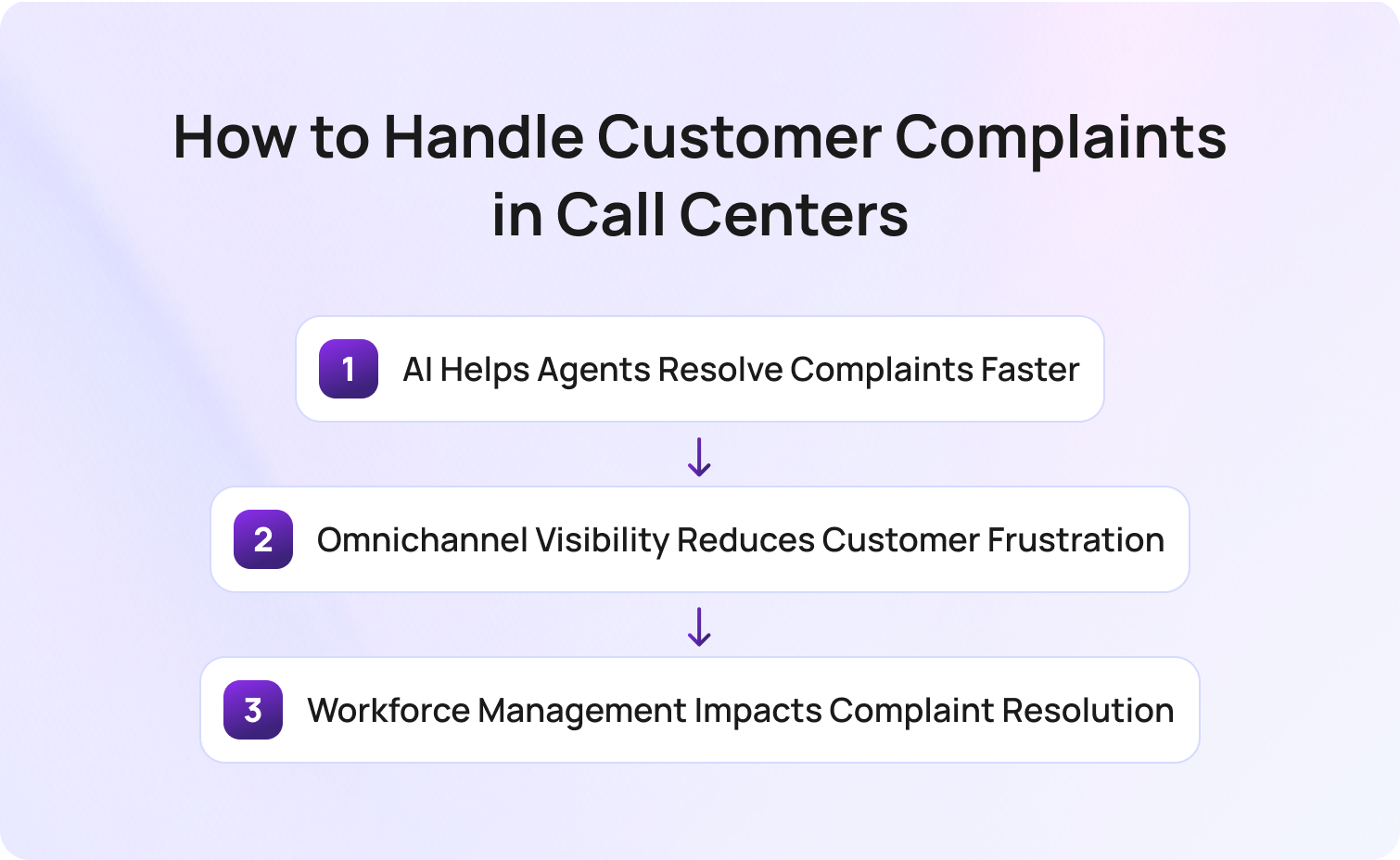
Handling customer complaints in call center operations requires balancing speed, empathy, consistency, and operational efficiency at scale. Call centers face unique challenges because agents manage high interaction volumes while attempting to maintain excellent customer service standards. This pressure often leads to rushed conversations, inconsistent responses, and poor customer experiences.
Modern contact centers increasingly use AI and analytics to improve complaint handling processes without losing the human element.
AI Helps Agents Resolve Complaints Faster
AI-powered support tools can help customer service representatives by:
- Surfacing relevant customer history instantly
- Recommending next-best actions
- Automating repetitive administrative tasks
- Detecting customer sentiment in real time
- Reducing average handling times
This allows agents to focus more on empathy, communication, and resolution quality instead of manual processes.
Omnichannel Visibility Reduces Customer Frustration
One major cause of customer dissatisfaction is repetition. Customers become frustrated when they must explain the same issue multiple times across channels.
Integrated customer experience platforms solve this by giving agents complete visibility into previous interactions across voice, email, chat, and social media through a centralized omnichannel support solution. This creates smoother experiences and improves first-contact resolution rates.
Workforce Management Impacts Complaint Resolution
Complaint handling is heavily influenced by operational planning. Poor scheduling and staffing decisions often increase wait times, overwhelm agents, and reduce service quality during peak periods. Businesses that align workforce management with customer demand can improve response times and reduce escalations significantly.
BlueTweak’s work with enterprise customer service operations demonstrates how AI-driven workforce engagement and operational analytics can improve both customer satisfaction and agent performance simultaneously.
In one customer experience transformation project, BlueTweak helped global BPO provider Conectys improve visibility across customer interactions and reduce operational bottlenecks that were contributing to inconsistent service experiences. After implementing BlueHub, Conectys achieved a 25% reduction in resolution times, a 35% improvement in customer satisfaction scores, and a 40% increase in reporting efficiency. Rather than simply accelerating response times, the focus was on giving agents better context, reducing customer effort, and identifying the root causes behind recurring complaints.
This case study demonstrates how AI-powered customer experience strategies can improve both operational efficiency and long-term customer loyalty.
Sign up for a 14 day free trial. No credit card required.
Get StartedHow to Handle Customer Complaints on Social Media
Handling customer complaints on social media requires fast responses, transparency, and brand consistency in public-facing environments. Social media complaints are uniquely challenging because other customers can see how the business responds in real-time, and a poorly handled interaction can damage the brand’s reputation quickly. At the same time, excellent complaint handling on social media can publicly demonstrate accountability and customer care.
Respond Quickly, But Thoughtfully
Customers expect fast responses on social platforms. However, speed should not come at the expense of quality. Businesses should acknowledge complaints quickly, sincerely apologize where appropriate, and explain next steps clearly.
AI-generated suggested replies can also help customer service teams respond faster while maintaining consistent brand communication across channels.
Move Sensitive Conversations to Private Channels
Public responses should remain professional and concise. If the issue involves sensitive customer data or requires deeper investigation, businesses should move the conversation into direct messages, email, or phone support while continuing to provide updates.
Maintain a Consistent Brand Voice
Customers notice inconsistencies between channels. Businesses should ensure social media teams follow the same complaint handling standards as customer support and contact center teams. Consistent communication builds trust and improves customer loyalty.
The Shift From Reactive Support to Predictive Customer Experience
Modern complaint handling is evolving from reactive customer service toward predictive, AI-driven customer experience management. This represents one of the biggest changes currently shaping customer service strategy.
Traditionally, businesses waited for complaints to happen before taking action. Today, leading organizations increasingly use AI, analytics, and customer behavior data to identify risks before customers complain at all. This includes:
- Detecting sentiment changes during interactions
- Identifying recurring service issues automatically
- Predicting churn risks
- Highlighting operational bottlenecks
- Proactively engaging dissatisfied customers earlier
This shift is becoming a major competitive advantage. According to research from Deloitte, organizations investing in AI-enhanced customer experience strategies are increasingly focused on proactive service models that improve both operational efficiency and customer satisfaction.
Customers do not expect perfection. They do expect businesses to listen, improve, and avoid making the same mistakes repeatedly. Companies that use complaints as a source of insight are often the ones that build stronger long-term customer relationships. Many organizations are now adopting automated customer interaction services to proactively engage customers earlier, reduce wait times, and identify issues before they escalate
Best Practices for Improving Complaint Handling Processes
Improving complaint handling requires both operational discipline and a customer-centric mindset.
Businesses looking to strengthen their complaint-handling processes should focus on several key areas.
| Best Practice | Why It Matters |
|---|---|
| Train customer service representatives regularly | Improves consistency and empathy |
| Use AI and analytics tools | Helps identify trends and root causes |
| Reduce wait times | Improves customer satisfaction |
| Create omnichannel visibility | Eliminates repeated customer effort |
| Collect customer feedback consistently | Supports continuous improvement |
| Monitor complaint trends | Helps prevent recurring issues |
| Empower agents to resolve issues | Speeds up resolutions |
| Personalize communication | Builds stronger customer relationships |
Strong complaint handling is not just about resolving issues. It is about creating customer experiences that strengthen trust, loyalty, and long-term brand value. Businesses using customer service analytics and reporting tools are often better positioned to identify recurring complaints, monitor service quality, and improve operational decision-making
Final Thoughts: Building Long-Term Customer Loyalty Through Better Complaint Resolution
Customer complaint handling is one of the most important moments in the customer journey because it directly shapes how customers remember a brand. Businesses that know how to handle customer complaints effectively create stronger relationships, improve customer satisfaction, and protect their brand’s reputation during difficult moments.
To achieve the most success, organizations should aim to combine human empathy with intelligent technology. By doing this, they can empower customer service teams with better visibility, faster workflows, and AI-powered insights while still prioritizing genuine communication and active listening.
When businesses treat complaints as opportunities to improve, rather than operational disruptions, they create better customer experiences across every touchpoint. In a market where customer expectations continue to rise, complaint handling is no longer simply a support function; it is a strategic driver of customer loyalty, operational improvement, and long-term business growth.
Businesses that want to improve complaint handling, reduce customer effort, and deliver more consistent customer experiences should invest in tools that combine AI, automation, analytics, and omnichannel visibility in a single platform.
To see how BlueTweak helps organizations modernize customer service operations, you can explore the platform, start a free trial, or book a personalized demo with the team.
Start your free trial now!
Start Now
Customer Support Cost Reduction AI: How Support Teams Lower Cost to Serve in 2026
Customer support cost reduction AI is most effective when it lowers operational costs without damaging customer satisfaction or service quality.
Support leaders are under pressure from every direction. Customer expectations continue to rise, interaction volumes keep growing, and leadership teams expect support operations to do more with less. The challenge is that traditional cost-cutting measures often create new problems. Reduced staffing levels can increase wait times, lower first contact resolution rates, and generate poor customer experiences that drive churn.
This is where customer support cost reduction AI has changed the conversation; rather than simply reducing headcount, AI allows support teams to automate routine inquiries, increase agent productivity, and improve customer experience simultaneously. Platforms such as BlueTweak help organizations combine conversational AI, agent assistance, workflow automation, and quality management in a way that delivers measurable efficiency gains without sacrificing service quality. Understanding how AI improves customer support is the first step towards building a credible business case for investment and so the key is understanding which costs AI can genuinely reduce, which costs remain unchanged, and how to measure savings accurately over time.
Before exploring specific AI customer support cost reduction strategies, it is important to understand where support costs actually come from.
Understanding Your Customer Support Cost Structure
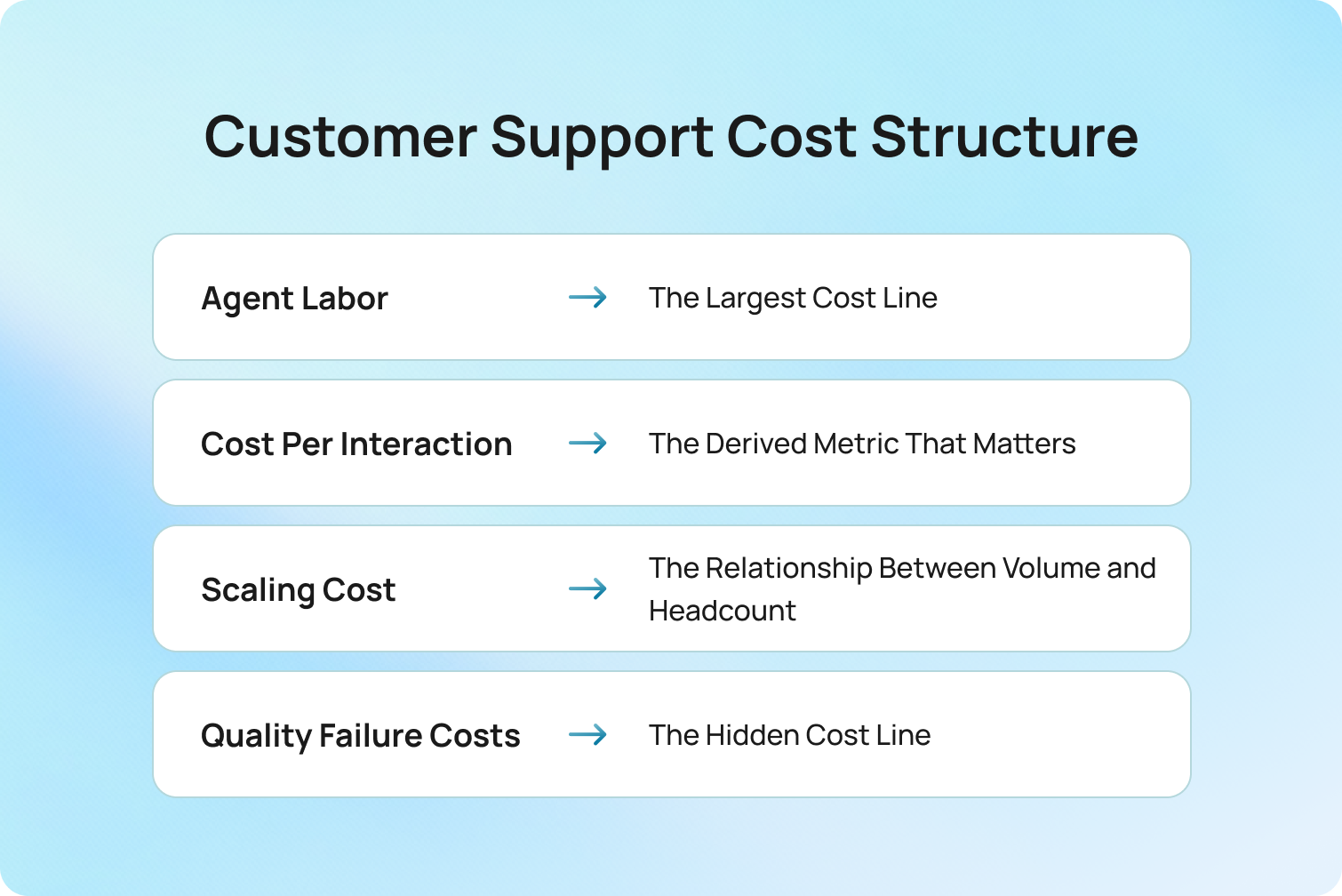
Customer support cost structure refers to the complete set of expenses required to deliver support services across all customer interactions. Many business cases fail because they start with AI capabilities instead of support economics. If leadership can’t clearly see which cost line an AI initiative affects, projected ROI becomes difficult to defend. Understanding support costs first creates a more credible foundation for any investment decision.
Agent Labor: The Largest Cost Line
Agent labor is typically the largest component of customer support costs. Research from the McKinsey Global Institute finds that today's AI technologies could theoretically automate more than half of current US work hours, with customer service roles among those most exposed, given their high concentration of repeatable, process-driven tasks. This makes labor the dominant cost driver and the primary target for efficiency improvements in support operations.
The fully loaded cost of a support agent extends well beyond salary. It includes benefits, payroll taxes, management overhead, recruitment expenses, onboarding costs, training investment, software licenses, and productivity losses associated with attrition. Many organizations underestimate support costs because they focus only on wages.
This omission matters. Deloitte Digital's 2023 Global Contact Center Survey found that 63% of contact center leaders reported facing staffing shortages, with workforce management and talent retention ranking among the top operational concerns; a picture that has persisted into more recent editions of the survey. According to research from the QATC (Quality Assurance & Training Connection) and SQM Group, annual contact center agent attrition rates commonly range from 30% to 45%, meaning the true cost of an agent seat is substantially higher than the wage bill alone.
Cost Per Interaction: The Derived Metric That Matters
Cost per interaction measures the average cost of handling a customer contact and is calculated by dividing total support costs by total interactions handled. This is the primary metric that customer support cost reduction AI influences.
AI can reduce cost per interaction in two ways. First, AI agent assist tools help support agents resolve issues faster, increasing the number of interactions handled per hour. Second, autonomous AI agents can fully resolve repetitive queries without human intervention, eliminating labor costs on those interactions entirely.
For support leaders focused on reducing customer service costs, cost per interaction is often the clearest indicator of operational efficiency.
Scaling Cost: The Relationship Between Volume and Headcount
Scaling cost describes how support costs increase as customer interaction volume grows. Without AI automation, support organizations typically scale in a linear fashion. More customers create more support requests, which require more support agents; as a result, labor costs rise alongside volume.
Customer support cost reduction AI changes this relationship. When AI agents successfully resolve high-volume, repetitive queries, the marginal cost of handling additional interactions falls dramatically. This allows organizations to support growth without proportional increases in staffing costs. Over time, these efficiency gains compound, creating significant savings that extend beyond a single budget cycle.
Quality Failure Costs: The Hidden Cost Line
Quality failure costs are the financial consequences of poor customer experiences, repeat contacts, escalations, complaints, and customer churn. These costs rarely appear in support budgets, but they can quickly outweigh short-term savings generated by aggressive cost reduction initiatives. A support team may appear more efficient after reducing staffing costs, yet increased repeat contacts and declining customer loyalty can create larger downstream losses.
Customer expectations have moved well beyond speed. Empathy, context, and consistency across interactions are now baseline expectations, and when support fails to deliver them, churn follows quickly and quietly.
PwC’s 2025 Customer Experience Survey highlights the scale of that risk: 52% of consumers surveyed said they stopped buying from a brand because of a bad experience with its products or services, while 29% stopped due to poor customer experience, either online or in person. When customer support quality declines, the resulting impact on revenue can exceed any immediate operational savings.
This is why successful AI deployments focus on both cost efficiency and maintaining high service quality. Reducing customer support costs without protecting customer satisfaction rarely produces sustainable results.
6 AI Mechanisms That Reduce Customer Support Cost to Serve
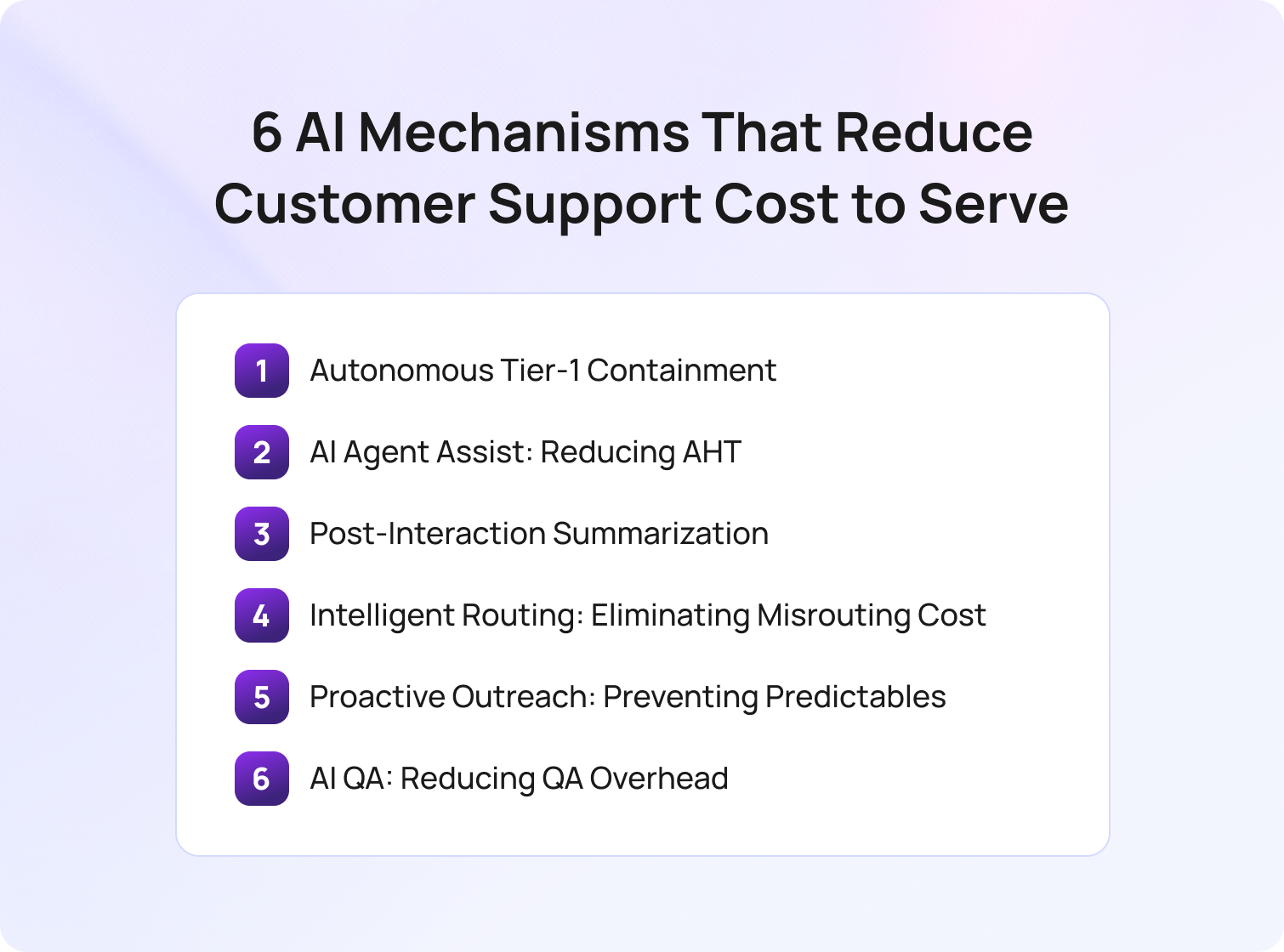
Customer support cost reduction AI reduces costs through a combination of automation, productivity improvements, and quality optimization across the support lifecycle.
Not every AI capability targets the same cost line; some reduce labor costs directly, while others lower interaction volume, improve operational efficiency, or protect against quality failure costs. The most successful deployments introduce these capabilities in a deliberate sequence rather than attempting to automate everything at once.
1. Autonomous Tier-1 Containment
Autonomous tier-1 containment uses AI agents and conversational AI for customer service to resolve routine customer queries without human intervention. The cost reduction mechanism is straightforward: every successfully contained interaction eliminates agent handle time and removes labor cost from that ticket entirely. This makes containment one of the most powerful ways to reduce customer support costs at scale.
The distinction between containment and deflection is important. A contained interaction is fully resolved by AI, while a deflected interaction simply avoids an agent, often pushing customers toward self service tools without confirming resolution. Effective deployments use confidence thresholds and escalation rules to ensure unresolved issues are transferred to human agents before customer frustration increases.
2. Intelligent Routing: Eliminating Misrouting Cost
Intelligent routing uses AI to classify customer intent, urgency, sentiment, and required expertise before assigning a support request. Misrouted interactions create hidden costs because the same issue is effectively handled multiple times. Customers are transferred between queues, agents spend time re-evaluating requests, and customers often repeat information they have already provided.
AI-powered routing reduces this waste by immediately directing interactions to the correct destination. The result is lower handling costs, improved first contact resolution, and faster service. For support leaders balancing cost reduction with customer satisfaction, routing often delivers benefits across both objectives simultaneously.
3. Post-Interaction Summarization: Eliminating Wrap-Up Time
Post-interaction summarization automatically generates structured conversation summaries immediately after a support interaction ends.
Many support teams underestimate how much time is spent on after-call work, ticket notes, and CRM updates. While each interaction may only require a few minutes of wrap-up, those minutes accumulate significantly across thousands of monthly support tickets.
By automatically creating summaries, action items, and customer records, AI eliminates repetitive administrative tasks and increases available agent capacity. An additional benefit is improved CRM data quality, which supports better reporting, forecasting, and customer experience initiatives across the business.
4.AI Agent Assist: Reducing AHT Without Reducing Quality
AI agent assist provides real-time recommendations, knowledge retrieval, suggested responses, and customer context while support agents handle interactions.
Instead of replacing human agents, agent assist improves their productivity. By reducing the time spent searching documentation, drafting replies, and locating account information, support teams can handle more customer interactions with existing staffing levels.
Research from Deloitte's State of Generative AI in the Enterprise found that nearly three-quarters of respondents reported their most advanced GenAI initiative was meeting or exceeding ROI expectations; reflecting a broader pattern of measurable productivity gains as organizations move from experimentation to deployment. Agent assist represents one of the most direct routes to that kind of operational return in support environments. Importantly, human approval remains in place for every outgoing response, ensuring service quality is maintained while handle times fall.
5. Proactive Outreach: Preventing Predictable Contacts
Proactive outreach uses AI automation to identify predictable customer concerns and communicate before a support request is created. Many support interactions are entirely foreseeable: delivery delays, payment failures, service outages, and subscription issues often generate spikes in inbound volume because customers lack information.
Rather than waiting for customers to contact support, AI can trigger personalized messages that answer likely questions before they occur. This reduces inbound ticket volume, lowers staffing costs, and improves customer experience by eliminating unnecessary effort. Customers receive updates proactively rather than needing to chase answers themselves.
6. AI QA: Reducing QA Overhead While Improving Quality Coverage
AI quality assurance automatically evaluates customer interactions against predefined quality standards and compliance criteria. Traditional QA programs typically review only a small sample of interactions because manual evaluation is time-intensive. This limits visibility and creates blind spots that allow service quality issues to persist.
AI QA enables quality coverage across 100% of customer interactions while reducing the administrative burden placed on QA teams. Coaching decisions remain human-led, but support leaders gain a far more complete view of performance trends, compliance risks, and customer experience issues. This protects both support quality and the quality failure cost line discussed earlier.
The value of these six mechanisms increases when they operate as part of a connected support ecosystem. However, many AI business cases still fail because they underestimate the operational costs required to sustain these improvements over time.
The Hidden Costs That Undermine AI Cost Reduction Projections
Hidden costs are the ongoing operational investments required to sustain AI performance after deployment.
Pre-deployment business cases often focus heavily on projected savings while giving limited attention to the operational requirements that sustain those savings over time. As a result, many support leaders discover six months after launch that containment rates have fallen, customer satisfaction has declined, or support costs have begun rising again.
The issue is not that AI failed, but that the operating costs required to maintain performance were never included in the original model.
Many of these challenges mirror the wider hidden costs of inefficient customer support systems, which often remain invisible until support costs begin to rise.
Knowledge Base Maintenance
Knowledge base maintenance is the ongoing process of keeping support content accurate, complete, and up to date.
Most modern AI-powered customer service platforms rely on retrieval-augmented generation (RAG) and an accurate customer service knowledge base to provide responses grounded in trusted company information. This means the quality of AI responses depends directly on the quality of the underlying knowledge base.
An outdated article, missing policy update, or incomplete troubleshooting guide can reduce containment rates and generate inaccurate responses. Those inaccuracies often create repeat contacts, escalations, and complaints that increase support costs rather than reduce them. Knowledge base maintenance is not an administrative overhead. It is a direct driver of customer support cost reduction AI performance and ROI.
Model Retraining and Optimization
Model optimization is the ongoing process of improving AI accuracy as customer behaviour, products, and business processes evolve.
Support environments are constantly changing. New products launch, policies are updated, customer expectations shift, and entirely new contact reasons emerge. AI models that performed well at launch can gradually become less effective if they are not reviewed and refined.
This can include intent classification updates, confidence threshold adjustments, workflow improvements, and retraining activities. Whether handled internally or by a technology partner, these activities require time and budget. Yet many cost reduction models treat AI deployment as a one-time investment rather than an ongoing operational capability.
Escalation Handling Overhead
Escalation handling overhead is the additional cost created when AI-to-human handoffs are poorly designed.
Not every customer interaction should be handled autonomously. Complex issues, sensitive situations, and high-value customers often require human intervention. The challenge is ensuring those escalations occur efficiently.
When customer context, conversation history, and previous actions are passed directly to the support agent, handle times remain low. When that information is missing, customers are forced to repeat themselves and agents must restart the discovery process. Even adding two or three minutes to every escalation can significantly increase operational costs at scale.
Failed Self-Service Follow-Up Volume
Failed self-service follow-up volume refers to customer contacts generated after an unsuccessful attempt to resolve an issue independently.
This is one of the most misunderstood costs in customer support operations.
A customer who fails to find an answer through self service often arrives at a live support channel frustrated and carrying additional context that must now be unpacked. These interactions frequently take longer to resolve than first-contact inquiries because the customer has already attempted multiple resolution paths.
This is why support leaders should be cautious when evaluating deflection metrics. Reducing immediate agent contacts is only valuable if the customer issue is actually resolved. Failed self-service can become a cost generator disguised as a cost reduction metric.
The organizations that achieve significant savings are not the ones with the highest automation rates. They are the ones that understand the full cost structure of customer support and measure outcomes rigorously. The next step is building a financial model that captures both the savings and the hidden costs before presenting a business case to leadership.
How to Calculate Customer Support Cost Reduction from AI
Calculating customer support cost reduction AI requires measuring both the savings generated and the costs incurred across the full support operation. Many ROI projections fail because they rely on vendor assumptions or isolated metrics. A credible business case should use operational data, conservative assumptions, and a clear methodology that finance stakeholders can validate.
The framework below provides a practical approach for estimating savings while avoiding the most common modelling mistakes.
Step 1: Establish Fully-Loaded Cost Per Interaction
Fully-loaded cost per interaction measures the true cost of resolving a customer contact across all support channels. The calculation should include agent salaries, benefits, payroll taxes, management overhead, software licenses, recruitment costs, onboarding costs, and attrition-related expenses.

For example, a support team with monthly operating costs of $250,000 handling 25,000 interactions would have a fully-loaded cost per interaction of $10.
This figure becomes the foundation for every subsequent cost reduction calculation.
Step 2: Model Containment Savings
Containment savings represent the labor cost eliminated when AI resolves customer queries without human intervention. The goal is to estimate how many interactions can realistically be contained and compare the cost of AI resolution against the cost of human resolution.
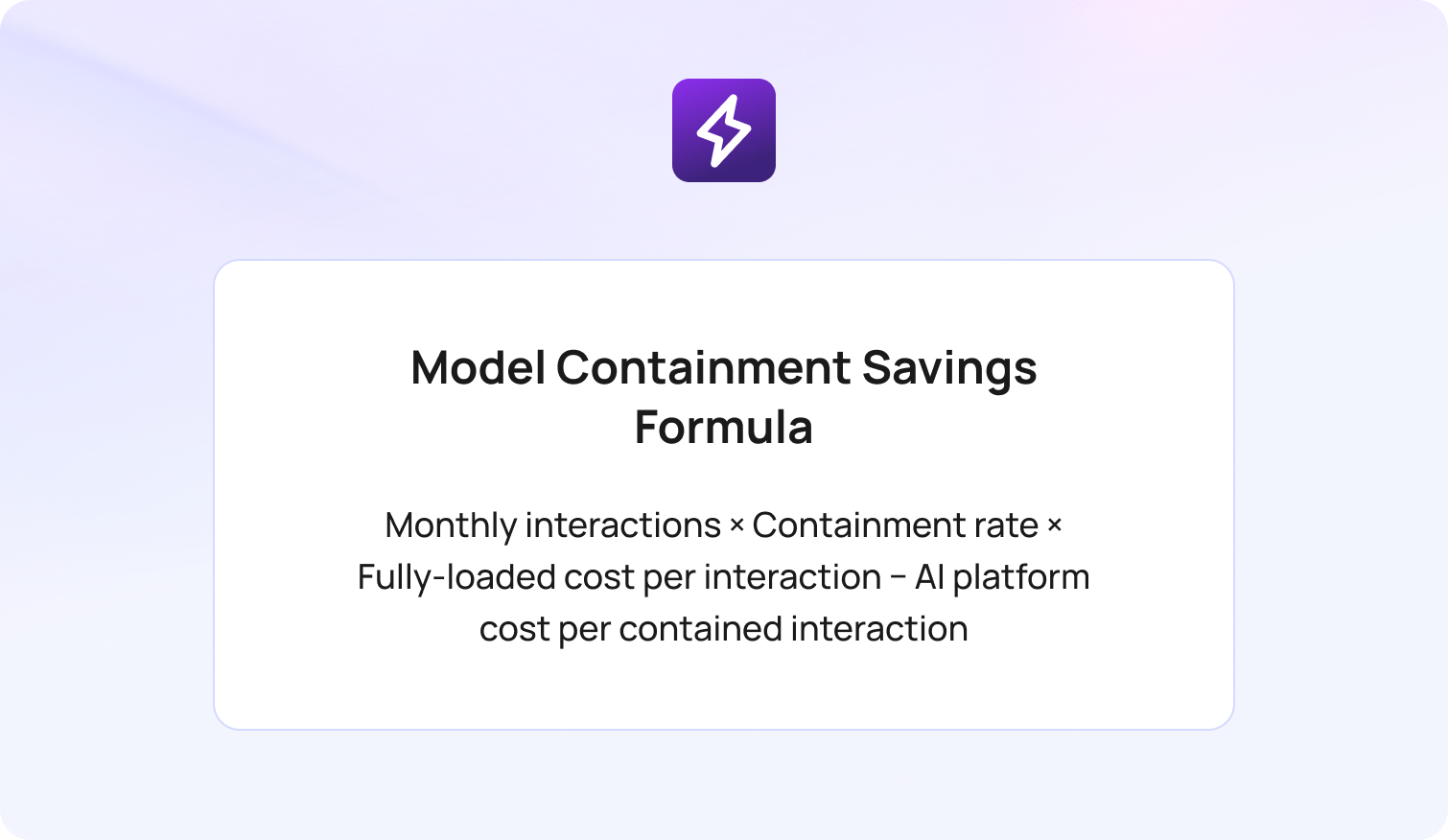
Consider a support operation handling 25,000 monthly interactions with a fully-loaded cost per interaction of $10.
| Scenario | Containment Rate | Monthly Interactions Contained | Gross Monthly Saving |
|---|---|---|---|
| Conservative | 30% | 7,500 | $75,000 |
| Mid-Range | 45% | 11,250 | $112,500 |
| Optimistic | 60% | 15,000 | $150,000 |
Industry benchmarks vary significantly depending on channel complexity, knowledge base maturity, and deployment scope. This is why support leaders should use conservative assumptions initially and refine projections as operational data becomes available.
Step 3: Model AHT Reduction Savings
Average handle time reduction savings measure the productivity gains created when AI helps agents resolve interactions faster. Agent assist, knowledge retrieval, suggested replies, intelligent routing, and automated summaries all contribute to lower handle times.
A conservative Year 1 assumption is typically a 15% to 20% reduction in average handle time. Rather than treating this as an immediate headcount reduction, organizations should model it as additional capacity that can absorb future growth, reduce overtime, or delay new hiring.
This distinction is important because capacity only becomes a financial saving once it is converted into avoided labour costs.
Step 4: Account for Hidden Costs
Hidden costs are the operational investments required to sustain AI performance after launch. Before calculating net savings, organizations should include:
- Platform licensing and infrastructure costs
- Knowledge base maintenance resources
- Model optimisation and retraining activities
- Escalation handling overhead
- Internal governance and compliance requirements
Ignoring these costs creates an inflated ROI projection that may not survive financial scrutiny. Including them creates a more realistic model and improves confidence in the business case.
Step 5: Calculate ROI and Break-Even
ROI measures the financial return generated after all costs have been considered.
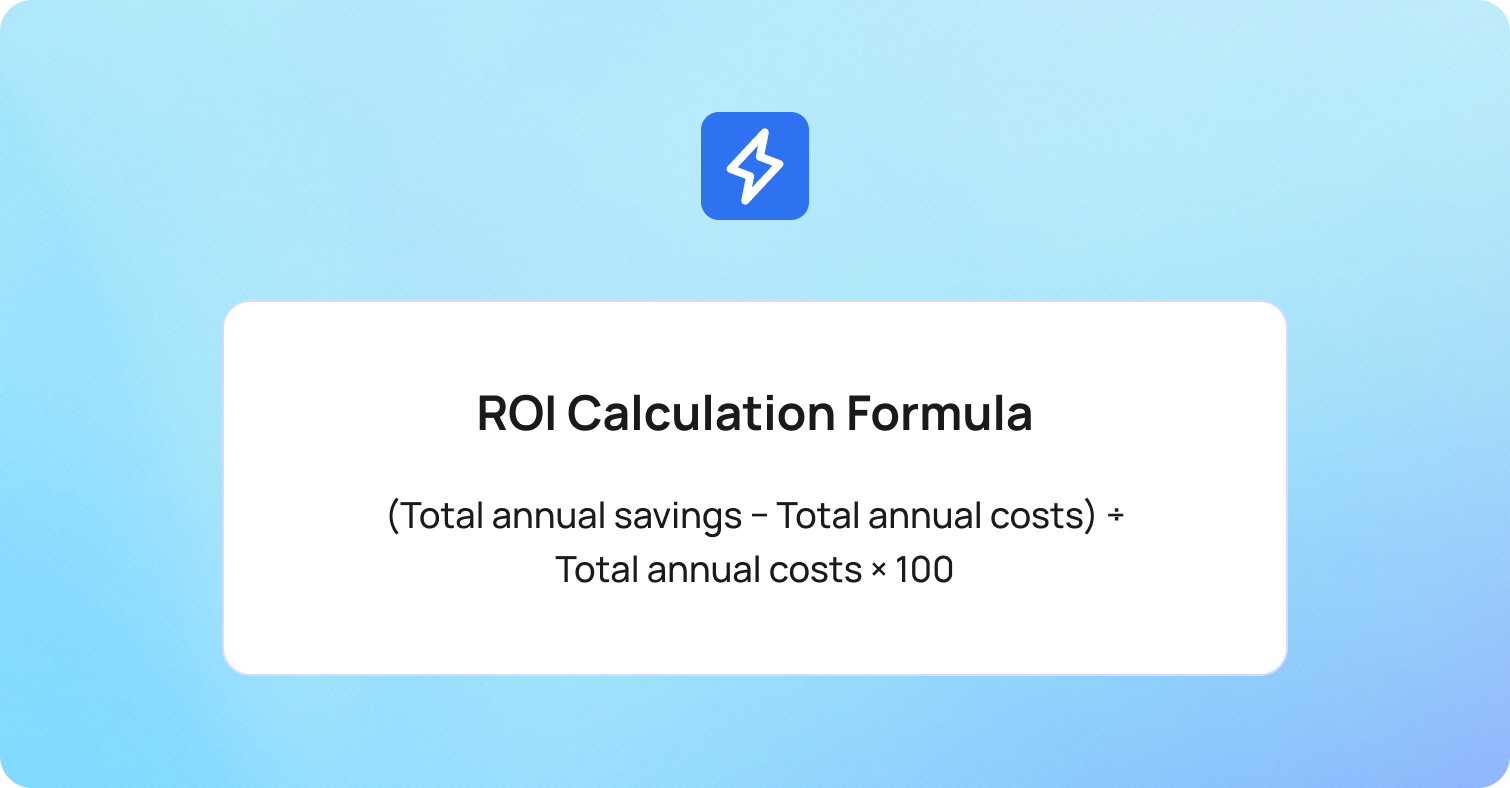
Break-even occurs when cumulative savings exceed cumulative investment.
For a well-scoped deployment operating at conservative containment rates, break-even commonly occurs within 60 to 90 days. However, timelines vary based on support volume, implementation scope, and the maturity of existing support operations.
Before presenting an AI investment proposal to leadership, it is worth pressure-testing the numbers. BlueTweak's ROI Calculator helps support leaders model containment savings, AHT improvements, hidden costs, and break-even timelines using real operational assumptions, giving finance teams a clearer picture of potential returns.
A financial model is only as valuable as the measurements used to validate it. Once AI is live, support leaders need a clear framework for determining whether projected savings are actually being realised.
Measuring Whether AI Is Actually Reducing Your Cost to Serve
Measuring customer support cost reduction AI requires tracking both cost outcomes and customer experience outcomes over time. This can be the point of make-or-break for many AI initiatives.
Most organizations have no shortage of dashboards, reports, and customer service analytics, but the problem is that they often track the wrong metrics, or track the right metrics in a way that obscures the true impact of AI. Cost reduction that appears impressive after 30 days can disappear by day 180 if containment rates fall, repeat contacts rise, or customer satisfaction declines.
Support leaders who consistently realise long-term savings focus on a small set of operational metrics that reveal whether AI is reducing costs or simply moving them elsewhere.
The 5 Metrics That Confirm Cost Reduction
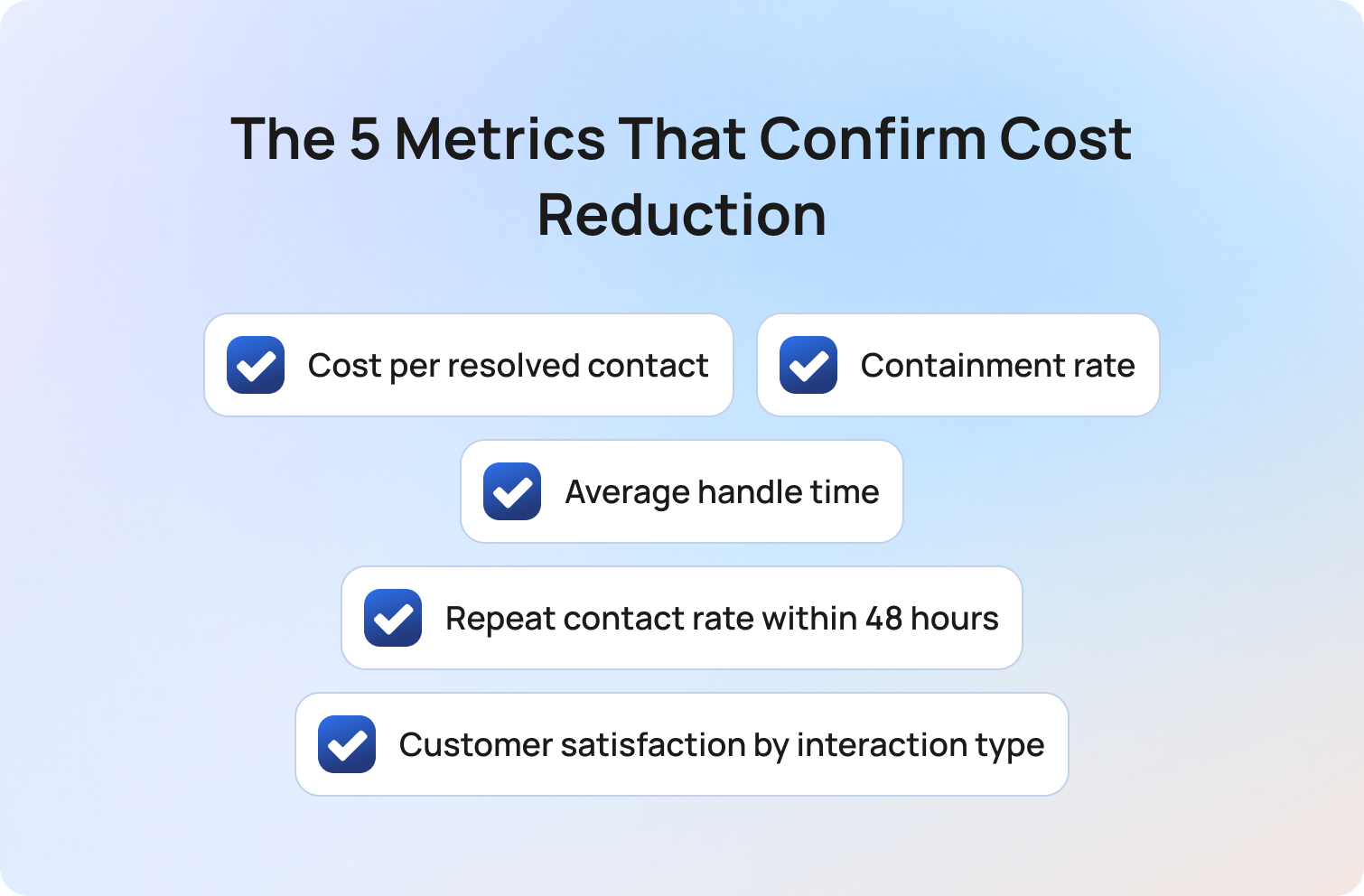
The most reliable measurement framework combines operational efficiency metrics with customer experience indicators.
Cost per resolved contact
This should be tracked separately for AI-handled and human-handled interactions. Combining both into a single average makes it difficult to understand where savings are actually being generated and whether those savings are increasing over time.
Containment rate
Containment rate measures the percentage of interactions fully resolved by AI without human intervention. This is one of the clearest indicators of AI performance because it directly reflects how many customer queries are being resolved without agent labor costs.
Average handle time (AHT)
Support leaders should separate handle time from wrap-up time when measuring AHT. This makes it easier to identify whether improvements are coming from agent assist, AI ticket summaries, workflow automation, or a combination of all three.
Repeat contact rate within 48 hours
A falling cost per interaction means little if customers are returning multiple times for the same issue. Tracking repeat contacts helps identify situations where apparent cost savings are being offset by unresolved customer needs.
Customer satisfaction by interaction type
AI-handled interactions and human-handled interactions should be measured separately. This provides a clearer view of support quality and helps identify opportunities to expand or refine automation scope.
Taken together, these metrics provide a more complete picture of whether customer support cost reduction AI is generating sustainable operational improvements.
The Three Measurement Errors That Make Savings Disappear
Measurement errors are one of the biggest reasons projected AI savings fail to materialise. While many organizations deploy capable technology, they still struggle to demonstrate ROI because the metrics they report to leadership do not accurately reflect operational performance.
The following mistakes appear repeatedly in post-deployment reviews.
Deflection vs. containment
Deflection measures whether customers avoided contacting a human agent. Containment measures whether the customer's issue was actually resolved.
A customer who abandons a chatbot session, leaves a self-service portal, or postpones contacting support may count as deflected in some reporting models. If that same customer returns later with the same issue, no meaningful cost reduction has occurred.
Containment should always be the primary metric because it reflects successful resolution rather than temporary avoidance.
Blended CSAT
Blended customer satisfaction scores can hide emerging service quality issues. For example, AI may successfully remove repetitive queries from agent queues, allowing support agents to spend more time on complex cases. Human-handled CSAT may improve as a result.
At the same time, AI-handled interactions could be generating lower satisfaction scores. When both groups are combined, the decline can remain hidden for months. Measuring customer satisfaction separately for AI and human interactions provides a more accurate view of customer experience.
Counting headcount savings before they exist
AHT reduction creates capacity, but capacity is not the same thing as savings.
Many business cases assume that a 20% productivity improvement immediately translates into a 20% reduction in staffing costs. In reality, the additional capacity often absorbs future growth, reduces overtime, or improves service levels before any direct labor savings appear.
Support leaders should only count headcount savings once they are reflected in avoided hiring, reduced contractor spend, or lower staffing costs.
“The biggest mistake organizations make is treating AI metrics as proof of ROI. A chatbot can have a high deflection rate and still increase support costs if customers come back later with the same issue. The only metrics that matter are the ones that connect operational efficiency with customer outcomes. If containment, cost per resolved contact, and customer satisfaction are all moving in the right direction together, the savings are real.”
This is where a finance-led approach to AI becomes essential. The focus shouldn’t just be on reducing contacts or automating routine tasks, but on reducing customer support costs while maintaining high service quality and protecting long-term customer loyalty.
Understanding what to measure is only half of the equation. The next step is selecting a platform that can deliver these improvements while providing the visibility required to prove ROI from day one.
How BlueTweak Helps Reduce Customer Support Costs at Scale
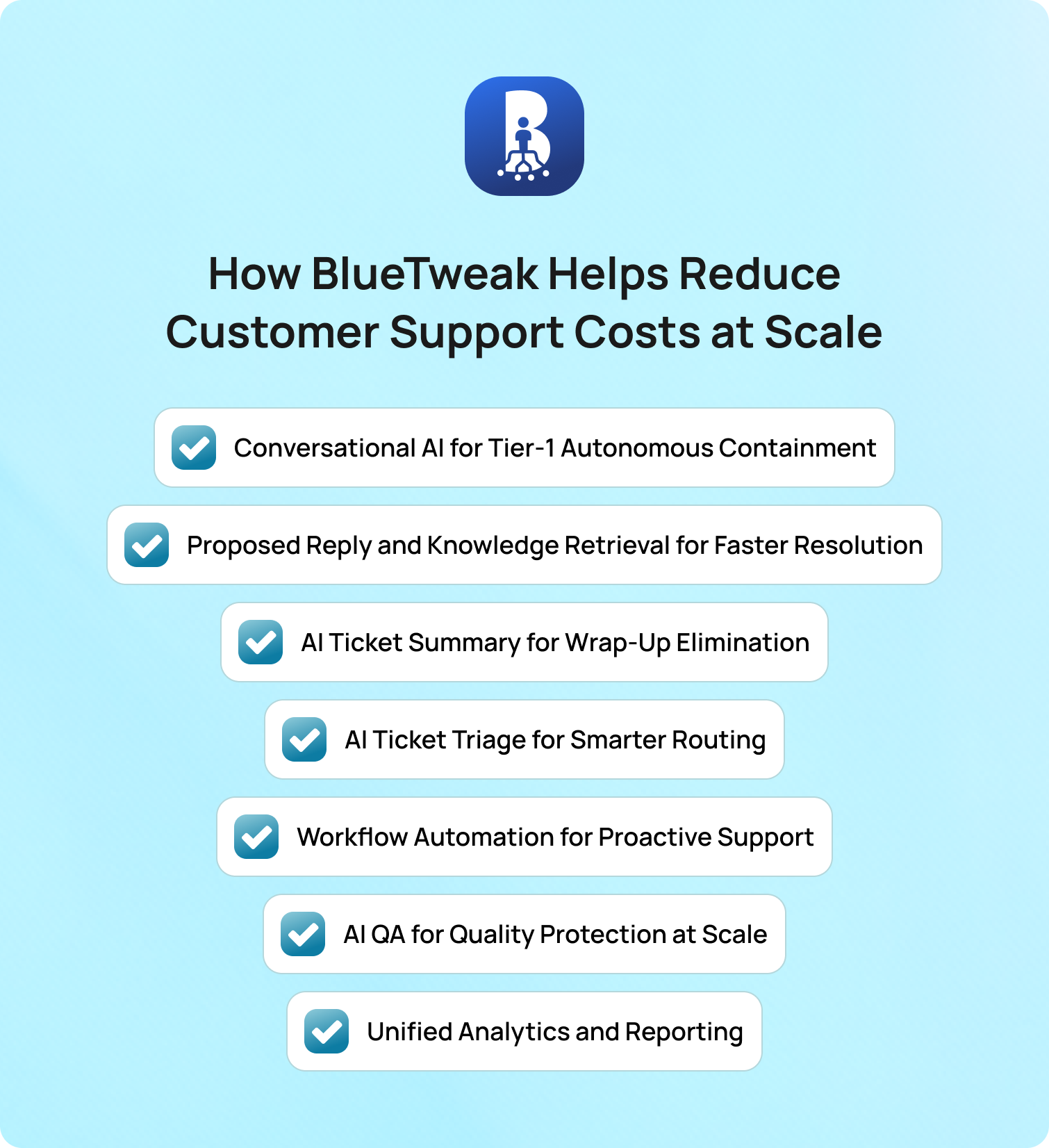
BlueTweak helps organizations reduce customer support costs by combining AI automation, agent productivity tools, workflow optimization, and quality management within a single platform.
Many support teams adopt multiple point solutions to address different operational challenges. One tool handles chat automation, another manages quality assurance, a third supports workflow automation. While each may deliver value individually, fragmented systems often create disconnected data, inconsistent reporting, and missed optimisation opportunities.
BlueTweak takes a different approach by connecting the six cost reduction mechanisms discussed throughout this article within a unified ecosystem.
Conversational AI for Tier-1 Autonomous Containment
BlueTweak's Conversational AI enables organizations to automate routine customer queries while maintaining clear escalation paths for complex issues.
By resolving repetitive requests autonomously, support teams can reduce cost per interaction, lower agent workload, and improve response times. Confidence thresholds and escalation workflows help ensure customers receive human intervention when required, protecting both service quality and customer satisfaction.
Proposed Reply and Knowledge Retrieval for Faster Resolution
BlueTweak's Proposed Reply and knowledge retrieval capabilities provide support agents with relevant information and draft responses in real time.
This reduces time spent searching documentation, improves consistency, and enables agents to resolve customer interactions more efficiently. The result is lower average handle time, greater agent productivity, and improved operational efficiency without sacrificing support quality.
AI Ticket Summary for Wrap-Up Elimination
BlueTweak's AI Ticket Summary automatically generates structured interaction summaries as soon as a conversation ends.
Removing manual note-taking reduces wrap-up time and increases available agent capacity across every interaction. It also improves CRM data quality, making reporting, forecasting, and customer journey analysis more accurate.
Combined with broader support ticket automation initiatives, summarization helps eliminate repetitive administrative work and improve operational efficiency.
AI Ticket Triage for Smarter Routing
BlueTweak's AI Ticket Triage analyses customer requests and routes them to the most appropriate team or specialist.
By reducing misrouting and unnecessary transfers, support teams can improve first contact resolution rates, reduce handling costs, and deliver faster service. Customers reach the right person sooner, while agents spend less time reprocessing requests that should have been routed elsewhere.
Workflow Automation for Proactive Support
BlueTweak's workflow automation capabilities help organizations identify predictable customer issues and communicate proactively.
Whether notifying customers about service disruptions, payment failures, delivery delays, or account updates, proactive support reduces inbound ticket volume and prevents avoidable contacts from reaching support queues in the first place.
AI QA for Quality Protection at Scale
BlueTweak's QA module evaluates customer interactions automatically, providing broader coverage than traditional sampling-based approaches.
Support leaders gain visibility into quality trends across the entire operation, enabling faster coaching, improved compliance monitoring, and more consistent customer experiences. This helps protect the quality failure cost line while reducing QA overhead.
Unified Analytics and Reporting
BlueTweak's customer service analytics and reporting analytics capabilities bring cost, quality, and operational performance metrics together in a single view.
Rather than relying on custom dashboards built across multiple systems, support teams can track containment rates, cost per resolved contact, customer satisfaction, and operational performance from one platform. This makes it easier to measure progress, identify optimisation opportunities, and demonstrate ROI to leadership.
The value of this approach is reflected in real-world deployments. For example, BlueTweak's work with Aeroitalia helped streamline customer support operations through intelligent automation and improved service workflows, demonstrating how operational efficiency and customer experience improvements can be achieved simultaneously.
Most importantly, BlueTweak makes customer support cost reduction measurable from day one. The metrics that matter most, including containment rate, cost per resolved contact, and customer satisfaction by interaction type, are tracked natively within the platform rather than requiring extensive reporting workarounds.
Final Thoughts: Sustainable Customer Support Cost Reduction Starts with Measurement
Customer support cost reduction AI works because it targets multiple cost lines simultaneously. Autonomous containment reduces the cost of routine interactions. Agent assist improves productivity. Intelligent routing, workflow automation, and AI QA eliminate operational inefficiencies while protecting service quality.
The organizations that achieve significant savings are not necessarily the ones with the most automation. They are the ones that understand their cost structure, account for hidden costs from the outset, and build a measurement framework before deployment begins. By tracking containment, cost per resolved contact, repeat contact rates, and customer satisfaction together, support leaders can demonstrate sustainable ROI rather than short-term improvements that fade over time.
If you're evaluating AI customer support cost reduction strategies, the next step is seeing how these capabilities perform in your own environment. Start a 14-day free trial with no credit card required to explore BlueTweak's AI-powered support platform firsthand, or book a demo to see how BlueTweak can help your team reduce customer support costs while maintaining high service quality.
Start your 14 day free trial today. No credit card required.
Get Started
Top 15 Customer Support Challenges in 2026 (& How to Solve Them)
What Makes a Customer Support Challenge Hard to Solve?

Most customer support challenges are not caused by a single failure. They are caused by a combination of volume growth outpacing process design, technology gaps that force manual workarounds, and measurement blind spots that hide problems until they are already affecting customer satisfaction and retention.
The result is that customer service teams spend time fixing symptoms: slow response times, low FCR, and inconsistent service quality, without addressing the root causes behind them. Poor routing logic, incomplete knowledge bases, and no automated oversight at scale.
This article addresses both. Each challenge below includes the root cause, the KPI it damages, and the specific fix. According to Salesforce's State of Service report, 80% of customers say the experience a company provides is as important as its products. Bad customer service is not usually the result of bad intentions. It is the result of customer service problems that were never properly diagnosed or resourced. Most of the challenges below are the reasons that the gap exists between stated values and customer reality.
Note on hypothetical customer support challenge examples: Where this article uses scenarios to illustrate a challenge, they are composites drawn from common patterns rather than specific organisations. A hypothetical customer support challenge is useful for illustrating the root cause, but the fixes described are operational and applicable to real teams today.
Customer Support Challenges at a Glance
| Challenge | Root Cause | Primary KPI Impact | Fix Category |
|---|---|---|---|
| High ticket volume | Volume growth without automation | AHT, response time, concurrency | AI automation |
| Slow response times | Manual routing, understaffing | First response time, CSAT, and abandon rate | Routing + WFM |
| Inconsistent quality | No QA at scale; agent variability | CSAT, FCR, repeat contact rate | AI QA + coaching |
| Agent burnout | Repetitive tasks, poor tooling, poor scheduling | Attrition, CSAT, absenteeism | Automation + WFM |
| Lack of customer context | Siloed customer data, no unified profile | AHT, FCR, repeat contact rate | CRM integration |
| Poor knowledge management | Outdated or incomplete KB | Containment rate, FCR, AHT | KB maintenance |
| Channel fragmentation | Separate tools per channel | FCR, CSAT, response time | Omnichannel platform |
| Scaling without losing quality | No automated oversight at volume | CSAT, QA coverage, error rate | AI QA + HITL |
| Poor AI deployment | Wrong use cases, missing oversight | Containment, CSAT, customer trust | HITL framework |
| Misaligned KPIs | Measuring volume over quality | CSAT, FCR, agent engagement | Metrics redesign |
| Reactive rather than proactive service | No triggered outreach system | Inbound volume, CSAT | Proactive outreach |
| Handling angry customers poorly | No real-time sentiment guidance | CSAT, churn, escalation rate | Sentiment AI + training |
| Ticket routing failures | Rules-based routing breaks on paraphrase | FCR, AHT, misroute rate | AI routing |
| Data silos and poor integration | Separate tools with no unified view | AHT, FCR, data accuracy | Platform consolidation |
| Self-service that does not help | Incomplete KB; AI not grounded in content | Inbound volume, containment rate | KB grounding + AI chatbot |
The Top 15 Customer Support Challenges in 2026: How to Fix Them
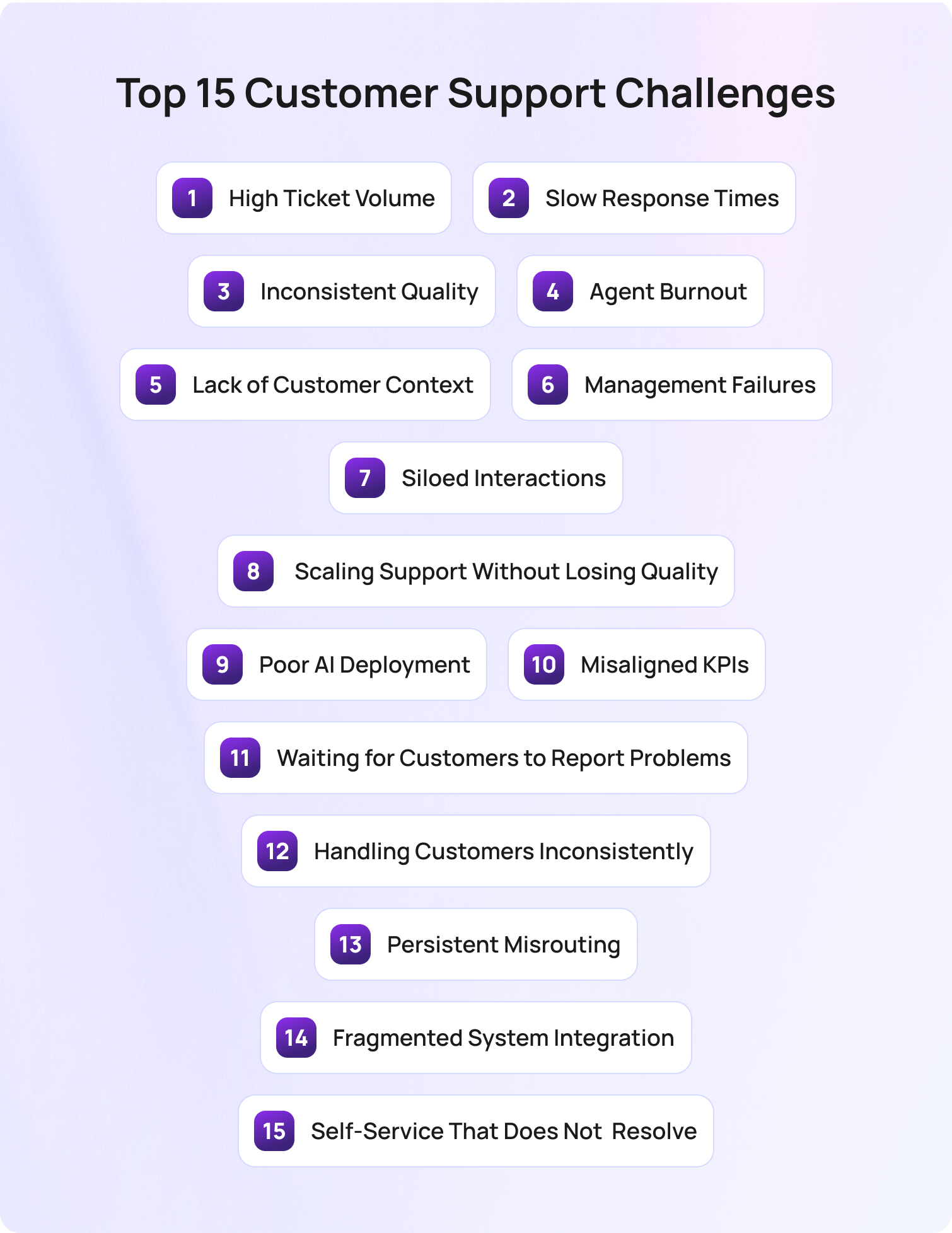
Each challenge below follows the same structure: what the challenge is, the root cause behind it, the KPI it damages, and the specific fix. Where AI capabilities are the solution, the fix names the specific tool to deploy.
1) High Ticket Volume Overwhelming Agent Queues
The challenge. Total inbound contact volume exceeds what customer service representatives can handle without backlogs, extended wait times, and quality shortcuts. This is the pressing customer service challenge most teams encounter first as they grow. Multiple customers submitting customer inquiries simultaneously, across multiple communication channels, creates concurrency pressure that manual workflows cannot absorb.
Root cause. Volume growth was not matched with automation for tier-1 queries. Support agents handle customer interactions that AI could resolve at a fraction of the cost and with higher consistency. The customer service process was built for lower volume and never redesigned.
KPI impact. AHT, response time, abandon rate, and agent concurrency.
The fix. Deploy a RAG-grounded conversational AI chatbot and voicebot to resolve repetitive tickets instantly before they reach agents. Target customer requests where the correct answer is definitive: FAQs, order status, password resets, and account queries. This lets agents focus on complex, high-value customer conversations where human judgment matters. Measure containment rate, not deflection rate. A deflected customer who follows up is a cost transfer, not a resolution.
For a deeper look at how AI removes volume pressure without sacrificing quality, read how AI improves customer support.
2) Slow Response Times Across Channels
The challenge. Customers expect fast answers, particularly on digital channels where expectations are highest. Slow response times are the single most cited driver of customer satisfaction decline in customer service research, and one of the most common reasons customers switch to a competitor. Frustrated customers who wait too long do not stay frustrated silently; they escalate, churn, or leave public feedback that damages your brand's reputation.
Root cause. Manual routing sends customer interactions to the wrong team or into long queues. No prioritisation logic means urgent customer requests wait alongside routine ones. Understaffing during peak periods compounds both. Most common customer service challenges around response times trace back to a customer service process that was not designed to handle current communication channels at the current volume.
KPI impact. First response time, CSAT, and abandon rate.
The fix. Intelligent routing that assigns incoming interactions by intent, urgency, and skill in real time. Pair with WFM forecasting to staff peaks accurately rather than reactively. Teams that address routing and scheduling together see the fastest improvement in response times. For the metrics that reveal where response time is breaking down, see the customer service analytics guide. Providing seamless support across multiple channels also requires that each channel is monitored with equal priority, not siloed into separate queues where some customer calls sit unanswered.
3) Inconsistent Quality Between Agents and Channels
The challenge. Customer satisfaction varies significantly by agent, shift, and channel. Customers receive different quality depending on who picks up the interaction and where. Dissatisfied customers who experienced inconsistent service quality on one channel often abandon that channel entirely. This inconsistency, one of the most common customer service challenges, is often invisible until it shows up in aggregate metrics, by which point customer loyalty has already been affected.
Root cause. No standardised QA at scale. Manual QA reviews only 5 to 15 percent of customer interactions. Ongoing training covers the process but not real-time quality guidance during live interactions. Customer service agents struggle to maintain consistent service quality when they have no live feedback mechanism and no standard for what good customer service looks like in practice.
KPI impact. CSAT, FCR, repeat contact rate.
The fix. AI QA scoring across 100% of interactions to identify patterns that manual sampling misses. Proposed reply standardises response quality during live customer conversations by surfacing KB-grounded responses agents can review and send. Both tools improve service quality and reduce the gap between best and worst performers, creating more consistent, excellent customer service regardless of who is handling the interaction.
4) Agent Burnout and High Turnover
The challenge. Customer service agents experience high stress, cognitive fatigue, and disengagement, leading to attrition that disrupts service quality and increases recruitment and training costs. Contact centre attrition rates frequently exceed 30% annually. When experienced agents leave, customer service representatives who remain absorb additional volume, accelerating the cycle.
Root cause. Repetitive tasks drain cognitive capacity with no intellectual reward. Poor tooling forces service agents to search for answers manually during every customer interaction. Unpredictable scheduling creates peak-period overload and makes it harder for agents to maintain a positive customer experience under pressure.
KPI impact. Attrition rate, CSAT, absenteeism, quality scores.
The fix. Automate repetitive tasks, particularly tier-1 customer inquiries, to remove them from agent queues. Give agents focus on complex, nuanced customer conversations where their skills are genuinely needed. Surface answers instantly during interactions, so agents stop searching. Use Workforce Management to create predictable, manageable workloads. The right tools make the difference between a customer service department that retains its best people and one that constantly replaces them.
5) Lack of Customer Context During Interactions
The challenge. Customer service agents start each interaction without full visibility of the customer's history, previous contacts, account status, or open issues, forcing customers to repeat themselves and agents to ask questions the system should already answer. Customers expect to be known. When a customer feels like a stranger every time they contact support, it signals bad customer service, regardless of how well the agent performs in the moment.
Root cause. Customer data is siloed across CRM, ticketing, and commerce platforms with no unified view in the agent workspace. Full customer journey visibility requires manually switching between tools. Without a unified customer profile, agents cannot deliver the customer context that makes interactions feel personalised and efficient.
KPI impact. AHT, FCR, CSAT, repeat contact rate.
The fix. A unified customer profile that centralises customer data and surfaces full interaction history, account data, and open tickets before the agent responds, providing instant access to the complete customer journey from a single workspace. The customer should never have to repeat themselves. When agents have full customer context from the first message, handle time drops, FCR improves, and the customer experience shifts from transactional to genuinely good customer service.
6) Knowledge Management Failures
The challenge. The knowledge base is incomplete, outdated, or too difficult to search quickly during live customer interactions, leading to inconsistent and inaccurate responses across the team. For customer service agents, this is one of the most damaging customer service problems: they want to give the right answer, but the right tools to find it are not there.
Root cause. KB ownership is unclear. Updates are reactive rather than proactive. Agents do not have a structured way to flag gaps in real time, so customer pain points accumulate silently in the gap between what customers ask and what the KB can answer.
KPI impact. FCR, AHT, containment rate.
The fix. Assign KB ownership with a defined review cadence. Deploy a RAG-grounded knowledge base that AI queries in real time during customer interactions, surfacing the right article at the right moment. Ongoing training should include regular KB updates so customer service representatives always have accurate, current answers. KB quality is the single most important prerequisite for AI accuracy in customer support and for outstanding customer service at scale.
7) Channel Fragmentation and Siloed Interactions
The challenge. Customer interactions across email, chat, social, voice, and messaging are managed in separate tools across multiple channels. Agents have no single view. Customers receive inconsistent experiences depending on which communication channels they use and which agent picks it up. Managing customer expectations across multiple communication channels is impossible when each channel operates independently.
Root cause. Channels were added incrementally to solve individual problems. Each tool has its own customer data, routing logic, and reporting, with no unified customer thread across them. Most customer service challenges around channel consistency trace back to this fragmented infrastructure.
KPI impact. FCR, CSAT, response time, repeat contact rate.
The fix. An omnichannel inbox that unifies all communication channels in one agent workspace with full customer history, regardless of channel. This enables seamless support across multiple channels without requiring customers to restart their customer journey every time they switch contact methods.
8) Scaling Support Without Losing Quality
The challenge. As customer interaction volume grows, consistent service quality declines. The oversight processes that worked at lower volume cannot keep pace. Support teams focus on throughput and quality monitoring, which falls behind one of the most critical challenges experienced in customer support operations as they scale.
Root cause. Manual QA, manual coaching, and human-led oversight do not scale proportionally with volume. When teams grow, quality review coverage shrinks as a percentage of total customer interactions. Customer service practices that worked for 50 agents do not translate to 200.
KPI impact. CSAT, QA coverage rate, error rate, and customer trust.
The fix. Automated QA scoring at 100% coverage maintains oversight regardless of volume. Human-in-the-loop AI frameworks keep humans in control of the interactions that require judgment while AI handles the oversight data collection that makes that judgment possible. To improve service quality at scale, support teams need measurement infrastructure that scales with volume, not manual processes that break under it. The customer service analytics guide covers how to build that measurement layer.
9) Poor AI Deployment Automation That Damages CX
The challenge. Customer service teams deploy AI across interaction types it cannot handle reliably, producing inaccurate responses that damage customer trust and generate repeat contacts that cost more to resolve than the original interaction. This is one of the most avoidable critical challenges experienced in customer support today because the failure pattern is well-documented and preventable.
Root cause. Automation scope is set too broadly at launch. Oversight thresholds are not configured. The distinction between AI-appropriate customer requests and those that require human judgment is not made before go-live. Customer service agents struggle to recover trust after customers have already experienced poor AI responses.
KPI impact. Containment rate, CSAT, repeat contact rate, customer trust.
The fix. Deploy AI only on high-confidence tier-1 customer inquiries initially. Configure escalation triggers for emotional, complex, and compliance-sensitive interactions before launch. Review the scope quarterly as AI performance data accumulates. Poor AI deployment is a customer service process failure, not a technology failure. Exceptional customer service from AI requires the same scoping rigour applied to human agent workflows.
See how BlueTweak's AI Empowerment tools are designed with this in mind.
10) Misaligned KPIs: Measuring Volume Over Quality
The challenge. Customer service teams track and reward volume metrics, such as calls handled and tickets closed, that incentivise speed over resolution quality. The result is declining FCR and customer satisfaction as customer service representatives optimise for throughput rather than outcomes. Teams cannot measure customer satisfaction accurately when the KPIs they use do not reflect what satisfied customers actually look like in the data.
Root cause. KPI frameworks were designed for cost reduction rather than a positive customer experience. Quality metrics exist but are not tied to agent recognition, ongoing training, or team goals. Most customer service challenges around quality are sustained by measurement systems that were never updated to reflect a customer-centric culture.
KPI impact. FCR, CSAT, agent engagement, attrition.
The fix. Reframe team KPIs around FCR, customer satisfaction, and containment rate. Use AI performance analytics to identify patterns across quality and volume separately. To measure customer satisfaction accurately, track how satisfied customers are after the first contact, not how many contacts were processed.
For the full list of customer service metrics that matter in 2026, the BlueTweak customer service analytics guide covers benchmarks and measurement frameworks. You can also use the BlueTweak ROI calculator to quantify what misaligned KPIs are costing your operation.
11) Reactive Support Waiting for Customers to Report Problems
The challenge. Customers contact support because they were not informed before they needed to ask. Avoidable inbound volume is generated daily on predictable trigger events, such as service outages, delivery delays, and payment failures, for which support teams have the data to anticipate. A reactive customer service department is structurally incapable of managing customer expectations because it always responds after the customer's frustration has already formed.
Root cause. No system for triggered proactive outreach. The customer service process is entirely reactive by design, waiting for the customer to initiate contact before addressing a known issue. Communicating proactively requires a workflow that does not exist in most teams.
KPI impact. Inbound contact volume, CSAT, and repeat contact rate.
The fix. Communicate proactively using AI-triggered messaging for order updates, delivery alerts, payment failures, and service outages. When support teams address customer pain points before customers need to ask, inbound volume drops, customer loyalty increases, and the customer experience shifts from damage control to genuine value.
Use the BlueTweak ROI calculator to estimate how much avoidable inbound volume is costing your team, and read how AI improves customer support for the full proactive outreach framework.
12) Handling Angry Customers Inconsistently
The challenge. Handling angry customers is one of the most common customer service challenges and one of the most consequential. Emotionally charged customer interactions are handled inconsistently, often escalating rather than resolving. Frustrated customers and dissatisfied customers who escalate and do not get a resolution are the highest churn risk in any customer base. Customer service agents struggle to detect the emotional shift in real time and adapt their approach before the situation deteriorates.
Root cause. No real-time sentiment detection in the customer service process. De-escalation training is delivered in onboarding and not reinforced in the moment when it actually matters. Ongoing training alone cannot replicate the in-the-moment guidance agents need when a customer feels unheard.
KPI impact. CSAT, churn rate, escalation rate.
The fix. AI sentiment analysis that flags emotional distress during live customer conversations and surfaces guidance for the agent in real time. Catching the shift in customer sentiment before it escalates is significantly less costly than recovering from a complaint. Agents who can address customer concerns in the moment before the customer feels dismissed deliver outcomes closer to exceptional customer service than those working without real-time support.
13) Ticket Routing Failures and Persistent Misrouting
The challenge. Customer interactions reach the wrong team or wrong skill level, requiring transfers that add handle time and frustrate customers who already explained their issue once. For dissatisfied customers, being transferred is often the moment they decide the brand's reputation for good customer service is undeserved. Routing failures are one of the most persistent customer service problems in teams that have grown without updating their routing infrastructure.
Root cause. Rules-based routing relies on keyword matching that breaks when customers phrase their requests in unexpected ways. New query types emerge without triggering a routing rule update because no one owns the customer service process for routing maintenance.
KPI impact. FCR, AHT, misroute rate, customer frustration.
The fix. AI-powered routing that classifies intent, sentiment, and required skill from natural language in real time across multiple channels. No manual rule updates needed when new query types emerge. For the case for AI-driven ticket routing over rules-based systems, the linked article covers the operational and scalability arguments.
14) Data Silos and Fragmented System Integration
The challenge. Support data lives in separate platforms: CRM, ticketing, commerce, and analytics, with no unified operational view. Agents lose time switching tools. Reporting is fragmented. Decisions are made on incomplete customer data. One of the most common customer service challenges in scaling organisations is that the customer service department operates without a single source of truth.
Root cause. Tools were added incrementally to solve isolated problems without considering the data architecture required to centralise customer data for unified support operations. Integration was always the next project.
KPI impact. AHT, FCR, data accuracy, reporting quality.
The fix. Platform consolidation that brings ticketing, AI, analytics, WFM, and customer profile data into one workspace, giving agents instant access to the complete customer journey without switching tools. For teams not ready for full consolidation, explore BlueTweak's contact center integrations for the integration architecture and priority order.
15) Self-Service That Does Not Actually Resolve Customer Issues
The challenge. Self-service options exist but fail to resolve customer queries, generating inbound contacts from customers who have already tried to help themselves and got nowhere. The frustration from a failed self-service attempt makes the follow-up interaction harder to resolve and leaves the customer feeling that the brand's customer service experience is deliberately unhelpful. Improving self-service options is one of the most high-leverage fixes available to support teams managing high inbound volume.
Root cause. KB content is incomplete or not surfaced effectively. AI chatbots are not grounded in the KB and generate inaccurate responses that erode customer trust in the self-service channel. Self-service options cannot address customer concerns that they were never trained to answer.
KPI impact. Inbound volume, containment rate, CSAT for bot-handled interactions.
The fix. RAG-grounded AI chatbot that retrieves accurate KB content rather than generating from a base model. Regular KB review to close content gaps. For a guide to building an AI-powered customer support knowledge base, see the BlueTweak Smart Knowledge Base page, which covers both the architecture and the maintenance cadence. Teams that improve self-service options alongside proactive outreach see the greatest reductions in avoidable inbound volume.
For more on AI-driven self-service done right, see how AI improves customer support.
How BlueTweak Solves the Most Common Customer Support Challenges
Most customer support challenges in 2026 are not people problems. They are customer service process and tooling problems that capable people cannot overcome with effort alone. Building a customer-centric culture starts with giving support teams the right tools, and removing the friction that prevents them from delivering excellent customer service.
Almost every customer service challenge we see traces back to one of two things: volume that the team was never set up to handle efficiently, or quality oversight that stopped scaling when the team started growing. The fix in both cases is the same. You need the right AI capabilities deployed against the right interaction types, with the right measurement in place from day one.

BlueTweak addresses the root causes behind the challenges above in a single unified platform. Conversational AI removes tier-1 volume from agent queues and helps resolve repetitive tickets instantly. The omnichannel inbox eliminates channel fragmentation across all communication channels. The QA module enables 100% interaction scoring to maintain consistent service quality at scale.
Analytics surfaces quality and volume metrics in the same view, making it straightforward to identify patterns and address customer concerns before they compound. WFM forecasting prevents understaffing-driven quality failure. The suggested reply workflow keeps humans in control of sensitive customer interactions while AI reduces the cognitive load of every other one.
Final Thoughts
Most customer support challenges in 2026 share the same root causes: volume outpacing automation, quality oversight not scaling with volume, and fragmented tools creating customer data gaps that support agents cannot overcome manually, whether you are dealing with slow response times, inconsistent service quality, agent burnout, or failed self-service options. The fix in most cases follows the same logic: the right AI capabilities deployed against the right customer interaction types, measured on the right KPIs, with human oversight maintained where it matters most.
A customer-centric culture is not built through mission statements. It is built by removing the customer service problems that prevent good customer service from happening, and giving support teams the right tools, visibility, and AI capabilities to address customer concerns consistently at scale.
Start your free trial today and see how BlueTweak addresses your biggest customer support challenges from day one.
Start your free trial now
Start Now
Biggest Challenges Training AI for Customer Support Intent Recognition (2026)
What Is Intent Recognition Training in Customer Support?

Customer intent recognition in customer support is the process of teaching AI models to classify what a customer wants from their message accurately enough to trigger the right automated action or route the interaction to the right human agent.
Understanding how AI intent recognition works starts with the training data. The model maps customer input to a predefined intent category using natural language processing NLP and natural language understanding to interpret human language as it actually appears in real-world customer conversations. In practice, that training data consists of historical support tickets, live chat transcripts, voice call transcripts, and email threads, each labelled with the intent they represent: refund request, account access issue, shipping query, cancellation, escalation, and so on.
Support is a harder domain to train for than most other NLP applications. Customer queries are often incomplete, emotionally charged, or phrased in ways that do not map to any clean category. The vocabulary shifts constantly as products change. Customer expectations are high: people expect the AI system to understand their needs without requiring them to repeat themselves.
And unlike a closed-domain task like booking a flight, customer intent in support can range from a simple password reset to a complex complaint spanning account status, customer history, and several previous interactions.
If you want to understand how conversational AI detects customer intent once the model is live, that is covered separately. This article is about what makes training that model hard in the first place.
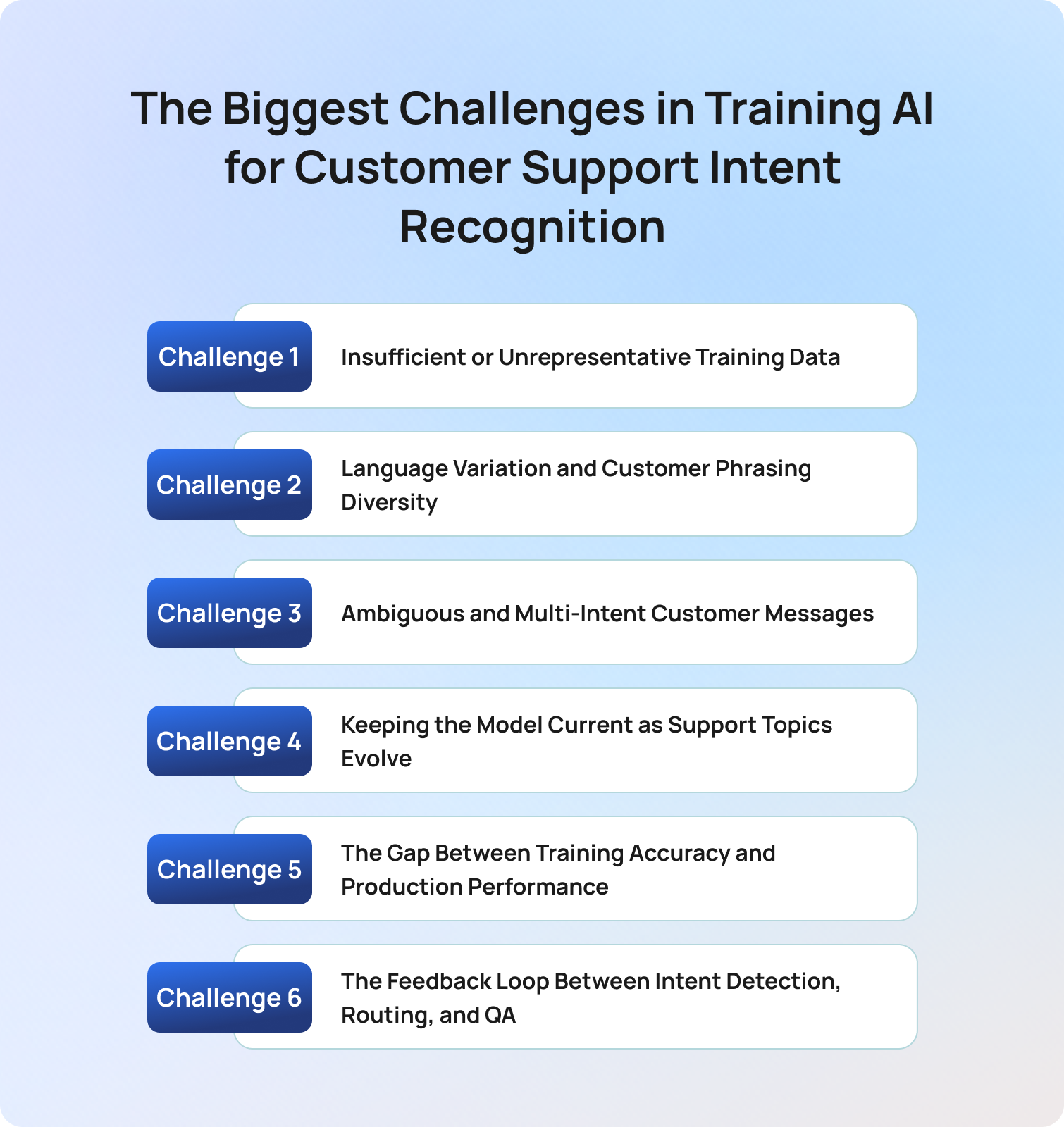
Challenge 1: Insufficient or Unrepresentative Training Data
The most common root cause of intent model failure is not a flaw in the algorithm. It is a flaw in the data the algorithm was trained on.
The cold start problem
When a support team launches a new product, opens a new communication channel, or handles a new category of customer inquiry for the first time, there is no historical data to draw from. The model has never seen these customer interactions before.
This cold start problem forces teams into an uncomfortable choice: deploy with no coverage for the new intent class, guess at how customers will phrase queries and build synthetic examples, or wait until enough real interactions accumulate before training. During that waiting period, every interaction in the new category is misrouted or unhandled.
The class imbalance problem
Most support queues are dominated by a handful of high-frequency customer requests: password resets, billing queries, order status checks. These intents are well-represented in training data. Rare but high-value intents (churn signals, escalation triggers, compliance-sensitive requests) have far fewer examples.
A model trained on imbalanced data learns to classify the common intents reliably and performs poorly on the rare ones. The result is that the interactions most in need of accurate intent detection are the ones the model handles worst.
The labelling quality problem
Support tickets used as training data are labelled by human agents, and agents are inconsistent. One agent writes "refund request." Another writes "wants money back." A third writes "billing dispute." All three map to the same customer intent, but the model sees three different labels.
Poor labelling quality introduces noise that degrades classification accuracy regardless of how sophisticated the underlying machine learning models are. The fix requires minimum sample thresholds per intent class before deployment, active learning loops that surface uncertain classifications for human review, and a labelling quality audit before each retraining cycle.
Customer feedback and user feedback captured post-interaction are also valuable insights for identifying which intent classes produce inaccurate responses. Teams that route this signal back into training achieve accurate intent recognition significantly faster than those relying on internal labels alone.
The connection between labelling quality and first contact resolution is covered in depth in the AI ticket classification guide, which is worth reading before you define your intent taxonomy.
Challenge 2: Language Variation and Customer Phrasing Diversity
Customers do not describe their problems the way a training dataset expects. This is one of the most persistent challenges in training AI for customer support intent recognition and one of the least discussed.
Paraphrase variation
Consider these four messages: "My package hasn't arrived." "Where is my order?" "I've been waiting two weeks and nothing has shown up." "Is my delivery lost?"
All four map to the same customer intent: a delivery status query. But a model trained on one phrasing pattern and tested on another will misclassify real-world customer conversations at a rate that aggregate accuracy scores hide.
Paraphrase augmentation during training, specifically generating alternative phrasings for each intent class, is the standard fix. Pre-trained language models, which have been exposed to broad human language patterns, significantly reduce this problem compared to models trained from scratch on a narrow support corpus. AI-powered intent recognition that draws on diverse training corpora is better at recognizing intent across the full range of ways businesses interact with their customers.
Channel-specific language
The way a customer phrases something on live chat differs from an email, a voice call, or a social media message. Chat messages tend to be short and colloquial. Emails are longer and more formal. Voice transcripts include false starts, filler words, and incomplete sentences.
A model trained on email transcripts and deployed on voice or chat will underperform, not because the intent is different but because the surface form of natural language varies by channel.
Voice channels introduce speech recognition outputs with transcription noise and incomplete sentences. Sentiment analysis adds a further layer: customers expressing frustration and customers making neutral factual requests may use near-identical phrasing, and a model without sentiment analysis capability cannot distinguish between them. Chat channels reflect informal customer behavior and abbreviated phrasing. Each channel expresses the same underlying customer needs and customer preferences differently.
Omnichannel customer support operations that handle customer interactions across multiple communication channels need intent models trained on channel-stratified datasets, or at a minimum, evaluated separately by channel to surface where accuracy degrades.
Multilingual support complexity
For teams providing multilingual support, the phrasing variation problem compounds further. The same customer intent expressed in French, Dutch, and Portuguese will produce very different input tokens. Regional dialects and code-switching (customers mixing languages mid-message) add a layer that many intent detection models are not trained to handle.
The result is that multilingual customer interactions are systematically underserved by models trained predominantly on one language.
Challenge 3: Ambiguous and Multi-Intent Customer Messages
Single-intent classification models fail most visibly on the customer interactions that matter most. Complex queries are also the ones most likely to contain ambiguous or multiple intents.
Ambiguous intent
"I need help with my account" contains no deterministic classification signal. The model must either attempt a classification based on the most common account-related user intent it has seen, ask the customer a clarifying question, or escalate to a human agent.
Guessing wrong triggers a misroute. Asking a clarifying question adds friction. Escalating everything with low confidence is expensive.
Understanding how intent detection works handles this ambiguity is what separates AI-powered systems that provide relevant responses from those that produce detected intent errors at scale. The solution is a properly calibrated confidence threshold: if the model's confidence score falls below a defined level, the interaction goes to a human agent rather than being auto-routed. Most teams deploy without tuning this threshold, which means the model assigns classifications even when it should not.
Multi-intent messages
Customers frequently combine intents in a single message. "I want to cancel my subscription, but first I need a refund for last month's charge" contains two separate customer requests requiring two separate workflows. Most intent classification models are trained to output a single label per input. On a multi-intent message, the model either classifies on the dominant intent and ignores the secondary one, or fails on both.
The BlueTweak Intent Hierarchy Model addresses this by classifying primary and secondary intent slots separately, ensuring that both the cancellation workflow and the refund request are captured and routed without requiring the customer to send two separate messages.
Virtual assistants and virtual agents that handle multi-intent queries correctly enable better customer interactions and free human agents to focus on more complex tasks rather than recovering from misrouted tier-1 queries.
Intent drift across a conversation
In longer customer conversations, intent can change. A conversation that starts as a delivery query can shift to a complaint, then to a refund request, as the customer learns more about what happened.
Models trained on single-turn inputs do not handle this shift reliably. Conversation-level context windows that re-evaluate intent as new customer input arrives are required for accurate intent detection in complex, multi-turn interactions. Contextual understanding of the full customer journey is what makes intent recognition technology reliable in practice rather than in controlled tests.
Context-aware AI suggested replies are one practical output of getting this right: the system can respond appropriately because it is tracking how customer intent shifts across the conversation, not just what was said in the first message.
Challenge 4: Keeping the Model Current as Support Topics Evolve
A model trained on last year's support tickets degrades the moment the product, policy, or customer base changes. Concept drift, the gradual shift in the statistical distribution of live traffic away from the training distribution, is one of the most underestimated challenges in training AI for customer support intent recognition.
How concept drift accumulates
New products launch and introduce customer queries that the model has never classified. Policies change and shift the language customers use to describe their problems. Seasonal events such as a peak shipping period, a billing cycle change, or a product recall generate spikes in query types that the training data does not represent.
Each of these events erodes model accuracy silently. There is no error message. Misclassifications are assigned with the same confidence as correct ones.
Most teams retrain on a scheduled cadence: quarterly or biannual cycles driven by the calendar rather than performance signals. Accuracy degradation accumulates between cycles, and the team only discovers the problem when customer satisfaction scores drop or escalation rates rise.
Enhancing customer satisfaction and customer engagement through AI-driven customer service requires continuous learning. The model must improve as customer behavior evolves, not just when the next calendar retrain is scheduled.
The new intent category problem
When a genuinely new intent emerges (a new product fault, an unexpected policy change, a public incident generating a spike in a specific type of customer query) the model has no class for it. It routes the new query as the closest approximation from its existing intent taxonomy.
Which is often wrong. And which generates handle time, repeat contacts, and dissatisfied customers before anyone notices the misroute pattern.
The fix is live customer service analytics that monitor per-intent accuracy in real time, with automated alerts that trigger retraining when a specific intent class drops below threshold, and a fast-path process for adding new intent categories before misrouted tickets accumulate.
Challenge 5: The Gap Between Training Accuracy and Production Performance
A model that achieves 92% accuracy in testing can perform significantly worse in production. This is one of the most common and most avoidable failures in AI-powered customer support deployments in 2026. It is not a model quality problem. It is an evaluation methodology problem.
Distribution shift between test and production
Test data is drawn from the same historical corpus as training data. It represents the past. Production traffic includes edge cases, new customer phrasings, and query types that emerged after the training cutoff. The model was never exposed to them.
Accuracy on a historical test set tells you how well the model performs on data that looks like your training data. It tells you very little about how it performs on the next six months of live customer interactions.
The wrong evaluation metric
Overall accuracy is a poor metric for intent classification in customer support. A model that correctly classifies 95% of high-frequency intents but fails on 40% of rare ones looks excellent in aggregate. It is not. The interactions it gets wrong are disproportionately likely to be the high-value, high-sensitivity ones: churn signals, escalation triggers, compliance queries that most require accurate routing.
Evaluating intent detection models on per-intent precision and recall, not overall accuracy, surfaces these failure patterns before they reach production. Precision measures how often the model is correct when it assigns a given label. Recall measures how often it correctly identifies a given intent when it is present. Both matter. Neither is visible in an aggregate accuracy score.
Miscalibrated confidence thresholds
Deploying without a properly calibrated confidence threshold means the model assigns classifications at high confidence even when it is uncertain. A customer input that genuinely falls between two intent categories gets assigned to one of them as if the classification were clear. The routing system acts on that. The customer arrives at the wrong team. The agent sees a misrouted ticket with no flag that the AI system was uncertain.
The result is not just a failed interaction. It is an operational costs problem, because recovering a misrouted interaction costs more than handling it correctly the first time. Accurate intent recognition is the foundation of accurate responses, personalized responses, and the operational efficiency that customer expectations increasingly demand.
Per-intent confidence threshold calibration, which means setting different escalation thresholds for different intent classes based on the cost of a misclassification, is standard practice in well-deployed support ticket automation systems. It is rarely implemented at first deployment and rarely revisited after.
Challenge 6: The Feedback Loop Between Intent Detection, Routing, and QA
Intent recognition does not operate in isolation. Its output feeds the routing system, which feeds the QA process, which generates the data that should feed back into the next training cycle. When that loop is broken, training failures propagate downstream and accumulate silently.
How misclassified intent reaches the customer
A routing system that relies on intent labels from an underperforming model sends interactions to the wrong team. Agents receive tickets outside their skill area. Handle time increases. Customer satisfaction drops. First contact resolution falls.
How well an AI customer support platform handles the routing integration layer is one of the clearest differentiators between systems that work in production and ones that look good in a demo.
The customer in this scenario does not know that an AI system misclassified their request. They know they explained their problem, were transferred, and had to explain it again. What they experience is bad service. What the data shows is a rising escalation rate that no one has attributed to an intent classification problem.
The customer journey breaks not at the moment of human intervention, but at the moment the AI agent made a silent misclassification that no one caught. Customer service teams that surface these failures quickly are the ones that recover fastest.
Human agents as an underused training signal
Every time a human agent overrides an AI classification by reassigning a ticket to a different category, transferring an auto-routed interaction, or escalating a query the AI system marked as tier-1, they are creating a labelled training example. The model got it wrong. The agent corrected it. That correction is the most accurate signal available for improving accurate intent classification over time.
AI agents and virtual agents that improve through this loop reduce the volume of queries requiring human intervention, freeing agents to focus on complex tasks where judgment genuinely matters: from account status disputes to queries that resemble tailored financial advice more than a standard FAQ resolution.
Most teams do not have a structured process for capturing these overrides as training data. The corrections happen. The improved labels are never fed back into the retraining pipeline. The same misclassification pattern repeats in the next deployment cycle.
QA as a retraining signal
AI quality assurance scoring across 100% of interaction surfaces, interactions where the AI system performed poorly: wrong routing, poor response quality, unnecessary escalation. These QA flags are the richest available signal for identifying which intent classes are underperforming in production.
Teams that feed QA data back into their training pipeline close the feedback loop that makes continuous improvement practical rather than aspirational.
Tracking per-intent performance metrics through a proper customer service analytics layer is what turns QA flags into actionable retraining signals rather than numbers on a dashboard no one acts on.
How BlueTweak Handles Intent Recognition Training Challenges
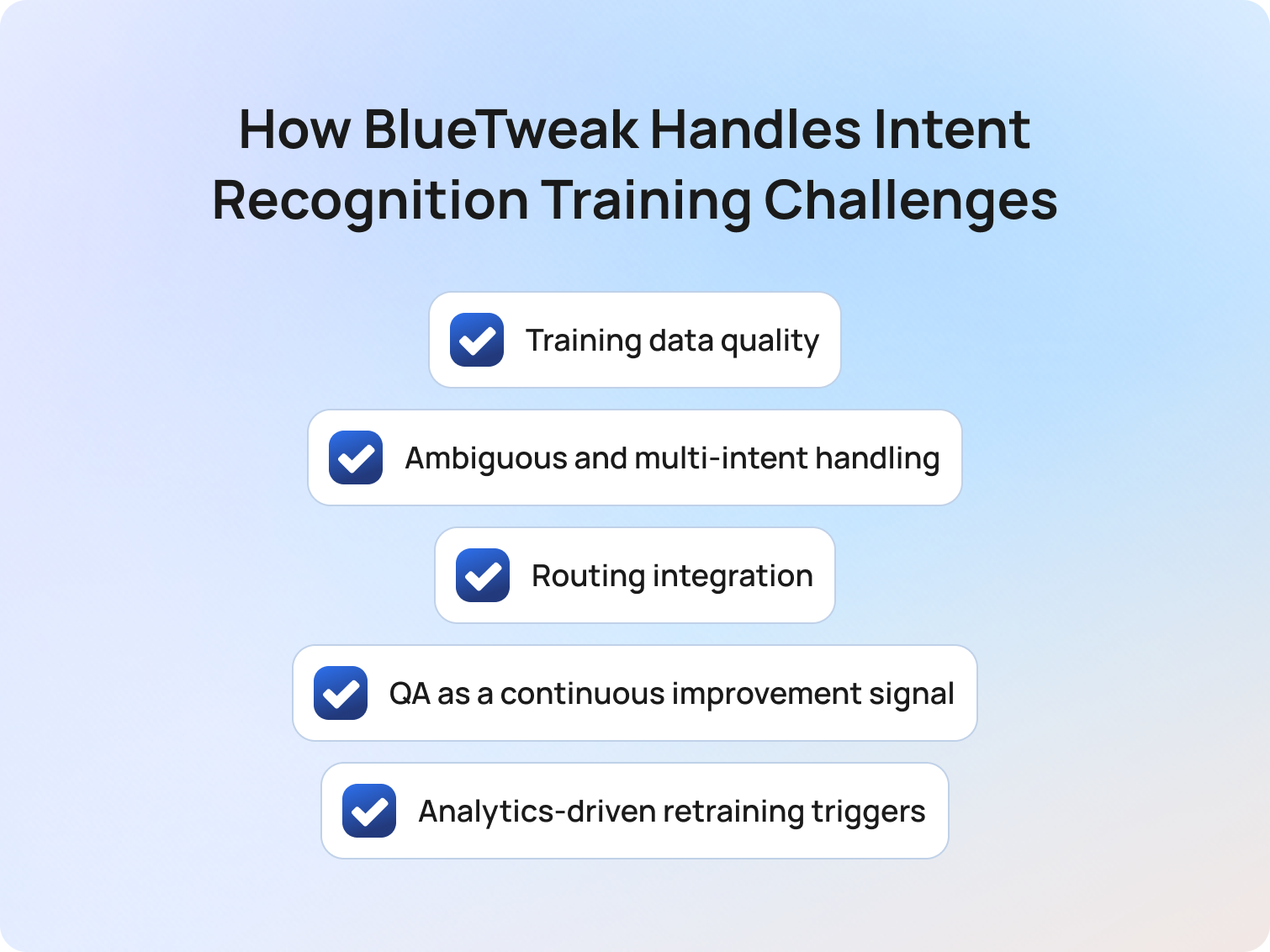
Most of the challenges above trace back to the same structural gap: intent recognition is treated as a one-time deployment problem rather than an ongoing operational discipline. Train the model, launch it, move on. BlueTweak is built on the premise that AI-powered customer support requires the same continuous learning commitment as the human teams it supports.
Training data quality. BlueTweak's conversational AI is grounded in support-specific interaction data rather than general-purpose language corpora, reducing the distribution mismatch that causes production degradation. The Smart Knowledge Base provides the structured content layer that grounds automated responses in verified information, reducing the gap between what the model classifies and what it can actually resolve.
Ambiguous and multi-intent handling. BlueTweak's confidence scoring and escalation triggers prevent low-confidence classifications from reaching the customer as if they were certain. When customer intent is ambiguous, the interaction is routed to a human agent rather than being misclassified. Virtual agents handle tier-1 interactions where intent is clear and consistent. Human agents focus on the complex queries where contextual understanding and judgment are required.
Routing integration. Intent classification output connects directly to the AI Ticket Triage system, closing the loop between classification and routing correction. Agent overrides are captured as labelled training signals rather than lost as one-off corrections.
QA as a continuous improvement signal. The QA module scores 100% of interactions, not the 5 to 15% that manual review covers. QA flags on misrouted or poorly resolved interactions surface directly as retraining candidates rather than disappearing into an aggregate satisfaction score.
Analytics-driven retraining triggers. Rather than retraining on a calendar schedule, BlueTweak surfaces per-intent accuracy signals through the analytics and reporting layer. Teams see when a specific intent class starts underperforming before that degradation affects CSAT or escalation rates.
The teams that get the most out of AI in customer support are not the ones with the most sophisticated models. They are the ones with the tightest feedback loops. Every misclassification is a training example. Every agent correction is a signal. The system gets better only if you build the infrastructure to capture those signals and act on them.
Intent classification is one piece of a larger picture. How AI improves customer support across the full operation is worth reading alongside this.
Final Thoughts
The challenges in training AI for customer support intent recognition are not technology problems. They are data quality problems, evaluation methodology problems, and operational discipline problems.
Insufficient training data, language variation, ambiguous customer intent, concept drift, the test-production gap, and broken feedback loops are all fixable with the right process, the right measurement infrastructure, and the right commitment to treating intent recognition as an ongoing practice rather than a one-time deployment.
Customer service teams that build this discipline see the key benefits compound over time: more accurate intent classification, better routing, higher first contact resolution, and customer interactions that feel genuinely responsive rather than mechanically routed. AI-powered intent recognition that learns continuously is what enables businesses to meet customer needs at scale and deliver exceptional customer experiences.
The customer experience does not improve because the model is smarter. It improves because the model keeps getting better.
If you want to go deeper into what happens once the model is deployed, how conversational AI detects customer intent in real time covers the full detection pipeline.
Start your free trial and see how BlueTweak handles intent recognition against your own support data.
Start your free BlueTweak trial
Start Today
Customer Support Automation ROI: How to Measure What Matters
Why Most Customer Support Automation ROI Numbers Are Wrong

Let's start with the honest version of this conversation, because in 2026, most customer service operations teams are working with customer service ROI projections that will not survive contact with reality. Measuring customer service ROI accurately is harder than vendors make it look, and the gap between what gets promised and what gets delivered is almost always a measurement problem, not a performance problem.
That is not a technology problem. Automation genuinely delivers a significant return when it is deployed well and measured correctly. The problem is the measurement methodology, which inflates early results, hides long-term performance problems, and sets teams up to explain why the numbers looked better in the proposal than they do six months in.
Three measurement errors account for most of it.
Deflection Rate Is Not Containment Rate
This is the single most common and most consequential measurement error in support automation. Deflection rate counts the number of sessions that ended inside the bot without escalating to a human agent. Containment rate counts the number of contacts that reached a full resolution without the customer following up on any channel within 24 hours.
A customer who used the bot, got an incomplete answer, and then sent an email is counted as deflected. They are not contained. They generated two contacts instead of one. Most customer service AI and AI customer service automation vendor dashboards report deflection by default, because deflection is the metric that makes customer interactions look resolved faster than they are.
Cost Per Ticket Ignores Resolution Quality
Dividing the total support operating cost by the total tickets closed produces a number that falls when automation closes more tickets, even when automation is creating repeat contacts by failing to resolve the underlying issue. A team with a bot generating failed self-service attempts will show a lower cost per ticket and declining customer satisfaction scores simultaneously. Improved customer satisfaction and service quality are moving in opposite directions from the cost metric, while the cost metric flatters the deployment. The metric looks good. The operation is getting worse.
Headcount Savings Are Counted Before They Exist
Reducing average handle time by 20% does not automatically reduce headcount by 20%. It creates capacity. Real headcount ROI requires either a hiring freeze applied against projected growth or an actual reduction in force. Both are real outcomes, but they take time and deliberate management decisions to materialise. Most ROI projections count them on day one.
The Customer Support Automation ROI Formula
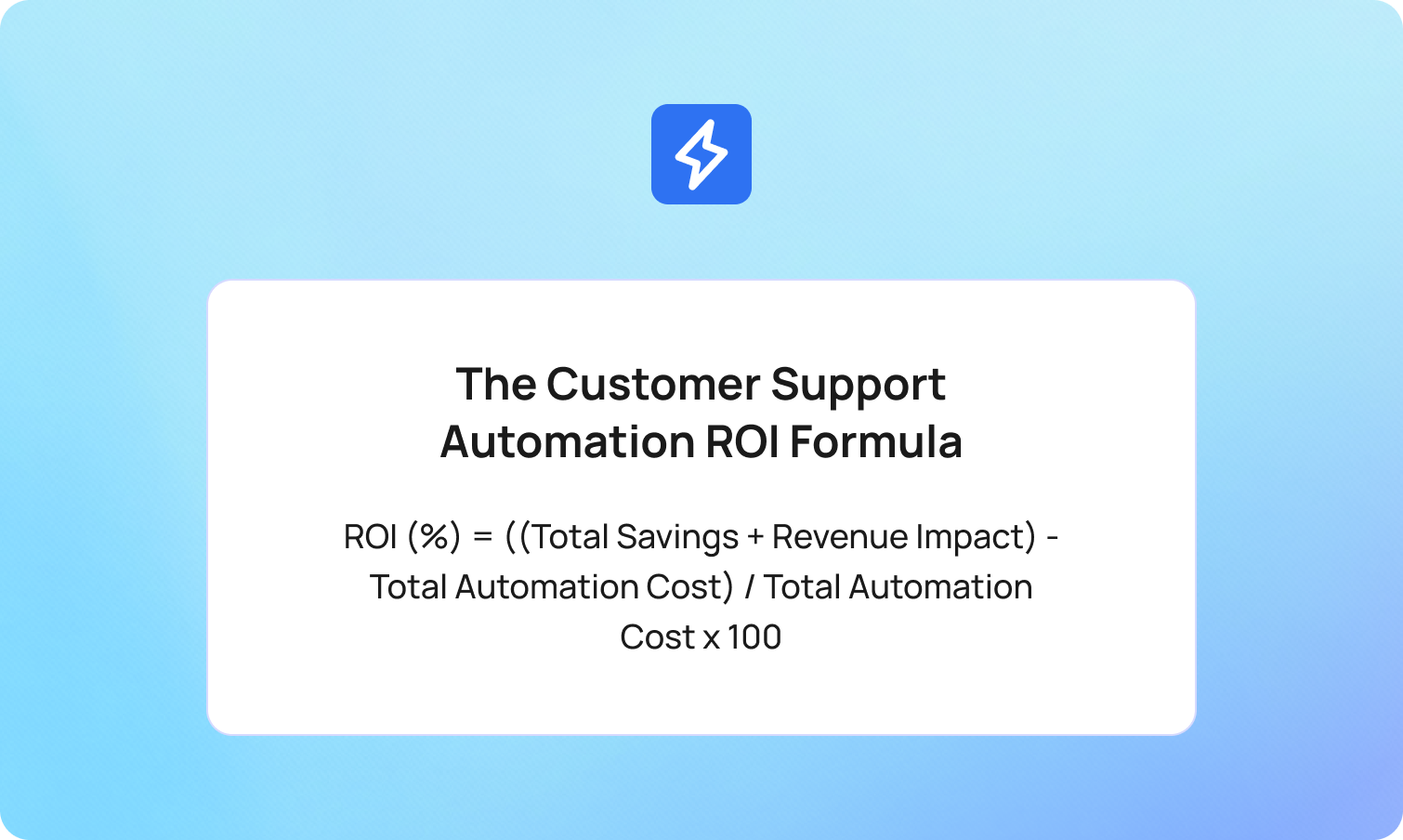
The formula itself is straightforward. The discipline is in what you put into it.
ROI (%) = ((Total Savings + Revenue Impact) - Total Automation Cost) / Total Automation Cost x 100
Each component deserves a precise definition.
Total Savings
The reduction in cost per resolved contact, multiplied by resolved contact volume. Not deflection volume. Not ticket closure volume. Resolved contact volume: the number of contacts that reached a full resolution in the measurement period. If your cost per resolved contact falls from €8 to €3 on automated interactions, and you handle 15,000 automated resolutions per month, your monthly saving is €75,000.
Revenue Impact
The improvement in customer retention is attributable to service quality, quantified through churn rate reduction. Keeping existing customers costs less than acquiring new ones. Customer expectations of fast, accurate service are rising, and automation that meets those expectations compounds value through customer loyalty, higher lifetime value, and revenue growth over time. A 1% reduction in monthly churn on a customer base with an average lifetime value of €500 is a concrete number. Most ROI models leave this cell empty or fill it with aspirational estimates. It is the hardest component to measure and the most important to get right, because it is where automation either creates or destroys long-term value.
Total Automation Cost
Platform licensing, implementation fees, ongoing KB maintenance, model retraining, escalation overhead, and internal resource time for managing the system. Most teams calculate the first two correctly and ignore the rest. The cost savings and cost reduction numbers that appear in vendor proposals are built on the first two. The operational costs that determine whether lowering operational costs at scale is genuinely achievable are the ones that come after. The hidden costs of inefficient customer support systems are well documented, and the same logic applies to automation: the costs that do not appear in the vendor proposal are the ones that erode ROI silently.
Worked Example
A team handling 50,000 contacts per month at €8 cost per resolution deploys automation scoped to tier-1 queries. At 90 days, the containment rate on automated interactions is 62%. That means 31,000 contacts are fully resolved by automation at €2.50 cost per resolution, and 19,000 are handled by human agents at €8. Monthly saving: (31,000 x €5.50) = €170,500. Monthly platform cost, including maintenance: €18,000. Monthly net saving: €152,500.
That is a real number from a realistic deployment, and it only holds if the containment rate is measured correctly.
For an overview of customer support automation ROI calculator tools comparison, the BlueTweak ROI calculator is one of the few built specifically for contact centers running AI automation. It accepts your actual cost per resolution, contact volume, and containment targets and outputs a time-phased projection rather than a single headline number.
The Metrics That Actually Measure Customer Support Automation ROI

Containment Rate
Containment rate is the percentage of automated interactions that reach a complete resolution without a follow-up contact on any channel within 24 hours.
Calculation: (Fully resolved automated contacts / Total automated contacts attempted) x 100
The 24-hour cross-channel window is what makes this metric honest. A customer who ended a bot session and sent an email 90 minutes later was not contained. Measuring containment properly requires joining bot session data with email, chat, voice, and social contact data. That is why teams using fragmented tooling default to deflection rate. It is not a better metric. It is an easier one.
For a well-scoped tier-1 deployment at 90 days, a containment rate of 55–70% is a realistic target. Automating routine tasks and routine inquiries, password resets, billing inquiries, order status, and account updates is where self-service capabilities deliver the most consistent results. Below 50% usually signals either a scope problem (the bot is handling interactions it cannot resolve) or a knowledge base problem (the content it is grounding responses in is incomplete). Expanding self-service options before fixing a knowledge base gap will not improve containment.
Cost Per Resolved Contact
Total support operating cost divided by the number of contacts that were resolved, not closure, in the measurement period.
The distinction between closure and resolution matters. A ticket marked closed by an agent after a first response is not necessarily resolved. A contact where the customer sent three follow-up messages before the issue was addressed represents one resolution and three closures. Dividing cost by closures understates the true cost of poor resolution quality.
Split cost per resolved contact by channel and by interaction type (automated vs. human-handled). The gap between the two numbers is the efficiency case for automation. Watching that gap widen or narrow over time is how you track whether automation is improving or degrading.
First Contact Resolution Rate by Channel
First contact resolution rate is one of the key performance metrics that separates teams measuring automation correctly from those measuring it conveniently. It is the percentage of contacts resolved on the first interaction, tracked separately for automated and human-handled interactions. Contact resolution on the first touch is the outcome that reduces repeat contacts, lowers operational costs, and improves customer satisfaction in a single number.
Automation should increase FCR on the interactions it handles, not just reduce overall volume. If FCR on automated interactions is falling while overall contact volume is falling, the automation is resolving fewer issues per attempt. That means it is creating repeat contacts that are being absorbed elsewhere and not appearing in the automation metrics.
A misclassified contact is a misrouted contact, and a misrouted contact almost never resolves on the first touch. AI ticket classification is where that chain starts.
CSAT on Automated Interactions
CSAT scored specifically on bot-handled and automated interactions, tracked separately from human-handled interactions, and reported on the same cadence.
Automation that reduces cost while reducing CSAT is destroying customer lifetime value faster than it is saving on cost per ticket. The ROI model must net the two against each other. Higher customer satisfaction on automated interactions is not just a CX metric: it is the leading indicator for containment rate, customer loyalty, and net promoter score. A 1% drop in monthly CSAT on automated interactions is an early signal that containment rate is about to fall. Customer sentiment is shifting before the operational data catches up. Tracking it separately is the fastest way to improve customer service ROI before the churn data arrives.
Structuring customer service analytics to separate automated from human-handled CSAT is what makes the comparison meaningful rather than misleading.
Churn Rate Change Post-Automation
Change in customer churn rate at 90 and 180 days after automation deployment, segmented by customers who interacted primarily with automation versus human agents.
This is the metric most teams skip because it is the hardest to attribute. It is also the metric that captures whether automation is building or eroding the customer relationship over time. A team that reduces cost per resolved contact by 40% while increasing churn by 2% in its automated customer segment is not generating positive ROI. It is transferring cost from the support budget to the revenue line.
What Good Customer Support Automation ROI Looks Like at 30, 90, and 180 Days
Most ROI models present a single number. Operations teams report to leadership in time horizons. These are not the same thing, and the mismatch is where most automation deployments lose credibility internally.
30 Days: Baseline and Early Signals
At 30 days, the model is still being calibrated. Containment rates are lower than they will be at steady state. CSAT on automated interactions often dips before it recovers as the system learns which queries it can handle confidently. Handle time may temporarily increase as agents learn the escalation workflow.
The key metrics to track at 30 days are the containment rate improving week on week, whether the escalation rate to human agents is within the expected range, and what percentage of queries the bot is unable to answer. Also track agent productivity on escalated interactions, if the AI tools are passing poor context on handoff, agents are spending more time re-reading transcripts than resolving issues. Review customer data completeness in the handoff payload. These are trajectory metrics, not ROI metrics.
Do not report headcount ROI at 30 days. Do not report a cost saving based on deflection rate. Report trajectory.
90 Days: First Real ROI Signal
By 90 days, the containment rate should be approaching steady state for the scoped interaction types. Cost per resolved contact on automated interactions should be trackable against the pre-deployment baseline. FCR on automated interactions should be measurable and comparable to human-handled FCR on the same query types.
This is the first point at which a credible ROI number can be presented to leadership. For a well-scoped tier-1 deployment, a realistic 90-day benchmark is a 55–70% containment rate and a 30–40% reduction in cost per resolved contact on automated interaction types. This is also where AI for customer service starts delivering measurable value rather than trajectory signals. An AI-powered customer service that is showing efficiency gains at 90 days is a deployment that was scoped and measured correctly. Below those ranges, the deployment is either underscoped or the knowledge base needs attention before expanding automation coverage.
180 Days: Full ROI Picture
At 180 days, churn rate data becomes meaningful and attributable. Customer lifetime value impact is traceable through the retention data. Teams with predictive analytics in place can begin forecasting which customer segments are churn risks based on their automated interaction history, turning support data into a proactive customer experience input rather than a reactive report. The feedback loop between QA scoring and model improvement should be visible in containment rate improvements. A system built for continuous improvement will show steady containment rate gains between 90 and 180 days rather than a plateau, and support costs will continue to fall as the model gets better.
This is also the point at which headcount ROI can be credibly reported. The capacity freed by automation has had time to either reduce overtime costs, offset planned hiring, or support volume growth without additional headcount. Any of those outcomes is real ROI. None of them appears reliably in a 30-day measurement window.
The Hidden Costs That Kill Customer Support Automation ROI
Most vendor ROI models undercount costs. These four items appear consistently in post-deployment reviews and rarely in pre-deployment projections. Each one represents a customer service team resource, part of the ongoing customer service efforts, or a pattern in customer conversations that the initial proposal treated as zero-cost.
Knowledge Base Maintenance
The automation is only as accurate as the content it is grounded in. A RAG-grounded system retrieving from an incomplete or outdated knowledge base will produce inaccurate responses, reduce containment rate, and generate the kind of failed self-service contacts that inflate repeat contact volume. KB maintenance is not optional overhead. It is a direct driver of containment rate, which makes it a direct driver of ROI.
The BlueTweak Smart Knowledge Base is built on the assumption that KB quality and automation performance are the same problem.
Model Retraining and Optimisation
Intent models degrade as product changes, policy updates, and seasonal shifts alter the distribution of incoming queries. Retraining cycles, new intent category creation, and confidence threshold recalibration all require internal resource time or vendor fees. A model running on six-month-old training data against current traffic is not performing at its 90-day benchmark. Most initial ROI projections do not include a line item for ongoing optimisation.
Escalation Handling Overhead
When automation escalates to a human agent, the handoff quality determines whether the escalation adds or removes cost. A clean handoff, with full context, interaction summary, and intent classification passed to the agent, takes seconds. A poor handoff, where the agent re-reads an incomplete transcript and asks the customer to repeat their issue, adds minutes of handle time to every escalation. At scale, that is a material cost.
AI agents and conversational AI systems that pass full context across communication channels on escalation remove the need for human intervention to re-establish what the customer already explained. Human-in-the-loop AI done well is an efficiency gain. Done poorly, it offsets automation savings.
Failed Self-Service Follow-Up Volume
Customers who attempt self-service and fail do not disappear from the contact queue. They call, email, or message, and they arrive more frustrated than if they had contacted a human agent directly. Customer feedback on failed self-service interactions is a direct signal about customer preferences for resolution paths. Customers who prefer self-service but cannot get a resolution through it represent a containment problem and a satisfaction problem simultaneously. Failed self-service generates harder-to-handle customer inquiries with lower first-touch resolution rates and worse CSAT outcomes than contacts that never went near the bot. This volume must appear in the ROI model as a cost, not as evidence that automation is working.
How to Build a Customer Support Automation ROI Model That Holds Up
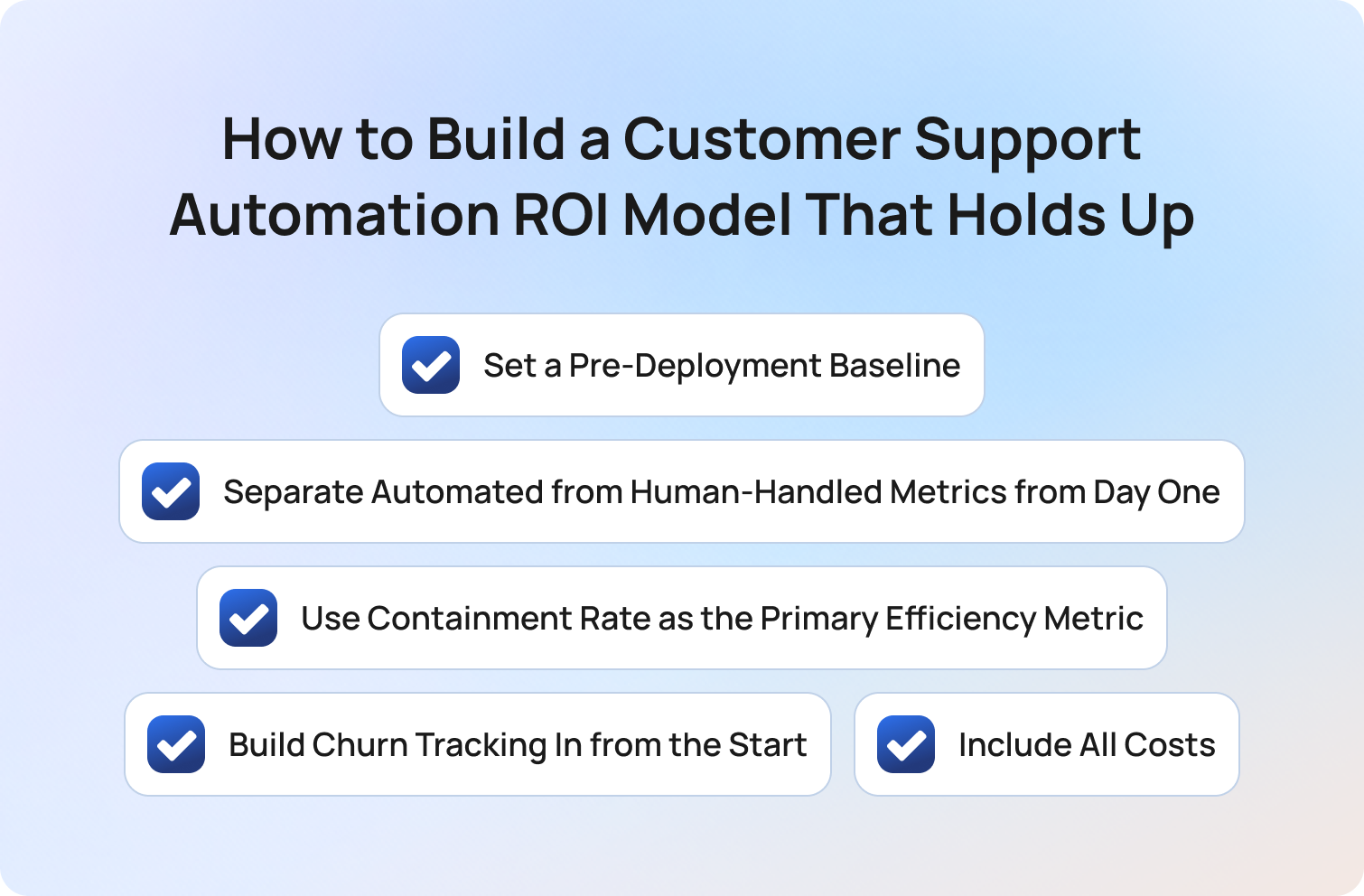
A ROI model that holds up under leadership scrutiny is built on five disciplines, not one formula. Customer service initiatives that reduce support costs and improve operational efficiency generate real returns. The measurement model is what determines whether customer support operations can prove it. Most AI implementation projects fail the ROI test, not because the technology underperformed but because the measurement model was not ready when the deployment went live.
Set a Pre-Deployment Baseline
Capture cost per resolved contact, FCR by channel, CSAT, and churn rate before automation goes live. Without a pre-deployment baseline, there is no ROI. There is only a before-and-after story that cannot be attributed to automation with any confidence.
Separate Automated from Human-Handled Metrics from Day One
Blended metrics hide automation performance behind human-handled performance. Set up reporting that tracks containment rate, CSAT, FCR, and cost per resolved contact separately for automated and human-handled interactions before the first automated contact is handled.
Use Containment Rate as the Primary Efficiency Metric
Define it precisely: resolution without follow-up contact across all channels within 24 hours. Report it weekly for the first 90 days. Any team using deflection rate as its primary automation efficiency metric is reporting a number that flatters the deployment and hides failure modes.
Build Churn Tracking In from the Start
Segment customers by their primary interaction type and track churn separately from the first month of deployment. This is the only way to capture the revenue side of the ROI equation with any precision. AI-driven automation that maintains service quality for existing customers will show this in churn data. AI-driven automation that is degrading customer relationships will also show it there, before it shows up anywhere else. Teams that skip this step cannot answer the question that matters most: Is automation improving or degrading customer relationships over time?
Include All Costs
Platform licensing, implementation, KB maintenance, model retraining, escalation overhead, and internal management time. If the vendor ROI model does not include KB maintenance and retraining, add them. They are not edge cases. They are the costs that determine whether 90-day performance holds at 180 days.
The BlueTweak ROI calculator is built on this framework. It accepts actual cost inputs, containment targets, and CSAT baselines and outputs a time-phased projection at 30, 90, and 180 days. A single headline number is not a measurement model. It is a marketing claim.
How BlueTweak Makes Customer Support Automation ROI Measurable
Most of the ROI measurement problems described above share a root cause: the platform being used to run customer service automation is not the same platform being used to measure it. Data lives in separate systems. Containment rate cannot be calculated because bot session data and email contact data are in different tools. CSAT on automated interactions is blended with human-handled CSAT because the reporting layer does not distinguish between them. The result is that AI customer support generates real service efficiency gains that the measurement model cannot capture as measurable ROI.
BlueTweak is designed so that measurement and automation run in the same workspace. AI-driven tools that generate data in one system and report it in another will always produce ROI numbers that operations teams cannot fully stand behind.
Containment Over Deflection
The platform tracks whether a contact recurs across channels within 24 hours, giving teams a containment rate they can report with confidence, not a deflection rate that counts sessions rather than resolutions.
Cost Per Resolved Contact in the Dashboard
The analytics and reporting layer separates automated and human-handled interaction costs, and reports cost per resolution rather than cost per ticket closure. The number that appears in the dashboard is the number that will hold up in a leadership meeting.
CSAT Tracked by Interaction Type
CSAT is tracked and reported separately for automated and human-handled interactions, so teams can see within the same view whether automation is improving or degrading satisfaction alongside cost. A rising containment rate paired with falling CSAT is a signal that the system surfaces before it compounds.
KB Quality as a Direct ROI Input
The Smart Knowledge Base and QA module work in the same system. QA flags on bot responses surface KB gaps that, once closed, directly improve containment rate. The relationship between content quality and automation ROI is visible rather than assumed.
The 30/90/180-Day View Built In
Rather than a single ROI snapshot, BlueTweak's reporting gives teams the trajectory view they need to report credibly at each stage of deployment: week-on-week containment improvement, 90-day FCR comparison, and 180-day churn segmentation, all in the same platform.
The teams that struggle to prove automation ROI are almost never struggling because the automation is not working. They are struggling because the measurement model they are using was built to show deflection, not resolution. Once you switch to measuring containment, cost per resolved contact, and churn by interaction type, the ROI story becomes a lot clearer and a lot more defensible. The question changes from ‘did the bot handle the contact?’ to ‘did the customer’s problem get solved?’ Those are very different questions, and they produce very different numbers.
Final Thoughts
Customer support automation ROI is real. The business outcomes it delivers, reducing costs across tier-1 interactions, better customer experience, and stronger customer retention, are significant for any customer service team running at scale. The teams generating measurable ROI are not doing anything exotic. They are measuring containment instead of deflection, tracking cost per resolved contact instead of cost per ticket, building churn segmentation into their model from the start, and including the hidden costs that most vendor proposals omit.
The teams that cannot show ROI at 180 days are usually the ones that reported a deflection rate at 30 days, called it success, and stopped measuring. The number looked good. The operation did not improve.
Get the measurement model right first. The ROI follows from the discipline, not the technology.
Run your own numbers with the BlueTweak ROI calculator and see what a realistic 90-day and 180-day projection looks like for your team. Or start your free trial and build the measurement infrastructure alongside the automation from day one.
Start your 14-day free trial
Start Today
AI Chatbot Customer Service Cost Reduction: How to Lower Costs Without Hurting CX
AI Chatbot Customer Service Cost Reduction: The Statistics
Before the mechanics, the scale. These are the numbers that define where AI chatbots' cost reduction in customer service actually stands in 2026.
According to IBM, AI chatbots can reduce the operational costs of contact centers by up to 30%. McKinsey data shows AI-enabled self-service can cut incidents by 40–50%, with cost-to-serve reductions of more than 20%. Companies are seeing average returns of $3.50 for every $1 invested in AI customer service, with top-performing organisations achieving up to 8x ROI.
Gartner's 2025 research predicts that agentic AI will autonomously resolve 80% of common customer service issues by 2029, with a corresponding 30% reduction in operational costs. Businesses using AI-driven routing have already achieved 30% faster average response times compared to manual triage.
Those numbers are real. They are also averages across deployments that range from excellent to deeply counterproductive. Customer service chatbots and the AI technologies and AI tools that power them are capable of delivering significant cost savings. The headline figure, 30% cost reduction, is broadly accurate for well-implemented deployments and largely unachievable for poorly scoped ones. Understanding why is what this article is about.
What AI Chatbot Cost Reduction Actually Looks Like
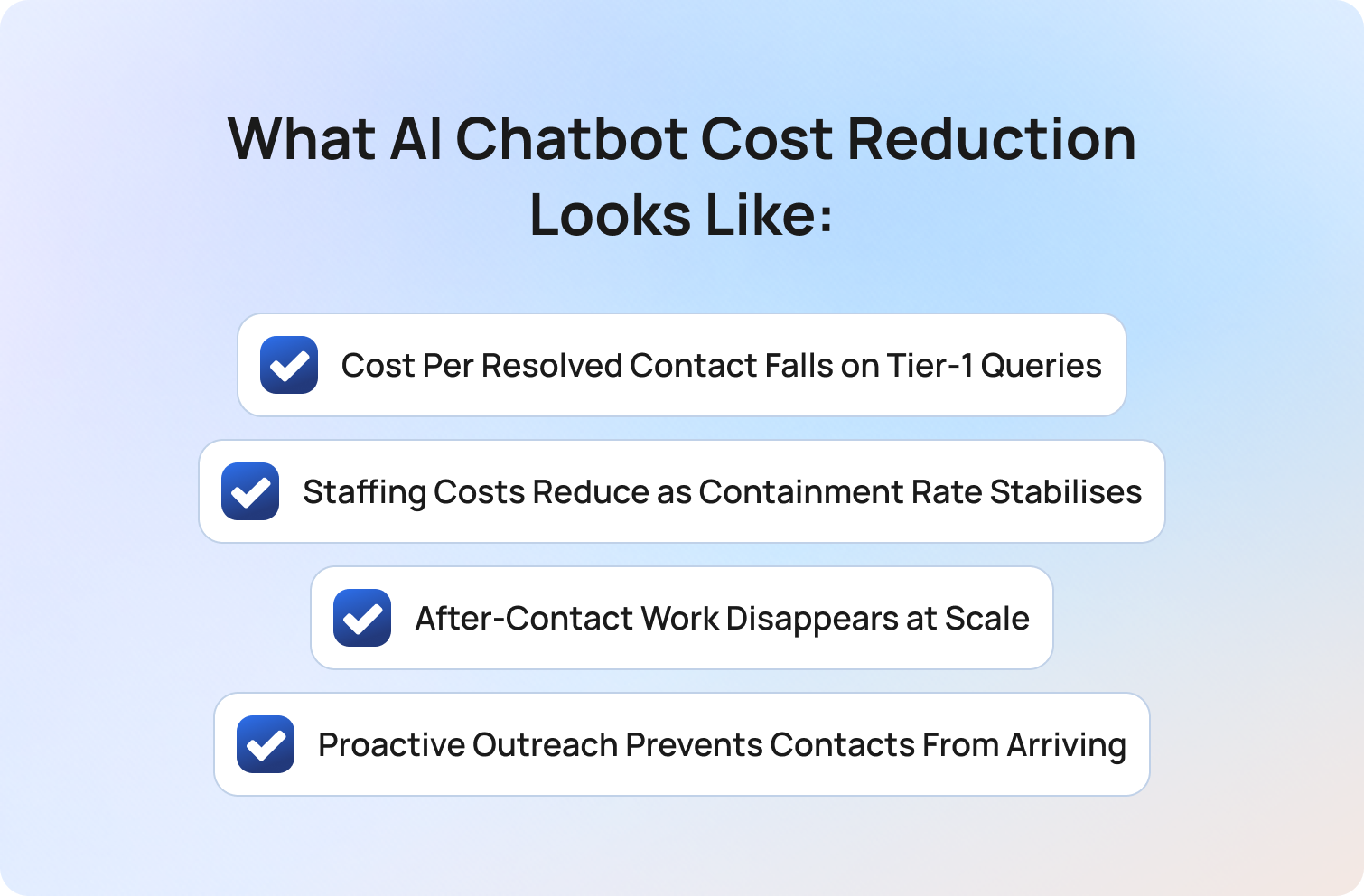
AI chatbots reduce customer service costs and lower support costs through four distinct mechanisms. Each is measurable. Each has a condition attached. Customer support costs fall in different ways depending on which mechanism is working, and the largest reductions come when all four operate together.
Cost Per Resolved Contact Falls on Tier-1 Queries
The unit cost of a human-handled support interaction, including agent time, tooling, and overhead, typically runs between €6 and €12, depending on complexity and channel. The unit cost of an automated resolution handled end-to-end by a well-scoped AI chatbot runs between €1.50 and €3. The difference is where the cost reduction in customer service originates.
At volume, this compound quickly. A support team handling 40,000 contacts per month, where 60% are tier-1 queries, achieving 62% containment on those queries, removes roughly 14,880 contacts from the agent queue per month. The direct savings on those interactions alone represent a material reduction in monthly operational costs before any other efficiency is counted.
Use the BlueTweak ROI calculator to run this against your own contact volume and cost per resolution.
Staffing Costs Reduce as Containment Rate Stabilises
Reduce customer service costs at the contact level, and the staffing implications follow, but on a lag. The capacity freed by automation at a 90-day containment rate steady state either offsets planned hiring, absorbs volume growth without additional headcount, or reduces overtime costs during peak periods. None of those outcomes is instant. Teams that count staffing savings on day one and measure them at day 30 will find the numbers do not match. Teams that build staffing ROI into the 180-day projection will find it arrives reliably.
After-Contact Work Disappears at Scale
Every resolved interaction generates wrap-up work: summary, tagging, and CRM update. Support tickets handled manually require agents to write that record from scratch. For human agents, that is 3–5 minutes per interaction. AI ticket summaries generate a structured record automatically, reducing agent wrap-up to a 20–30 second review and confirmation. Across a team handling 200 interactions per day, the time saving compounds into a significant share of daily capacity that can be redirected to complex issues. Operational efficiency at the team level rises because agents are doing work that requires their judgment rather than work that a summary generator handles better and faster.
Proactive Outreach Prevents Contacts From Arriving
The contact that never happens costs nothing to handle. AI-triggered workflow automation sends proactive messages on predictable trigger events, order delays, payment failures, shipping updates, and billing events before customers need to reach out. Inbound volume on those event types typically falls by 20–40% for well-implemented proactive workflows, generating direct savings that do not require a single automated resolution to count.
The Three Deployment Mistakes That Turn Cost Reduction Into Cost Generation
This is what most AI chatbot cost reduction articles do not cover. The reason many teams cannot show chatbot ROI at 180 days is not that chatbots do not save money. It is because three deployment mistakes systematically offset the savings. 40% of customers abandon chatbots due to poor experiences, and every abandoned interaction is a failed self-service attempt that generates a follow-up contact that costs more to handle than the original interaction would have.
Deploying on Interaction Types the Chatbot Cannot Reliably Resolve
Scope creep is the most common and most damaging mistake. Unlike human agents who can apply critical thinking and adapt to unexpected queries, an AI chatbot scoped beyond its reliable range will misclassify complex issues, escalate poorly, and generate repeat contacts from customers who received an inaccurate or incomplete response.
Each failed resolution costs more than a single human-handled interaction would have, because the customer arrives at the agent queue frustrated, and the agent must start from scratch without useful context. Customer frustration from a failed chatbot experience is harder to recover from than customer frustration from a slow initial response. The perception of being passed between systems after a bad automated experience is one of the fastest drivers of customer loyalty erosion.
The fix is straightforward: scope chatbot deployment to automating routine tasks, repetitive queries, and routine inquiries where the correct answer is definitive and the resolution path is short. Billing balance checks, order tracking, password resets, account updates, FAQ queries, shipping status, these are the routine queries where AI chatbots generate cost savings reliably across all customer services and channels. Complex complaints, escalation requests, and emotionally sensitive interactions are not. Protecting the customer experience on complex interactions by keeping human agents responsible for them is what makes the cost reduction on tier-1 queries sustainable.
Measuring Deflection Rate Instead of Containment Rate
Deflection rate counts sessions that ended in the chatbot without escalating to a human agent. Containment rate counts contacts that reached full resolution without a follow-up on any channel within 24 hours. The gap between the two numbers is the gap between what gets reported and what actually happened.
A team reporting 70% deflection and 45% containment has a large population of customers who appeared resolved and then sent a follow-up email or called back. Those follow-up contacts generated double the interaction cost of a single human-handled resolution. Deflection rate is not a cost reduction metric. Containment rate is the only accurate measure of AI chatbots' cost reduction in customer service.
Most AI support vendor dashboards report deflection by default. It is not a better metric. It is an easier one.
Launching Without a Current, Accurate Knowledge Base
RAG-grounded chatbots retrieve answers from the knowledge base. A knowledge base with outdated pricing, discontinued products, or incorrect policy information produces inaccurate chatbot responses. Inaccurate responses reduce containment rate, generate complaint contacts from customers who acted on wrong information, and damage customer trust in the self-service channel.
The cost of rebuilding that trust, in repeat contacts, escalation volume, and churn, exceeds the cost savings from automation in most cases where this mistake is made. The hidden costs of inefficient customer support systems apply here too: a chatbot grounded in poor content does not reduce support costs. It transfers them downstream.
How AI Chatbots Reduce Customer Service Costs Without Hurting CX

Traditional customer support operations were built on a trade-off: quality costs money, and speed is expensive. AI-powered customer service breaks that trade-off when deployed correctly. Here is how each capability delivers cost reduction while maintaining high service quality.
Containing Tier-1 Volume End-to-End
Conversational AI chatbots built on natural language processing handle customer queries across chat and voice without requiring customers to navigate rigid menus or interactive voice response trees. The customer describes their issue in natural language. Machine learning classifies intent accurately. The AI system retrieves the relevant knowledge base content and delivers a relevant, accurate response.
Support agents never see these interactions. Every contained contact is time support agents spend on complex issues that require judgment, empathy, and critical thinking, the customer interactions where human agents add irreplaceable value. Agent productivity rises not because agents are working faster but because the queue they are working from contains fewer interactions that should never have reached them.
Maintaining high service quality alongside cost reduction comes from this separation. AI handles routine tasks consistently and at scale. Human agents handle complex issues with the full attention they deserve. Neither is doing the other's job.
Reducing Handle Time on Escalated Interactions
When the chatbot escalates to a human agent, the handoff quality determines whether the escalation is a cost-saving or a cost addition. A clean handoff, full customer data, interaction history, intent classification, and a structured summary of what was already attempted means the agent opens the interaction knowing exactly what the customer needs. Handle time on escalated interactions falls. Repeat contacts from poorly handled escalations fall.
Human-in-the-loop AI minimises human intervention to the interactions that genuinely require it, and reduces the cost of every escalation that does. Done poorly, with incomplete context, missing history, or no summary, it adds minutes to every interaction and forces customers to repeat themselves, generating customer frustration that damages customer satisfaction scores most visibly.
Automating After-Contact Work
AI ticket summaries eliminate manual wrap-up for both automated and human-handled interactions. For human-handled contacts, agents confirm a pre-generated summary rather than writing one from scratch. For automated contacts, the record is complete before the interaction closes. The time saving per interaction is modest. Across a team handling hundreds of contacts per day, it is material, and the data quality improvement is significant, because consistent AI-generated summaries produce customer data that is usable for predictive analytics and customer behavior analysis in ways that free-text agent notes rarely are.
Enabling Proactive Outreach on Predictable Events
AI-driven predictive analytics identifies the trigger events that generate predictable inbound volume: order delays, payment processing failures, service outages, and subscription renewal issues. AI-powered agents send tailored solutions and personalised proactive messages to affected customers before they need to ask, meeting customer expectations for immediate support without requiring the customer to initiate contact. Personalized service delivered proactively is a higher standard of customer care than reactive resolution. The inbound contact never arrives. Customer loyalty strengthens through the experience of being anticipated rather than reacted to.
This is transforming customer service at the operational level: shifting from a reactive model that waits for customer frustration to build, to a proactive model that prevents it. The cost savings are direct, fewer inbound contacts on predictable event types, and indirect, through the customer retention impact of a support experience that feels attentive rather than transactional.
Protecting CX While Reducing Costs: Three Practices That Matter
The "without hurting CX" part of AI chatbot cost reduction is not guaranteed. It is a design choice. Efficient customer service at lower cost requires that support quality is actively protected, not assumed. When you automate routine inquiries correctly and route everything else to human agents via clean escalations with full context, customer service agents are working on the interactions where their skills matter most. These three practices separate deployments that reduce costs and maintain CX from those that reduce costs at CX's expense.
Set Confidence Thresholds Before Launch
An AI chatbot without calibrated confidence thresholds will attempt to answer queries it cannot handle reliably, producing low-confidence automated responses that damage customer trust. Setting per-intent confidence thresholds before go-live determines which interactions get automated responses and which escalate to human agents. This is a pre-launch decision that determines whether consistent support is delivered at scale or whether CX is variable depending on how confidently the model handles each query type.
Track CSAT on Chatbot-Handled Interactions Separately
Blended CSAT hides chatbot performance behind human-handled performance. Improved customer satisfaction on human-handled interactions can mask declining satisfaction on automated interactions for months before the signal reaches aggregate scores. Tracking CSAT specifically on chatbot-handled interactions from day one makes CX degradation visible early enough to act on.
The QA module scores 100% of interactions and tracks customer sentiment separately for automated and human-handled contacts. Sentiment analysis flags interactions where customer sentiment shifted negatively during a chatbot conversation. These flags arrive before the churn data confirms the problem.
Close Knowledge Base Gaps Before Expanding Scope
The relationship between KB quality and CX protection is direct. A chatbot retrieving from a complete, current knowledge base produces accurate, relevant responses. Accurate responses build customer trust in self-service options. Customer trust in self-service increases willingness to use it again, which is what sustains containment rate improvement over time. Every scope expansion before a KB audit is a risk to service quality that the efficiency gains may not offset.
What Realistic Cost Reduction Looks Like at 30, 90, and 180 Days
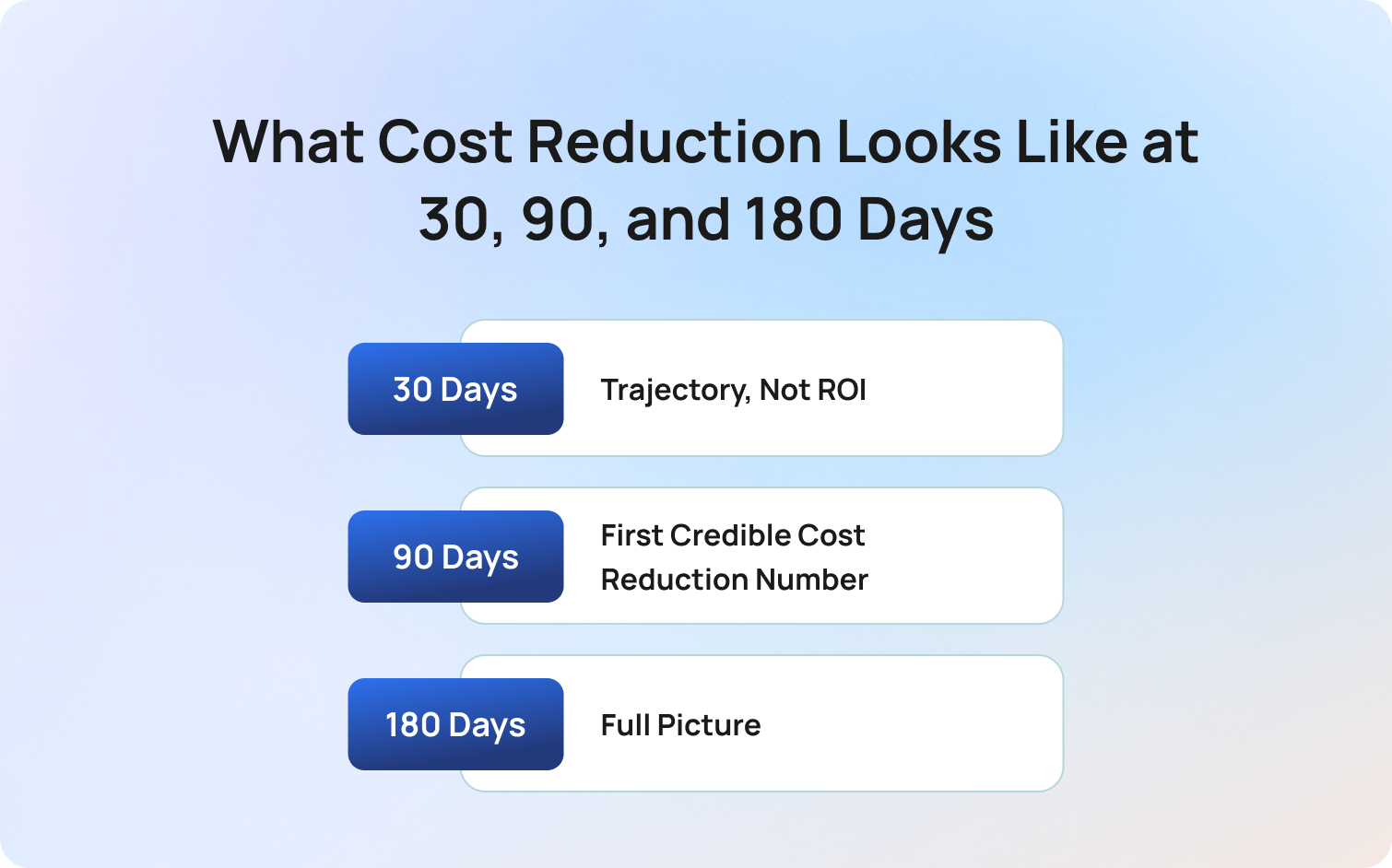
30 Days: Trajectory, Not ROI
At 30 days, the model is calibrating. Containment rate is below the steady state. CSAT on chatbot interactions may dip before it recovers. This is normal. What to track: is the containment rate improving week on week, is the escalation rate within the expected range, and what percentage of queries is the chatbot unable to answer? These are leading indicators of the cost reduction that follows, not cost reduction itself. Do not report staffing savings at 30 days.
90 Days: First Credible Cost Reduction Number
For well-scoped tier-1 deployments, 90-day benchmarks are: 55–70% containment rate, 30–40% reduction in cost per resolved contact on automated interaction types. McKinsey found that businesses implementing conversational AI saw a 25% increase in customer satisfaction scores alongside a 35% decrease in handling costs. At 90 days, the cost per resolved contact is trackable against the pre-deployment baseline, and the number is credible enough to present to leadership.
180 Days: Full Picture
At 180 days, churn rate change by interaction type is meaningful and attributable. Customer lifetime value impact is traceable through retention data. AI capabilities improve through the feedback loop between QA scoring, customer feedback, and knowledge base updates. A system built for continuous improvement shows steady containment rate gains between 90 and 180 days rather than a plateau. Support costs on affected query types continue to fall as the model gets better and KB coverage expands to new interaction types.
How BlueTweak Delivers AI Chatbot Customer Service Cost Reduction Without CX Compromise
Most AI chatbot customer service cost reduction failures share a root cause: the platform running the automation is not the same platform measuring it. Customer support costs cannot be accurately attributed when chatbot session data, support tickets, and email follow-up data live in different tools. Containment rate cannot be calculated. CSAT on chatbot interactions is blended with human-handled CSAT because the reporting layer does not distinguish between them. Knowledge base gaps are identified manually, slowly, and reactively.
BlueTweak is designed so that automation, measurement, and quality oversight run in the same workspace.
The conversational AI handles tier-1 customer interactions across chat and voice, grounded in the Smart Knowledge Base that feeds accurate, verified content into every automated response. Confidence thresholds are configured before launch. Low-confidence interactions go to human agents, not customers.
The QA module scores every interaction and tracks CSAT and sentiment separately for automated and human-handled contacts. KB gaps surfaced by QA flags are closed without manual audits. The feedback loop between quality data and content quality is automated.
The analytics and reporting layer reports containment rate, not deflection rate, alongside cost per resolved contact, FCR by channel, and CSAT by interaction type, giving support teams the measurement infrastructure to report AI support ROI credibly at 30, 90, and 180 days.
Seamless integration with existing CRM and ticketing tools means customer data flows into the platform rather than being duplicated across systems. Support operations retain full visibility of every interaction, automated or human-handled, in one workspace.
The teams that report genuine cost savings from chatbot deployment are almost always the ones that were honest about scope from the start. They deployed on the interactions the chatbot could reliably resolve, maintained their knowledge base, and measured containment rather than deflection. Those three decisions are not technical. They are operational. And they are the difference between a chatbot that cuts support costs at 180 days and one that looked good at 30 days and quietly generated more costs than it saved.
Final Thoughts
AI chatbot customer service cost reduction is a competitive advantage that is becoming a competitive necessity. The teams that have built AI-powered support infrastructure today will be at 60–70% containment by 2029. The teams that have not started will be at 20–25%, facing a competitive cost disadvantage that will be very difficult to close.
The savings are real, and the benchmarks are well-established. But saving money while maintaining high service quality is a design choice, not a default outcome. It requires the right scope, the right measurement model, and a knowledge base that is maintained as a first-class operational asset.
Teams that get those three right do not just cut support costs. They build a support operation that improves continuously and scales efficiently. That is the return that justifies the investment, not the first 30-day deflection rate, but the 180-day cost per resolved contact trend and the customer retention data that comes with it.
Run your own numbers with the BlueTweak ROI calculator, or start your free trial and build the measurement infrastructure alongside the automation from day one.
Start your 14-day free BlueTweak trial
Start Trial
8 Ways to Prevent Customer Service Agent Burnout in 2026
What Causes Agent Burnout in Customer Service and Why It's a Performance Problem

Agent burnout is not just a well-being issue. It is a business metrics problem. Call center burnout and employee burnout cost contact centers significantly in recruitment, ongoing training, and lost institutional knowledge. CSAT drops when burned-out agents handle customer interactions. FCR falls when fatigued agents take shortcuts. When many employees are experiencing center burnout simultaneously, the entire customer experience suffers.
Three causes of contact center agent burnout stand out specifically.
High repetitive task volume. Answering the same tier-1 questions hundreds of times per shift drains cognitive capacity with no intellectual reward. Agents dealing with an endless queue of identical customer requests quickly lead to disengagement, then exhaustion.
Inadequate tools. Agents who have to toggle between systems, manually search for answers mid-interaction, or handle calls without customer context are carrying unnecessary cognitive load during every workday. Feeling unsupported by the tools the company provides is a fast path to feeling overwhelmed. Poor work-life balance between high-demand calls and recovery time compounds this further.
Unpredictable volume and poor scheduling. Understaffing during peak periods creates acute stress. Overstaffing during lows creates boredom and disengagement. Both extremes affect the agent's well-being and quickly lead to declining quality scores.
According to Insignia Resources, contact center agent turnover averages 30 to 45 percent annually in many organizations, with burnout cited as a leading cause. The cost of replacing a single agent ranges from 50 to 150 percent of the annual salary. Separately, research shows that employees who feel they have adequate support from management are approximately 62% less likely to experience burnout. That is a performance and cost problem, not just a people problem.
Agent Burnout vs. Performance at a Glance
BlueTweak Agent Burnout and Performance Table
| Burnout Driver | Performance Impact | Prevention Strategy | KPI Recovered |
|---|---|---|---|
| High repetitive task volume | AHT inflation, CSAT drop | AI automation of tier-1 queries | AHT, agent concurrency |
| Poor tool access during interactions | FCR drop, handle time extension | KB-grounded agent assist | FCR, AHT |
| Unpredictable scheduling and peaks | Error rate, absenteeism | WFM forecasting and flexible scheduling | SLA compliance, CSAT |
| No escalation path for complex cases | Frustration, disengagement | Clear escalation logic and HITL controls | Agent satisfaction, FCR |
| QA used punitively, not for coaching | Disengagement, defensive behaviour | Coaching-led QA with positive reinforcement | Quality scores, CSAT |
8 Ways to Prevent Customer Service Agent Burnout Without Hurting Performance
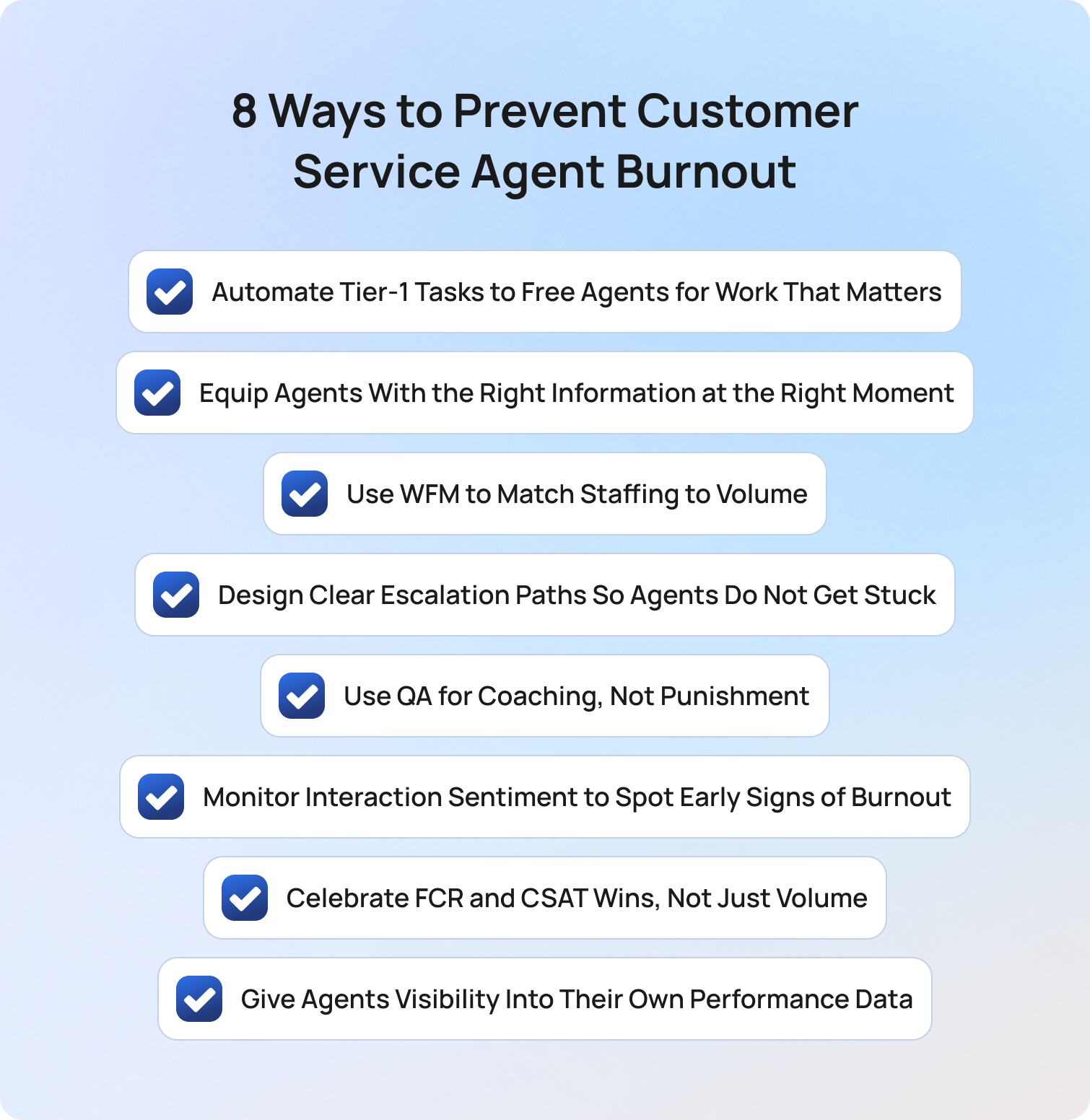
Every strategy below addresses a root cause of burnout and a corresponding performance metric. Where the strategy involves technology, the performance benefit is direct and measurable. Where it involves culture or management practice, the performance benefit operates through reduced attrition and improved engagement.
1) Automate Tier-1 Tasks to Free Agents for Work That Matters
Deploying an AI chatbot and AI voicebot to handle high-volume, low-complexity interactions removes the most repetitive tasks from agent queues. FAQs, order status, password resets, and account updates. When AI handles routine inquiries, agents focus on complex, escalated, and high-value customer interactions that require judgment. That shift is more engaging and less exhausting in equal measure.
This is one of the most effective ways to prevent burnout at the structural level and to genuinely empower agents to do their best work. You are not asking employees to manage stress better. You are removing the source of it. That difference matters both to the agents and to the numbers.
Performance benefit: containment rate improves, agents are available for complex tasks, and AHT on agent-handled interactions typically drops.
2) Equip Agents With the Right Information at the Right Moment
Agents who manually search for answers during live customer interactions carry unnecessary cognitive load on every call and chat. Toggling between tabs, searching knowledge bases, and asking colleagues mid-interaction is friction that compounds across an entire shift. Proposed reply and real-time KB retrieval surfaces the right answer directly in the agent workspace, reducing friction and helping agents feel supported rather than left to fend for themselves.
Supervisors who want to reduce friction quickly should prioritise this before expanding AI autonomy. Maintaining a strong, updated knowledge base and enabling real-time AI coaching directly empowers agents to handle customer interactions with confidence rather than uncertainty. The impact is immediate, and the risk is low. Agents who spend a few minutes less per interaction searching for answers accumulate hours of recovered capacity across a week.
Performance benefit: AHT drops, FCR improves, and agents report higher confidence in their ability to handle customer interactions.
3) Use WFM to Match Staffing to Volume
Understaffing during peak periods forces contact center agents to handle unsustainable volumes under time pressure. That is one of the most reliable triggers for acute burnout in a call center. Overstaffing during slower periods creates disengagement. AI-powered WFM forecasting schedules the right number of agents for predicted volume and supports flexible scheduling that reduces both extremes.
Workload adjustments driven by data rather than gut feel create a more predictable work day for agents. When the workload is predictable, stress is manageable. Scheduling regular breaks into shifts also matters. Enforcing short, frequent breaks during shifts helps agents reset from intense customer interactions, reducing the cumulative emotional strain that builds across a full day.
Performance benefit: SLA compliance improves during peaks, abandon rate falls, and agent satisfaction scores typically improve when workloads are consistent.
4) Design Clear Escalation Paths So Agents Do Not Get Stuck
Agents who cannot resolve a complex interaction because there is no escalation path, no authority to act, and no human-in-the-loop option experience acute frustration and helplessness. Feeling stuck is one of the fastest paths to feeling burnt out. Designing clear escalation triggers and handoff paths removes this failure mode. Agents need to know that when a situation exceeds their scope, there is a clear route forward.
This is equally important for the customer experience. Complex issues and escalating complaints routed to the right person are resolved faster, with less customer frustration on both sides of the interaction.
Performance benefit: FCR improves on escalated interactions, and agents report higher confidence when they know complex cases have a clear path.
5) Use QA for Coaching, Not Punishment
QA programmes that agents experience as surveillance or punishment increase disengagement and anxiety. When the QA module is framed as coaching, it fosters psychological safety and open communication. Recognising strong interactions, identifying development opportunities, and giving agents visibility into their own performance builds confidence rather than eroding it.
Regular one-on-one sessions between managers and agents to discuss workload, feedback, and development goals extend this further, creating a structured cadence for checking in before problems become burnout. Team meetings that share insights from QA reviews, rather than singling out poor performers, build a sense of camaraderie and shared purpose.
Managers who shift QA from a compliance function to a coaching function consistently report improvements in both agent experience and service quality. Giving employees a safe space to talk through performance data with their supervisor, without fear of punishment, is one of the most practical ways to make a difference in both engagement and results.
Performance benefit: quality scores improve when agents understand expectations and receive actionable coaching. CSAT follows.
6) Monitor Interaction Sentiment to Spot Early Signs of Burnout
AI sentiment analysis can flag interactions where agent stress signals are present before they become a burnout event. Tense language, shortened responses, and declining quality scores across a shift. Supervisors who recognize these early signs can intervene proactively, such as a check-in, a regular break, or a workload adjustment, rather than reacting after disengagement has already set in.
Proactive manager intervention is far more effective than any amount of mental health resources offered after the fact. The goal is to prevent burnout, not manage it once it has happened.
Performance benefit: catching early signs reduces absenteeism and attrition. Early coaching improves quality before scores deteriorate.
7) Celebrate FCR and CSAT Wins, Not Just Volume
Contact centers that measure and celebrate only volume metrics, such as calls handled and tickets closed, inadvertently incentivise speed over quality. Agents who are measured primarily on throughput feel like throughput. Shifting recognition in team meetings and one-to-ones to quality metrics such as FCR, CSAT, and positive customer feedback creates a customer-centric culture where agents feel valued for what they achieve, not just how fast they move.
Offering recognition and clear opportunities for career growth also combats feelings of being undervalued, which research consistently identifies as one of the most significant contributors to agent burnout. Creating an environment that encourages collaboration among employees enhances skill development and builds the kind of team culture that serves as a practical buffer against stress.
Employers who make this shift consistently report lower attrition, higher engagement, and stronger quality scores.
Performance benefit: FCR and CSAT improve when agents are motivated to resolve well, not just fast. Attrition falls when agents feel the job recognises their contribution.
8) Give Agents Visibility Into Their Own Performance Data
Agents who have no visibility into their own performance data cannot self-correct or take pride in their own improvement. Real-time dashboards showing individual FCR, CSAT, and AHT, framed as personal development tools, not management surveillance, give agents a sense of agency over their own work. The ability to see improvement over time is one of the most underrated drivers of job satisfaction in a contact center.
Performance benefit: self-awareness of metrics correlates with quality improvement. Agents who see their own progress report higher job satisfaction and are less likely to leave.
How BlueTweak Helps Prevent Agent Burnout Without Sacrificing Performance
BlueTweak applies the capabilities that matter most for agent well-being in a unified platform. Agents work in one workspace rather than toggling between collaboration tools and systems, which itself reduces cognitive load throughout the shift.
AI chatbot and AI voicebot automate tier-1 volume so agents handle work that requires their skills. Proposed reply and KB-grounded responses reduce in-interaction cognitive load. The WFM module forecasts volume and supports flexible scheduling that reduces the peaks-and-troughs stress cycle. The QA module enables coaching-led quality review rather than punitive monitoring. Customer service analytics gives agents visibility into their own performance data as a development tool.
The fastest way to burn out a good agent is to give them bad tools and call it a support role. When agents have what they need, the right information, the right workload, the right feedback, both their well-being and your metrics move in the same direction.
Try BlueTweak for yourself with a 14-day free trial
Try NowFinal Thoughts
Preventing agent burnout and maintaining performance are not competing goals. They are the same goal approached from two different directions. The teams that solve burnout by removing repetitive tasks, improving tools, fixing scheduling, and building coaching-led QA consistently report improvements in both agent retention and CX metrics.
The work day does not have to be a choice between protecting your agents and protecting your numbers.
How Support Teams Use Conversational AI to Improve CX in 2026
What Is Conversational AI for Customer Service?
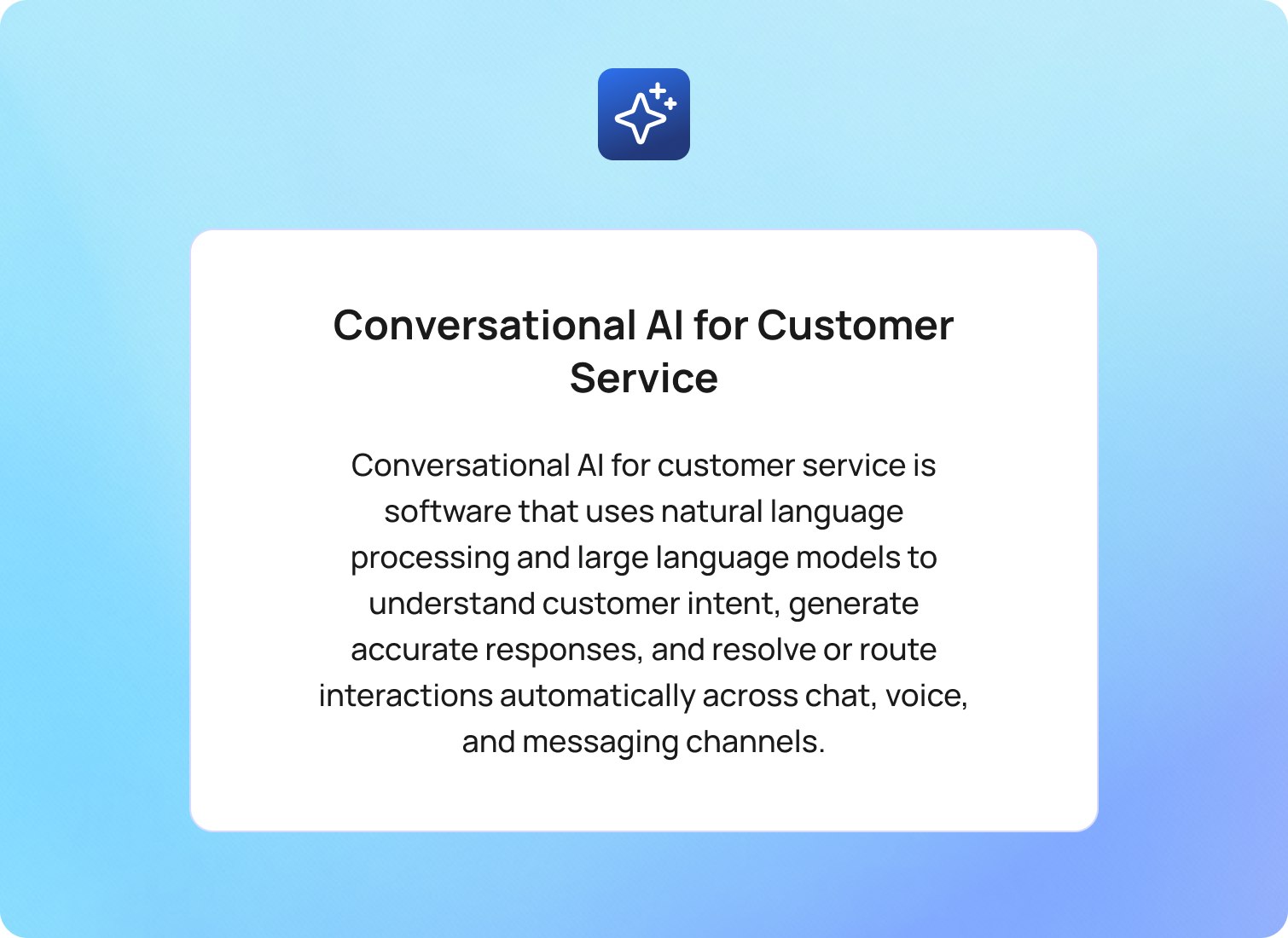
Conversational AI for customer service is software that uses natural language processing and large language models (LLMs) to understand customer intent, generate accurate responses, and resolve or route interactions automatically across chat, voice, and messaging channels.
At a practical level, conversational artificial intelligence enables support systems to understand natural language in the same way customers naturally communicate. Instead of forcing users through rigid workflows, conversational AI works by interpreting customer inputs, identifying intent, and generating relevant answers dynamically. This is the key difference between conversational AI and traditional rule-based chatbots.
Rule-based chatbots follow scripted decision trees. However, these break when customers phrase questions in unexpected ways or move outside predefined support scenarios.
Modern conversational AI customer service platforms use natural language understanding, machine learning, and LLMs to interpret human language more flexibly. They can manage paraphrased customer questions, multi-turn support conversations, slang, incomplete sentences, and context carried across multiple interactions.
Today, conversational AI in customer service typically falls into three categories:
- Text-based conversational AI for chat, email, messaging apps, and digital support channels
- Voice-based conversational AI using AI voicebots and interactive voice response replacements
- Omnichannel conversational AI platforms that unify customer interactions across all communication channels
The deployment model matters because evaluation criteria differ significantly. A conversational AI chatbot designed for asynchronous customer messages has very different requirements from a real-time AI voicebot handling inbound support calls.
For a conversational AI tool to be at its most useful and powerful, the technology must be used as part of a broader customer experience and operational strategy.
The Five Ways Support Teams Use Conversational AI to Improve CX

Conversational AI in customer service improves CX when it is tied directly to measurable operational and customer outcomes rather than deployed purely for automation.
The strongest deployments focus on solving specific customer service tasks with clearly defined KPIs attached.
1. Instant Resolution for Routine Interactions
Conversational AI handles high-volume, low-complexity customer inquiries that do not require human judgment. This includes:
- Order status requests
- Password resets
- Account management updates
- FAQ responses
- Appointment confirmations
- Business hours inquiries
When conversational AI software is grounded in an up-to-date RAG-enabled knowledge base, containment rates between 40–70% on tier-one support interactions are increasingly achievable in mature deployments.
These routine customer interactions typically consume a disproportionate amount of agent capacity. The KPI improvements usually include:
- Lower cost per interaction
- Reduced AHT
- Higher containment rates
- Faster response times
This is particularly important for customer service teams managing high inbound volumes across multiple languages and digital channels.
2. Real-Time Agent Assist During Live Interactions
Conversational AI for customer service not only automates interactions autonomously. Increasingly, it works alongside human agents during live support conversations. Modern conversational AI capabilities now include:
- Suggested replies
- Real-time KB retrieval
- Sentiment analysis
- Post-call summarization
- Recommended next actions
- Customer intent detection
This changes how support teams operate because agents spend less time searching support data manually and more time focusing on complex customer interactions.
A 2026 field study conducted with Alibaba customer service operations found that generative AI assistance improved service speed and customer ratings by making agent communication more efficient and informative. The most important strategic shift here is that conversational AI becomes a productivity layer, not simply a deflection tool.
That distinction matters because many customer expectations still center on access to human conversation when complexity or emotion is involved.
3. Intelligent Routing and Triage
Conversational AI customer service systems increasingly act as the front door to support operations. Before a customer ever reaches an agent, conversational AI can classify:
- Intent
- Urgency
- Sentiment
- Language preference
- Account priority
- Product category
This enables support interactions to route automatically to the correct team, queue, or skill group. But the CX impact is often underestimated; poor routing creates repeat contacts, escalations, customer frustration, and unnecessary transfers. Intelligent triage reduces all of those friction points simultaneously.
Support leaders frequently focus too heavily on automation rates while ignoring routing accuracy. But routing quality often has a larger impact on FCR and CSAT than pure containment rate alone.
4. 24/7 Support Without Additional Headcount
Conversational AI for customers extends support availability beyond standard operating hours. For organizations serving global customers across multiple time zones, this removes one of the biggest structural limitations in customer service operations.
Instead of scaling overnight shifts linearly with volume, conversational AI can respond instantly to routine customer queries outside business hours. This improves:
- Abandon rates
- Response times
- Customer satisfaction
- Global support coverage
It also creates operational resilience during seasonal spikes and unexpected surges in customer inquiries.
Importantly, the strongest implementations maintain seamless escalation paths to human agents when necessary. Meanwhile, AI-only support experiences without intelligent escalation continue to create customer frustration in many industries.
According to PwC’s 2025 Customer Experience Survey, consumers remain significantly more comfortable using AI for routine support activities like order tracking than for sensitive or emotionally nuanced interactions.
5. Proactive, Personalized Outreach
Modern conversational AI not only reacts to customer conversations, but it also initiates them proactively. This includes:
- Delivery updates
- Appointment reminders
- Renewal notifications
- Service disruption alerts
- Billing reminders
- Personalized support recommendations
The operational advantage is substantial because proactive support reduces inbound volume before customer issues escalate into live contact. This is where conversational AI strategy increasingly overlaps with customer engagement and retention.
The most mature organizations are now using conversational AI platforms as customer communication infrastructure rather than standalone support automation. That evolution is one of the clearest indicators of where conversational AI in customer service is heading next.
Types of Conversational AI for Customer Service (at a Glance)
The different types of conversational AI customer service deployments solve different operational problems and improve different CX metrics.
As conversational AI in customer service matures, support leaders are moving away from treating AI as a single-purpose chatbot solution. Instead, organizations are building layered conversational AI strategies that combine automation, agent augmentation, and omnichannel orchestration depending on the complexity of the interaction and the communication channel involved.
The deployment model is important because the operational expectations for an AI chatbot are very different from those of an AI voicebot or an AI agent assist layer. Some conversational AI tools are designed to maximize containment rates, while others focus on improving agent efficiency, routing accuracy, or customer satisfaction during live support interactions.
The table below outlines the primary types of conversational AI for customer service in 2026, how each conversational AI technology works, and the CX metrics support teams most commonly use to evaluate performance.
BlueTweak Conversational AI Types Table
| Type | How It Works | Best For | Key CX Metric |
|---|---|---|---|
| AI chatbot (text) | LLM + RAG knowledge base; handles chat, messaging, and email | Digital-first support teams managing high-volume customer messages | Containment rate, CSAT |
| AI voicebot | Speech recognition + NLP + text-to-speech; handles inbound calls | Voice-heavy customer service operation environments are replacing IVR | AHT, abandon rate, MOS |
| AI agent assists | Suggests replies, surfaces KB content, flags sentiment during live interactions | Teams are improving agent efficiency and consistency | AHT, FCR, concurrency |
| Omnichannel conversational AI | Unified AI layer across various communication channels with shared intent detection | Organizations managing customer interactions across multiple channels | FCR, CSAT, repeat contact rate |
The important thing to note is that conversational AI tools should be evaluated based on the operational problem they are solving, not simply the underlying AI model. Too many conversational AI projects still fail because organizations deploy technology before defining the customer service work they actually want improved.
Key Benefits and the Metrics That Prove Them
Conversational AI customer service initiatives succeed when improvements are tied to measurable business outcomes rather than vague automation goals. The strongest implementations consistently improve both operational efficiency and customer experience simultaneously.
Faster Resolution
Conversational AI reduces resolution time by surfacing relevant answers instantly. For autonomous support, this eliminates handling time entirely on contained interactions.
For agent-assisted workflows, suggested replies and KB retrieval reduce the time agents spend searching for information during support conversations. The operational effect compounds quickly at scale.
Consistent Quality at Scale
Human agents naturally vary in performance based on experience, workload, and fatigue. Conversational AI produces more standardized responses because every interaction draws from the same support systems and knowledge sources.
This consistency becomes especially important for multilingual support environments and globally distributed customer service teams.
The KPI many organizations overlook here is CSAT variance between shifts, teams, and channels.
Lower Cost Per Interaction
Conversational AI lowers operational costs through two mechanisms simultaneously:
- Autonomous resolution removes agent involvement entirely for routine customer service tasks
- AI agent assist reduces the time spent on human-handled interactions
This distinction matters strategically because the most successful organizations are not necessarily replacing agents; they’re reallocating human effort toward higher-value customer interactions.
Improved First Contact Resolution
Correct routing, accurate answers, and contextual understanding improve first contact resolution significantly. Customers who receive relevant answers the first time are less likely to recontact support or escalate unnecessarily. This directly improves:
- FCR rates
- Repeat contact rates
- Escalation rates
- Customer satisfaction
The operational gains from conversational AI are therefore cumulative rather than isolated to a single metric.
How to Implement Conversational AI in Customer Service

Implement conversational AI successfully by narrowing scope early, grounding responses in reliable knowledge, and measuring outcomes continuously.
Too many conversational AI projects fail because organizations attempt overly broad deployments too early. The technology itself is rarely the primary problem; more often, failure stems from unclear operational goals, inconsistent support data, fragmented ownership, or unrealistic expectations around automation.
Treating conversational AI implementation as a CX transformation initiative rather than a software deployment exercise is the route most successful organizations are taking in 2026. That means aligning customer service teams, knowledge management, IT, operations, and analytics teams around a shared support strategy before launch.
1. Define Scope by Interaction Type
Start with the highest-volume, lowest-complexity customer queries first, as these interactions are most likely to produce strong early containment rates and measurable operational improvements.
The objective is controlled success that builds organizational confidence, rather than maximum automation immediately.
This is a common mistake: attempting to deploy conversational AI across every support scenario simultaneously. Complex billing disputes, emotionally sensitive complaints, or highly technical support cases are rarely the best starting point. Early deployments should focus on repeatable customer service tasks with clear workflows and predictable resolution paths.
Good early-stage conversational AI use cases often include:
- Order tracking
- Password resets
- Appointment confirmations
- Subscription management
- FAQ handling
- Business hours and store location requests
This approach creates two advantages: first, it reduces implementation risk while the conversational AI learns from real-world customer conversations; second, it gives support teams time to adapt operationally before introducing more advanced workflows.
Importantly, organizations should map each query type to a target outcome before deployment. For example, if the goal is to reduce inbound call volume, containment rate becomes critical. If the objective is improving customer experience, then CSAT and FCR may matter more than pure automation percentages.
2. Prepare Your Knowledge Base Before Configuring the AI
Conversational AI is only as accurate as the knowledge base supporting it, and this remains one of the biggest gaps between pilot performance and production performance in 2026.
Organizations often underestimate the amount of KB cleanup required before conversational AI learns effectively from support data.
Many support environments contain years of duplicated articles, outdated policies, inconsistent terminology, and undocumented escalation processes. Human agents can often work around these gaps through experience and judgment, but conversational AI simply can’t.
Before implementation begins, support leaders should evaluate whether their knowledge base is genuinely usable for AI-driven retrieval. That includes reviewing:
- Article accuracy
- Content duplication
- Ownership and governance
- Escalation documentation
- Multilingual support coverage
- Update frequency
One increasingly important consideration is how conversational AI handles conflicting information. If multiple KB articles provide slightly different answers to the same customer inquiry, response quality quickly becomes inconsistent. This creates customer trust issues and undermines confidence in the AI system internally.
The most mature organizations now assign dedicated KB governance owners as part of conversational AI deployment. In practice, conversational AI implementation often improves knowledge management maturity across the entire customer service operation.
3. Set Success Metrics Before Launch
Support leaders should define operational thresholds before deployment begins. This includes:
- Containment rate targets
- CSAT floors
- Repeat contact thresholds
- Escalation tolerance
- Routing accuracy benchmarks
Without defined metrics, conversational AI projects often drift into subjective evaluation.
This is particularly important because conversational AI success can look very different depending on the organization’s priorities. A support operation focused on reducing operational costs may prioritize automation and AHT reduction, while a premium CX-focused brand may place greater importance on customer satisfaction and escalation quality.
Metrics should also be segmented by interaction type rather than measured globally. For example, conversational AI may perform extremely well on account management queries while underperforming on technical troubleshooting. Measuring everything under one aggregate score hides those operational differences.
Another best practice emerging in 2026 is defining “acceptable failure” conditions before launch. No conversational AI platform will resolve 100% of customer interactions successfully, so the target should be a predictable performance with safe escalation paths.
4. Phase the Rollout
Launch conversational AI in one channel first, then monitor performance closely for at least two weeks before expanding the scope.
The strongest deployments expand based on operational data rather than implementation timelines.
This phased approach is especially important for omnichannel conversational AI deployments. Customer behavior differs significantly between live chat, email, messaging apps, and voice support; an AI workflow performing effectively in chat may struggle in voice environments where interruptions, accents, and conversational pacing introduce additional complexity.
A controlled rollout also allows support teams to identify operational blind spots before scaling further. These often include:
- Escalation bottlenecks
- Incorrect routing logic
- KB coverage gaps
- Poorly defined intents
- Customer frustration patterns
- Agent workflow friction
One of the biggest misconceptions around conversational AI technology is that implementation is primarily technical. In reality, operational adaptation is often the larger challenge. Agents need new workflows, supervisors need new analytics, and support leaders need new QA processes for AI-generated interactions.
Organizations that scale too quickly often create internal resistance because teams lose confidence in the system before optimization is complete.
5. Build the Feedback Loop
Every failed interaction becomes training data.
Organizations seeing long-term conversational AI success now treat AI optimization as an operational discipline rather than a one-time deployment project. That means assigning ongoing ownership for:
- Failure review
- KB updates
- Intent refinement
- Escalation analysis
- Prompt optimization
The most effective support teams now run conversational AI optimization similarly to continuous improvement programs in customer operations. Failed customer interactions are reviewed weekly, escalation trends are analyzed systematically, and KB gaps are corrected continuously. This ongoing refinement process is critical because customer expectations evolve constantly. New products, policy changes, seasonal support trends, and emerging customer behaviors all affect how conversational AI performs over time.
Support leaders should also monitor how conversational AI impacts human agents operationally. One unintended consequence of successful automation is that agents increasingly inherit only the most emotionally charged or technically difficult customer interactions. But without proper workload balancing and coaching support, this can increase agent burnout despite lower interaction volumes overall.
How BlueTweak Delivers Conversational AI for Customer Service
Conversational AI platforms create the most value when they unify customer interactions, support intelligence, and operational analytics inside one connected workspace.
This is where BlueTweak positions its conversational AI platform differently from fragmented point solutions.
Rather than separating voice AI, AI chatbots, agent assist, and analytics into disconnected systems, BlueTweak unifies conversational AI customer service capabilities across both text and voice channels.
Its conversational AI platform supports:
- AI chatbot deployment for digital customer interactions
- AI voicebot support for inbound voice automation
- Shared KB-grounded responses across all channels
- Suggested reply functionality for live agent assist
- Native customer service analytics tied to CX metrics
Because both text and voice conversational AI pull from the same knowledge base, organizations can maintain more consistent customer experiences across communication channels.
That consistency becomes increasingly important as customer conversations move fluidly between messaging apps, voice calls, email, and live chat.
BlueTweak also places significant emphasis on operational measurement.
Rather than focusing purely on automation metrics, the platform surfaces interaction-level analytics tied directly to:
- Containment rate
- FCR
- CSAT
- Repeat contact rate
- Escalation rate
That visibility helps support teams identify where conversational AI works effectively, where human escalation remains necessary, and where knowledge gaps still exist.
A strong example of this operational approach can be seen in BlueTweak’s packaging industry case study, where improved reporting visibility and faster issue resolution helped strengthen customer satisfaction outcomes across support workflows.
The biggest mistake organizations are making with conversational AI is assuming the model is the product. In reality, the knowledge layer determines whether the experience feels genuinely helpful or operationally risky. The gap between pilot success and production performance almost always comes down to KB quality, governance, and feedback ownership.
Final Thoughts: Why Conversational AI for Customer Service Matters More in 2026
Conversational AI for customer service matters because customer expectations now exceed what traditional support models can sustainably deliver at scale.
The strategic shift happening in 2026 is not simply about automation. It is about operational orchestration.
The organizations seeing the strongest results are using conversational AI to unify customer data, routing, support interactions, and knowledge delivery into a single operational layer.
That creates three major advantages simultaneously:
- Faster support experiences
- More consistent customer interactions
- Better visibility into support performance
The companies struggling with conversational AI adoption are typically treating it as a standalone chatbot initiative rather than a transformation of the broader customer service operation. Support teams seeing the strongest results with conversational AI are the ones treating it as central to their operational strategy rather than a standalone automation tool.
If you want to explore how conversational AI can improve FCR, reduce AHT, and create more consistent customer experiences across chat and voice channels, you can book a demo to see BlueTweak in action, or try BlueTweak for free to explore the platform at your own pace with no strings attached.
Try the BlueTweak free trial
Start Now



