



TL;DR
How can AI improve customer service efficiency? In six specific ways: containing routine volume before it reaches agents, routing interactions correctly the first time, surfacing answers instantly during live interactions, scoring quality across 100% of contacts, reducing wrap-up time through automated summaries, and enabling proactive outreach that prevents contacts from happening at all. Each capability reduces a different type of friction. Together they compound.
What "Efficiency" Actually Means in Customer Service
Customer service refers to the full range of interactions between a business and its customers across every contact point. Customer service efficiency is not just speed. It is three things working together: volume handled per agent, resolution quality per contact, and consistency across teams and channels. Customer expectations for fast, accurate, consistent service have risen sharply, and most customer service agents are being asked to meet them with tools that have not kept pace.
An operation that handles more volume but resolves fewer is not more efficient. A customer service team that resolves quickly on chat but inconsistently on email is not efficient at scale. Customer satisfaction scores fall when any one of the three breaks down.
AI in customer service improves all three when deployed correctly. That is the honest answer to how AI can improve customer service efficiency: not by making one metric look better, but by removing the friction that causes all three to underperform.
6 Ways AI Improves Customer Service Efficiency
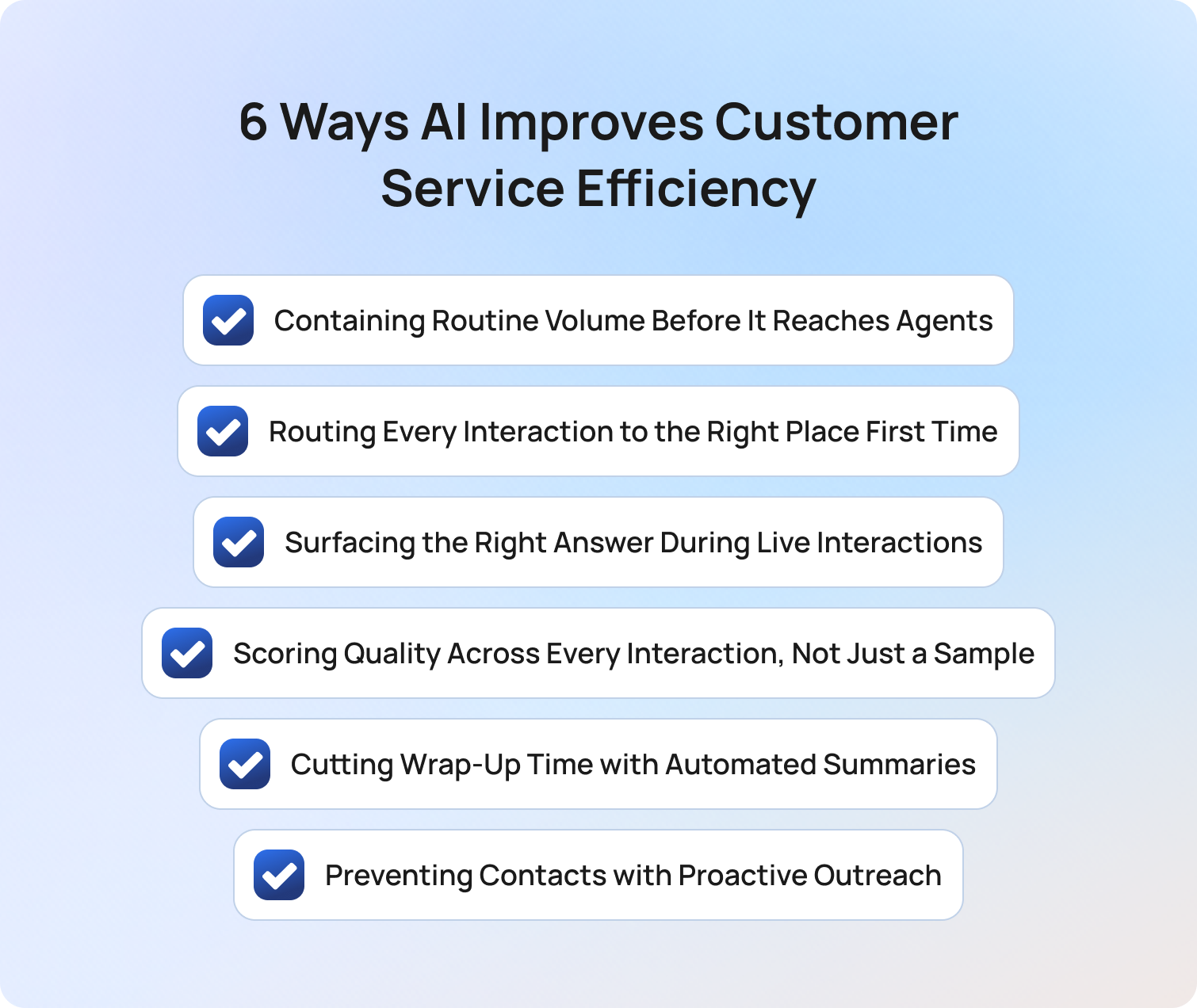
Each of the six capabilities below targets a different friction point in the customer interaction lifecycle. The efficiency gains are real, individually. They compound when the tools work together.
1. Containing Routine Volume Before It Reaches Agents
The single biggest efficiency drain in most customer service operations is agents spending time on interactions that do not require human judgment. Password resets, order status queries, billing inquiries, and account updates are routine inquiries with definitive answers. They are also the interactions that fill queues, extend response times, and push complex customer issues to the back of the line.
Conversational AI handles these tier-1 customer queries end-to-end. The customer gets an accurate, instant response. The agent never sees the interaction. Every contained contact is the time a support agent spends on something that actually requires problem-solving skills and human judgment.
The efficiency metric that matters here is containment rate, not deflection rate. Deflection counts sessions that ended in the bot. Containment counts customer inquiries that reached a full resolution without a follow-up contact. A well-scoped conversational AI deployment handling initial customer inquiries typically achieves a 55–70% containment rate at 90 days.
Artificial intelligence built on natural language processing means customers do not need to navigate rigid menus or interactive voice response trees or phrase queries precisely. They describe their issue in their own words, and the customer service AI understands their intent accurately enough to resolve it. This is one of the clearest ways AI in customer service can enhance customer service quality alongside efficiency.
2. Routing Every Interaction to the Right Place First Time
Misrouted contacts are one of the most expensive efficiency failures in customer support operations. An interaction sent to the wrong team adds handle time, reduces first contact resolution, generates repeat contacts, and creates customer frustration before a human agent has said a word.
Rules-based routing breaks when customers phrase their requests in ways the rules do not anticipate. AI routing uses natural language processing and machine learning to classify intent, urgency, and required skill from every customer question in real time. Customer support teams no longer need to maintain manual rule sets or rebuild routing logic every time a new product launches or a new query type emerges.
AI Ticket Triage routes customer requests to the right team and skill level on the first touch. For customer service teams handling volume across multiple channels, the compound effect on response times, handle time, and first contact resolution is significant. Misrouting is not a minor inconvenience. It is a repeating cost that AI routing eliminates.
3. Surfacing the Right Answer During Live Interactions
Human support agents spend a significant portion of every interaction searching for information: checking the knowledge base, switching between tools, consulting colleagues. This is not a performance problem. It is a tooling problem. The information exists. Retrieving it during a live customer conversation takes time the customer is waiting for.
AI suggested replies solve this. The AI reads the customer's message and the customer's history, retrieves the relevant knowledge base content, and drafts a response that the agent can review, edit, and send. The agent does not search. They evaluate and approve.
This improves efficiency in three directions simultaneously. Handle time falls because agents stop searching. Service quality rises because responses are grounded in verified content rather than recall. Consistency improves because every support agent gives the same accurate answer regardless of their tenure or expertise. A new agent and a five-year veteran provide the same quality of personalized service when both are drawing from the same AI-surfaced content.
Consistent service across all agents is one of the most direct ways AI in customer service addresses the quality variation that manual QA and ongoing training alone cannot fix. Enhancing customer interactions with AI-assisted responses does not remove the human interaction from the conversation. It improves it. Human customer service teams using AI tools deliver more personalized interactions because they are spending their cognitive capacity on the customer's actual problem rather than on information retrieval. Customer preferences for fast, relevant, accurate answers are met more consistently. Improving customer satisfaction at this level is what customer service offers as a genuine business differentiator rather than a cost centre.
4. Scoring Quality Across Every Interaction, Not Just a Sample
Manual QA reviews 5–15% of interactions. The rest are invisible. Patterns in customer sentiment, recurring compliance risks, coaching opportunities for specific agents, all of it exists in the 85–95% of customer conversations that no one ever reviews.
AI quality assurance scores 100% of interactions automatically. This is not just a coverage gain. It is a data gain. With full coverage, support teams can identify patterns they could never see in a sample: which query types generate the most customer frustration, which agents need coaching on which interaction types, which customer service strategies are producing better outcomes on specific channels.
Sentiment analysis runs alongside QA scoring, flagging interactions where customer sentiment shifted negatively during the conversation. These flags give team leaders actionable data for coaching rather than anecdotal impressions from the interactions they happened to review.
The feedback loop between QA data and model improvement is where AI customer service efficiency gains compound over time. Customer feedback captured through CSAT surveys and post-interaction scores integrates with QA data to help teams gain insights into what is driving satisfaction and what is driving churn. Teams that understand customer behavior patterns from this data can make the adjustments that improve customer retention. Every QA flag is a training signal. Every pattern identified is an opportunity to close a gap in the knowledge base or refine automation scope.
5. Cutting Wrap-Up Time with Automated Summaries
After-contact work is a hidden operational cost. Agents summarising interactions, tagging topics, and updating records after every customer conversation add minutes per interaction. Across a team handling hundreds of contacts per day, that is a material share of total capacity.
AI ticket summaries generate a structured record automatically: what the customer asked, what was resolved, what actions were taken, and what the next step is if the issue remains open. Agents do not write the summary. They review it and confirm.
The efficiency gain is straightforward: agents move to the next interaction faster. The secondary gain is data quality. AI-generated summaries are structured consistently, which means the customer data they produce is usable for analytics, reporting, and predictive analytics in ways that free-text agent notes rarely are. Analyzing customer data from consistent summaries gives operations teams visibility into customer behavior patterns, repeat contact drivers, and resolution quality across teams.
6. Preventing Contacts with Proactive Outreach
The most efficient contact is one that never happens. Most customer service operations are reactive by design: the customer experiences a problem and contacts support. But the trigger events for most inbound customer inquiries are predictable. Order delays, payment failures, service outages, and billing events are known, and they are coming.
AI-triggered workflow automation sends proactive messages to customers before they need to ask. The customer gets the update they were about to request. The inbound contact never arrives. Customer satisfaction improves because customers feel informed rather than ignored. Inbound volume on predictable trigger events falls.
When you anticipate customer needs before customers feel the need to reach out, the efficiency gain extends beyond the contact prevented. It shows up in customer retention, in customer satisfaction scores, and in the customer engagement that comes from a support experience that feels thoughtful rather than reactive. Generative AI is increasingly used in these proactive workflows to draft personalised messages at scale, adapting tone and content to individual customer preferences and history. Proactive outreach is one of the customer service strategies with the clearest compound return: every prevented contact is also a strengthened customer relationship.
How Efficiency Gains Compound When AI Works Across the Full Platform
Individual AI tools improve efficiency at specific points. The largest efficiency gains come when AI capabilities work together across the full customer interaction lifecycle, and each one informs the others.
Follow a single interaction through a unified AI customer service platform:
The customer sends a message. The AI system classifies intent using natural language processing and machine learning. If it is a routine inquiry the conversational AI can handle, it is contained end-to-end. No agent involvement. The customer gets a relevant response in seconds.
If the query requires human support, AI routing sends it to the right team and skill level immediately, with full customer context attached. The human agent opens the interaction with the customer's history, previous contacts, and a suggested reply already drafted. They spend their time on the substance of the customer's issue rather than on setup.
The interaction is QA scored automatically. If the customer conversation is flagged for negative sentiment, the team lead sees it in the dashboard before the customer sends a follow-up complaint. The wrap-up summary is generated without agent input. The customer data feeds back into analytics.
If the interaction was triggered by a predictable event, the next similar customer query is pre-empted by a proactive outreach workflow.
Each step saves minutes. Together, they reduce cost per resolved contact, improve first contact resolution, and improve customer satisfaction simultaneously. Operational costs fall because the same volume is handled with less agent time. Cost savings compound as containment rate improves and handle time falls across more interaction types. This is how AI improves customer service efficiency at scale: not by optimising one metric in isolation, but by removing friction at every stage of customer support processes and letting the gains compound. Service professionals who would previously spend their shift on repetitive queries are now handling the complex issues where their skills generate real value. AI-powered tools make that possible without adding headcount.
The question we hear most often is whether AI will improve efficiency for agents or for customers. The answer is both, and the two are connected. When agents have the right context, the right answer, and the right routing from the start, they resolve faster. When customers get accurate, immediate, consistent service, they do not follow up. The efficiency gain shows up in the cost data and in the satisfaction data at the same time.

What AI Cannot Fix on Its Own
Implementing AI improves customer service efficiency within the boundaries of the process and data it works with. Three things AI cannot fix without human decisions:
Knowledge Base Quality
AI-powered tools that retrieve and generate responses are only as accurate as the content they draw from. A knowledge base that is incomplete, outdated, or inconsistently structured produces inaccurate responses. Inaccurate responses reduce containment, generate repeat contacts, and damage service quality faster than efficiency gains offset the cost. Customer service agents using AI tools that draw from a weak knowledge base will give worse answers than agents working without them. The team provides comprehensive training and maintains the KB before expanding the AI scope, not after.
Deployment Scope
AI deployed on complex customer issues that it cannot handle reliably will generate more customer frustration and more repeat contacts than it prevents. The efficiency case for AI is built on tier-1 automation of repetitive tasks and routine tasks. Human agents remain the right answer for complex issues that require empathy, judgment, and problem-solving skills. Scope decisions are human decisions, and they determine whether AI customer service delivers cost savings or creates new operational costs.
Escalation Design
When AI agents escalate to human support agents, the handoff quality determines whether the escalation is an efficiency gain or a loss. A clean handoff with full context passed to the human agent takes seconds. A poor handoff, where the agent must re-read an incomplete transcript or ask the customer to repeat themselves, adds minutes to every escalation and damages the customer service experience at the moment it matters most. Human-in-the-loop AI done well reduces the cost of every escalation. Done poorly, it offsets the savings from every automated interaction that preceded it.
How BlueTweak Improves Customer Service Efficiency Across Teams and Channels
BlueTweak brings all six efficiency capabilities into one platform so the feedback loops between them work. Most AI tools for customer service add one capability to an existing stack. BlueTweak is designed on the premise that efficiency gains compound when automation, routing, quality oversight, and analytics share the same data.
The conversational AI contains tier-1 customer requests across chat and voice. AI Ticket Triage routes what escalates to the right place immediately. Proposed Reply surfaces the right answer to the right agent during live customer interactions. The QA module scores every interaction and feeds the data back into the platform. AI Ticket Summary automates wrap-up. Workflow automation handles proactive outreach.
The analytics and reporting layer makes the compound efficiency visible: containment rate, cost per resolved contact, FCR by channel, and CSAT by interaction type in the same dashboard, tracked over the 30, 90, and 180-day horizons that customer service operations teams actually report against.
Transforming customer service with AI technology does not require replacing your existing customer support processes wholesale. It requires deploying the right AI systems against the right customer service functions, measuring what actually changes, and expanding scope as performance data confirms the model is ready. Read how AI improves customer support for the full operational picture.
Final Thoughts
How can AI improve customer service efficiency? By removing friction at every stage of the customer interaction lifecycle: before the contact arrives, during the interaction, and after it closes. The gains are measurable individually and significant together.
The teams seeing the strongest results are not the ones with the most sophisticated AI technology. They are the ones who scoped their deployment correctly, maintained their knowledge base, and measured the right things from the start. AI customer service efficiency is a discipline as much as a technology.
Start your free trial and see how BlueTweak improves customer service efficiency across your teams and channels from day one.
Start your free trial and see how BlueTweak improves customer service efficiency
Start Now
As Head of Digital Transformation, Radu looks over multiple departments across the company, providing visibility over what happens in product, and what are the needs of customers. With more than 8 years in the Technology era, and part of BlueTweak since the beginning, Radu shifted from a developer (addressing end-customer needs) to a more business oriented role, to have an influence and touch base with people who use the actual technology.



