16 Best Practices to Maximize FCR With Multilingual Voicebots



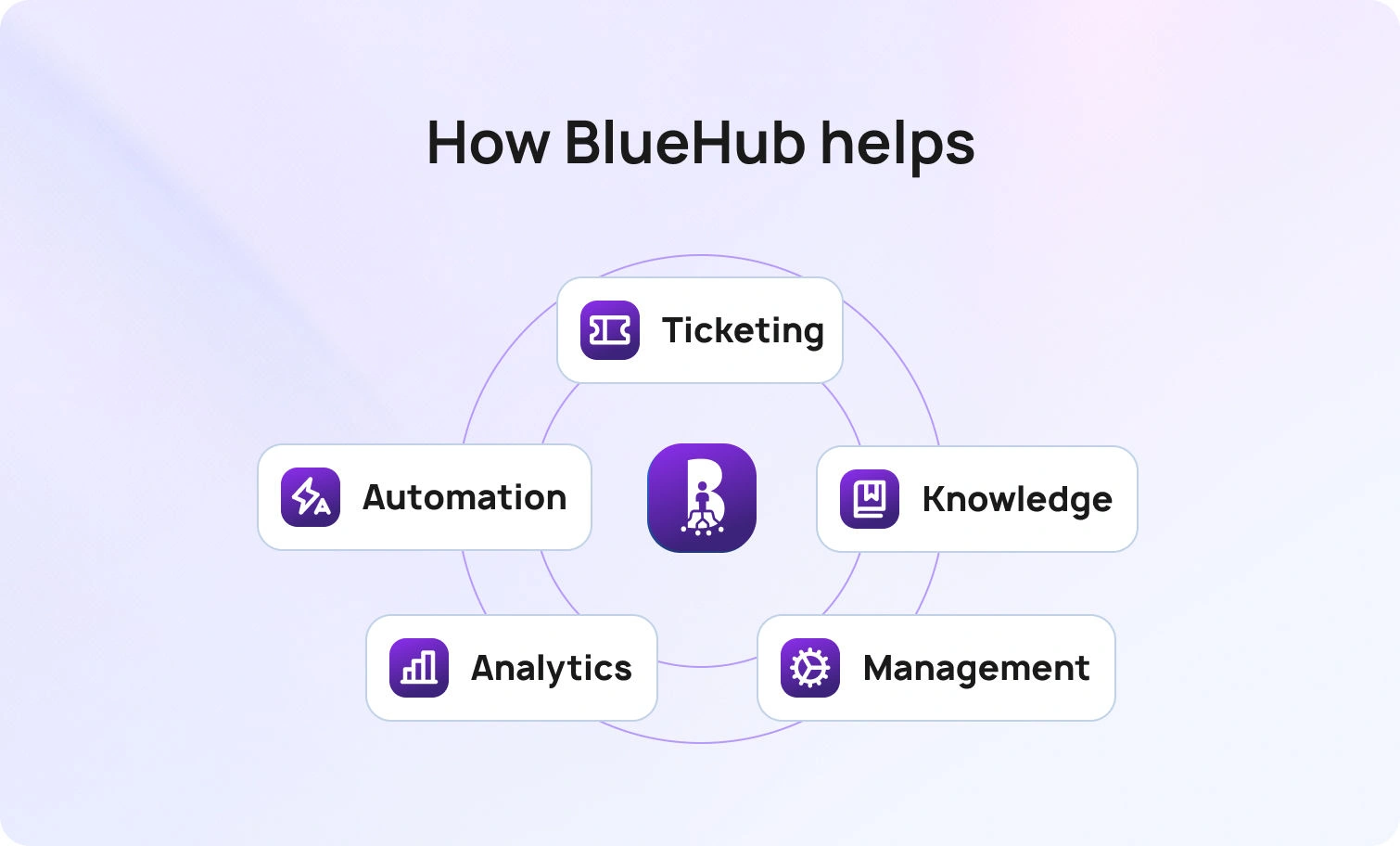
BlueHub unifies every conversation, customer record, and automation into one powerful platform.
Explore more
First contact resolution improves when multilingual voicebots automatically detect a caller’s preferred language, reliably understand their intent, and hand off to human agents with full context. Multilingual voicebots contribute to business growth by expanding market reach and improving customer satisfaction across diverse linguistic regions. Expect higher customer satisfaction and lower operational costs when language coverage matches demand, conversation flow feels natural, and analytics drive steady improvements. Organizations gain a competitive advantage by leveraging advanced, AI-powered multilingual voicebots that enhance engagement and operational efficiency.
Most first-contact failures can be attributed to three primary causes: language barriers, limited domain knowledge, and routing that directs calls to the wrong queue. A multilingual voicebot tackles each one from the first seconds of the call. Speech recognition tuned for different languages and accents reduces early confusion. Natural language understanding interprets real sentences instead of forcing rigid menu choices. With intent and language identified, intelligent routing directs the caller to the appropriate bot flow or a human agent who has the necessary skills to complete the task.
The payoff shows up in the conversation itself. Multilingual voice agents facilitate complex discussions in multiple languages, allowing customers to communicate naturally and remain engaged. Companies serving a global audience benefit from consistent service across regions, as the same system supports multiple languages without requiring the use of separate tools or processes.
For teams supporting a diverse customer base, this is not a nice-to-have. Callers expect to use their native language, not adapt to a different language for every situation. When the voice assistant detects the customer’s preferred language and mirrors local phrasing, clarifications drop and repetition disappears. Routine requests are resolved through self-service, while more complex issues are directed to the right person on the first attempt. The result is higher first contact resolution and a smoother experience for everyone involved.
This article provides a practical blueprint for enhancing FCR with multilingual voicebots, covering language coverage, automatic language detection, conversation design, and intent-plus-skill routing. It walks through grounding answers in a smart knowledge base, tuning speech recognition, and preserving context during handoffs. It closes with KPIs to track, an optimization cadence, and deployment tips for seamless integration with CRM and existing systems.
These practices move from language planning to day-to-day operations. Each one is tied to concrete signals, such as containment rate, transfer rate, first contact resolution, abandon rate, sentiment score, concurrency, and average handling time.
AI agents and voice bots are enabling businesses to deliver advanced multilingual support, handling complex customer interactions across various platforms and languages. By adopting these best practices, organizations are enabling businesses to improve customer service outcomes.
When considering solutions, look for AI agents that provide advanced, multilingual, multi-channel support systems, as well as voice bots that can communicate seamlessly across multiple languages to enhance global customer engagement.
Natural language only works as well as the knowledge behind it. Multilingual voicebots that cite a single source of truth provide consistent and accurate information in multiple languages. A smart knowledge base maps intents to precise articles, keeps steps short, and includes outcome checks that work in voice. Multilingual chatbots use the knowledge base to deliver accurate answers in multiple languages, ensuring native-fluency customer support and consistent information globally.
BlueHub Fit: The smart knowledge base powers suggested replies for agents and grounds bot responses, keeping answers aligned across channels.
Callers want to communicate naturally, not navigate a maze. The goal is to create human-like conversations that feel natural and engaging for callers. Brief recaps, clear next steps, and polite closings establish a professional tone.
Multilingual conversations benefit from phrasing reviewed by native speakers who understand cultural nuances. Every path should end in either a clear resolution or a seamless handoff.
BlueHub Fit: Classification and summarization maintain conversation context, ensuring agents and channels stay aligned on the same storyline.
Strong FCR starts with coverage that reflects reality. Usage volume by region, revenue mix, and channel preference points to the languages that matter most. To maximize FCR, it is essential to cover both common languages and major languages such as English, Spanish, Mandarin, French, German, Portuguese, and Japanese, ensuring broad language coverage and ongoing language expansion. A focused set with depth usually beats a sprawling list with uneven quality. Dialects and accent ranges deserve attention as well, not just the language label.
BlueHub Fit: BlueHub unifies chat, email, and voice, so analytics by language show where demand lives and where expansion makes sense. Analytics can also help identify which supported languages should be prioritized for expansion, ensuring continuous improvement and optimal performance across all supported languages.
Callers feel the benefit in the first seconds. Automatic language detection eliminates guesswork, while a brief confirmation ensures that callers are not required to use only one language and avoids lengthy IVR menus. If the language is not supported, the call can be routed to multilingual staff as a fallback, preventing frustration and keeping abandonment rates low.
BlueHub Fit: Routing can factor detected language alongside brand, skill, and intent, and real-time translation keeps conversations moving across channels.
Clear recognition is half the battle, and it shifts with accent ranges, background noise, and speaking speed. In multilingual voice settings, breadth of training data matters, but so does a second layer of review from native speakers who can spot language-specific quirks that generic models miss. With those insights, acoustic tests by language and region highlight exactly where models need tightening.
For critical moments, such as identity checks or payments, a quick confirmation step prevents errors from slipping through. Finally, a custom vocabulary for brand and product terms provides the recognizer with an extra boost where it matters most.
FCR rises when the first responder can actually solve the problem. Routing decisions should consider detected intent, language, brand, and the required skill set simultaneously. Adding sentiment and customer priority helps protect service levels without breaking policies.
BlueHub Fit: Automatic routing combines brand, skill, language, and intent. Priority rules can be configured by the team; confirm any sentiment- or tier-based escalation with product documentation before stating it.
Language models work on probabilities. Confidence thresholds decide when to confirm or transfer. Good transfers include transcripts, detected language, sentiment, and structured fields, so human agents start at step three rather than step zero. Clean handoffs preserve momentum and protect first contact resolution.
BlueHub Fit: Summaries and conversation context stay with the case in the unified queue, helping agents pick up the same storyline across channels.”
Plenty of requests do not require a human. Password resets, order status updates, plan changes within policy, and appointment rescheduling fall under this category. Clear confirmations build trust, and audit-friendly records ensure honest reporting. These self-service options enhance containment and free up human agents for more complex work.
BlueHub Fit: Centralized knowledge and content governance help maintain consistency across macros and articles across channels and languages.
Small tone shifts often deliver outsized gains. Formality levels, directness, and cadence vary by region. Native speakers can spot awkward phrasing and tune text-to-speech pronunciation. A few adjustments per language usually raise satisfaction enough to prevent repeat calls.
Product names, policy terms, and plan labels are subject to change. Language packs need to keep up. A glossary per language and a regular sync with product and legal teams prevent drift. Speech recognition vocabularies should be updated with every release to maintain accuracy and relevance.
BlueHub Fit: A shared smart knowledge base and standardized macros help keep answers consistent across channels and languages.
Native models shine on high-volume paths. Translation covers the long tail. A hybrid approach balances quality and scale, particularly for diverse customer bases where maintaining hundreds of separate flows would be challenging.
BlueHub Fit: Real-time chat translation enables agents to serve customers in their preferred language, and routing can factor in the detected language for the current case across chat, email, and voice.
Good decisions rely on clear signals, not hunches. Per-language dashboards that show first contact resolution, containment, transfer, abandonment, sentiment, concurrency, and average handling time make gaps visible at a glance. The same view should break down usage and engagement by intent so trend lines are obvious, not buried in exports. Error markers for misrecognition and misunderstood intents pinpoint the exact turns in the conversation that require a rewrite, a vocabulary tweak, or a confirmation step. With that level of visibility, teams can refine prompts, optimize routing, and demonstrate ROI with before-and-after deltas rather than relying on anecdotes.
BlueHub Fit: Real-time dashboards and historical analytics provide support, product, and leadership with a shared view of performance and trends across chat, email, and voice. Teams can track core metrics such as FCR, handle time, and abandon rate per language and intent, and visualize sentiment where that signal is captured, keeping optimization efforts grounded in data.
Multilingual programs stabilize when feedback loops are tight. Review a sample of calls for understanding, tone, and policy accuracy. A dedicated team should be responsible for monitoring and optimizing multilingual support systems, ensuring ongoing performance and continuous improvement. Findings should update knowledge base content, training phrases, and scripts to reflect the new information. Coaching becomes specific and measurable when transcripts and summaries highlight patterns by language.
BlueHub Fit: Reviews and analytics inform coaching, and updates flow back into macros and knowledge base articles so improvements reach daily operations.
FCR depends on context. Profile data, owned products, open cases, and regional rules should be at hand. Outcomes need to flow back to the record so sales and service work from the same truth. A multilingual voicebot without this foundation will still generate follow-ups and transfers.
Custom development can tailor integrations and conversation flows to meet specific business needs, providing highly flexible solutions that address unique industry requirements.
BlueHub Fit: API openness supports CRM and ticketing integrations, with data available for export to analytics platforms for consolidated reporting.”
Global businesses work under different rules. Private cloud or hybrid options, where required, help hit data residency and latency targets. Enterprise-grade security should encompass authentication, encryption, and administrative controls that provide reassurance to security teams.
BlueHub Fit: Security and administration meet enterprise expectations, while the platform remains open for integrations.
Momentum matters. A small launch with two or three languages and a focused set of intents provides a quick signal without risking quality. Expansion follows the data. New languages join once conversation flow, routing, and content governance hold steady. Expanding to new languages enables support for diverse markets and diverse regions, allowing businesses to reach a broader global audience and better understand customer needs across different cultures.
BlueHub Fit: Unified channels, a smart knowledge base, proposed reply, classification, and summarization, and analytics provide a strong foundation for staged rollouts and measured scaling.
The cost side becomes tangible when containment and FCR improve simultaneously. Imagine 60,000 monthly calls at an average variable cost of 4.50 dollars per agent-handled interaction. Raising containment for routine intents by 12 to 18 percent and increasing FCR by 6 to 10 percent results in thousands of agent minutes saved each month. Savings are realized through lower talk time, fewer transfers, and fewer repeat contacts. Multilingual voicebots also enhance customer satisfaction by offering personalized support in the caller’s native language, resulting in a more positive overall experience.
Top-line impact shows up as well. Multilingual capabilities enable callers to complete sales, enrollment, or renewal actions in their native languages. Automatic language detection avoids early drop-offs created by single-language IVR flows. More conversations in the customer’s preferred language typically increase completion rates and reduce churn in regions where language barriers previously hindered progress. These solutions enhance operational efficiency by automating routine tasks, thereby freeing up human agents to address more complex issues. Additionally, multilingual voicebots enable businesses to expand into global markets by supporting customers across diverse regions through voice technology.
Sustained gains come from a steady cadence, not one-off fixes.
Multilingual voice is shifting from an add-on to an expectation. Three practical trends stand out:
Future multilingual AI voicebots will incorporate advanced features, including integrations with Google Calendar and CRM systems, powered by large language models, to further enhance communication and automation.
Platforms that blend multilingual voice, a smart knowledge base, analytics, workforce planning, and open APIs will set the standard. BlueHub aligns with this direction by keeping AI grounded in verified content, enabling multilingual conversations across channels, and offering the operational controls teams expect.
Raising first-contact resolution with multilingual voicebots requires more than simply toggling on another language. Results are derived from automatic language detection, robust natural language understanding, and speech recognition optimized for various languages and accents.
Advanced voice bots play a key role in enhancing multilingual customer service by communicating seamlessly across languages, breaking down language barriers, and improving global customer engagement. Conversation design keeps the experience human. Integrations with CRM systems and a smart knowledge base ensure accurate answers. Clean handoffs to human agents preserve momentum when complexity appears. Analytics, QA habits, and coaching lock in the gains.
BlueHub combines chat, email, and voice into a single platform, adding the essential components that enable multilingual operations to scale: a smart knowledge base, proposed replies, classification and summarization, real-time chat translation, automatic routing, spam detection, analytics, and workforce management. The combination enables multilingual customer support, resolves routine tasks through self-service options, transfers complex issues with complete context, and enhances customer satisfaction while reducing operational costs.
Request a demo to see multilingual voice, intelligent routing, and analytics-driven FCR improvements in BlueHub.
Traditional IVR relies on strict menus. Multilingual voicebots use speech recognition, natural language understanding, and natural language processing to handle free-form speech across languages. The result is more natural, conversational support, and higher first-contact resolution. In BlueHub, the voicebot runs in the same omnichannel queue, so context carries into tickets when handoff is needed.
Start with the languages that represent the largest share of usage and revenue, then expand as analytics confirm demand. Track FCR, abandonment, and sentiment for each language to guide the rollout and ensure consistent performance. BlueHub’s dashboards slice these metrics by language and intent so decisions are data-driven.
Advanced systems handle common code-switching patterns and a wide range of accents, and quality improves with targeted training phrases, custom vocabularies, and brief confirmations for high-risk actions. Use multilingual staff as a fallback for complex cases and maintain ongoing training and native-speaker oversight. BlueHub supports iterative tuning and seamless handoff to agents with full transcript and context.
Monitor FCR, containment, transfer rate, abandonment, sentiment, and average handle time by language and by intent. Detailed reports highlight where recognition or dialog flow needs refinement. BlueHub surfaces these signals in one place, making it easy to spot gaps and ship targeted improvements.
As Head of Digital Transformation, Radu looks over multiple departments across the company, providing visibility over what happens in product, and what are the needs of customers. With more than 8 years in the Technology era, and part of BlueTweak since the beginning, Radu shifted from a developer (addressing end-customer needs) to a more business oriented role, to have an influence and touch base with people who use the actual technology.
Quality
Administration
Workforce Management
Customer Support Analytics
Copyright BlueTweak 2025