



TL;DR
AI chatbot customer service cost reduction is real and measurable, but only when the chatbot is scoped correctly, grounded in accurate knowledge base content, and measured on containment rate rather than deflection rate. Teams that skip any of those three conditions see cost savings in the first 30 days and cost generation by 180, because failed self-service creates harder-to-handle repeat contacts that offset every automated resolution. Get the conditions right, and the savings are significant and sustainable.
AI Chatbot Customer Service Cost Reduction: The Statistics
Before the mechanics, the scale. These are the numbers that define where AI chatbots' cost reduction in customer service actually stands in 2026.
According to IBM, AI chatbots can reduce the operational costs of contact centers by up to 30%. McKinsey data shows AI-enabled self-service can cut incidents by 40–50%, with cost-to-serve reductions of more than 20%. Companies are seeing average returns of $3.50 for every $1 invested in AI customer service, with top-performing organisations achieving up to 8x ROI.
Gartner's 2025 research predicts that agentic AI will autonomously resolve 80% of common customer service issues by 2029, with a corresponding 30% reduction in operational costs. Businesses using AI-driven routing have already achieved 30% faster average response times compared to manual triage.
Those numbers are real. They are also averages across deployments that range from excellent to deeply counterproductive. Customer service chatbots and the AI technologies and AI tools that power them are capable of delivering significant cost savings. The headline figure, 30% cost reduction, is broadly accurate for well-implemented deployments and largely unachievable for poorly scoped ones. Understanding why is what this article is about.
What AI Chatbot Cost Reduction Actually Looks Like
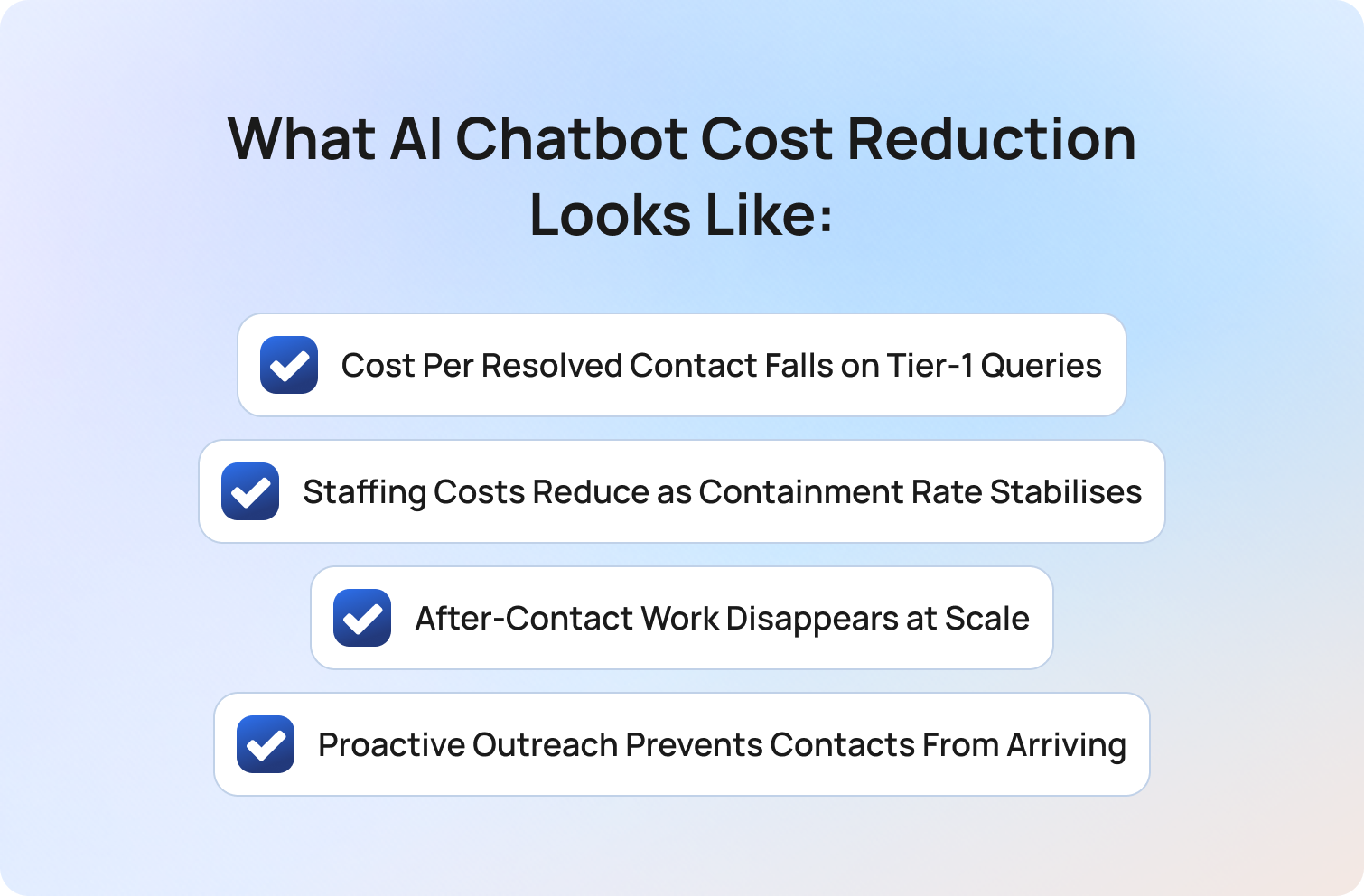
AI chatbots reduce customer service costs and lower support costs through four distinct mechanisms. Each is measurable. Each has a condition attached. Customer support costs fall in different ways depending on which mechanism is working, and the largest reductions come when all four operate together.
Cost Per Resolved Contact Falls on Tier-1 Queries
The unit cost of a human-handled support interaction, including agent time, tooling, and overhead, typically runs between €6 and €12, depending on complexity and channel. The unit cost of an automated resolution handled end-to-end by a well-scoped AI chatbot runs between €1.50 and €3. The difference is where the cost reduction in customer service originates.
At volume, this compound quickly. A support team handling 40,000 contacts per month, where 60% are tier-1 queries, achieving 62% containment on those queries, removes roughly 14,880 contacts from the agent queue per month. The direct savings on those interactions alone represent a material reduction in monthly operational costs before any other efficiency is counted.
Use the BlueTweak ROI calculator to run this against your own contact volume and cost per resolution.
Staffing Costs Reduce as Containment Rate Stabilises
Reduce customer service costs at the contact level, and the staffing implications follow, but on a lag. The capacity freed by automation at a 90-day containment rate steady state either offsets planned hiring, absorbs volume growth without additional headcount, or reduces overtime costs during peak periods. None of those outcomes is instant. Teams that count staffing savings on day one and measure them at day 30 will find the numbers do not match. Teams that build staffing ROI into the 180-day projection will find it arrives reliably.
After-Contact Work Disappears at Scale
Every resolved interaction generates wrap-up work: summary, tagging, and CRM update. Support tickets handled manually require agents to write that record from scratch. For human agents, that is 3–5 minutes per interaction. AI ticket summaries generate a structured record automatically, reducing agent wrap-up to a 20–30 second review and confirmation. Across a team handling 200 interactions per day, the time saving compounds into a significant share of daily capacity that can be redirected to complex issues. Operational efficiency at the team level rises because agents are doing work that requires their judgment rather than work that a summary generator handles better and faster.
Proactive Outreach Prevents Contacts From Arriving
The contact that never happens costs nothing to handle. AI-triggered workflow automation sends proactive messages on predictable trigger events, order delays, payment failures, shipping updates, and billing events before customers need to reach out. Inbound volume on those event types typically falls by 20–40% for well-implemented proactive workflows, generating direct savings that do not require a single automated resolution to count.
The Three Deployment Mistakes That Turn Cost Reduction Into Cost Generation
This is what most AI chatbot cost reduction articles do not cover. The reason many teams cannot show chatbot ROI at 180 days is not that chatbots do not save money. It is because three deployment mistakes systematically offset the savings. 40% of customers abandon chatbots due to poor experiences, and every abandoned interaction is a failed self-service attempt that generates a follow-up contact that costs more to handle than the original interaction would have.
Deploying on Interaction Types the Chatbot Cannot Reliably Resolve
Scope creep is the most common and most damaging mistake. Unlike human agents who can apply critical thinking and adapt to unexpected queries, an AI chatbot scoped beyond its reliable range will misclassify complex issues, escalate poorly, and generate repeat contacts from customers who received an inaccurate or incomplete response.
Each failed resolution costs more than a single human-handled interaction would have, because the customer arrives at the agent queue frustrated, and the agent must start from scratch without useful context. Customer frustration from a failed chatbot experience is harder to recover from than customer frustration from a slow initial response. The perception of being passed between systems after a bad automated experience is one of the fastest drivers of customer loyalty erosion.
The fix is straightforward: scope chatbot deployment to automating routine tasks, repetitive queries, and routine inquiries where the correct answer is definitive and the resolution path is short. Billing balance checks, order tracking, password resets, account updates, FAQ queries, shipping status, these are the routine queries where AI chatbots generate cost savings reliably across all customer services and channels. Complex complaints, escalation requests, and emotionally sensitive interactions are not. Protecting the customer experience on complex interactions by keeping human agents responsible for them is what makes the cost reduction on tier-1 queries sustainable.
Measuring Deflection Rate Instead of Containment Rate
Deflection rate counts sessions that ended in the chatbot without escalating to a human agent. Containment rate counts contacts that reached full resolution without a follow-up on any channel within 24 hours. The gap between the two numbers is the gap between what gets reported and what actually happened.
A team reporting 70% deflection and 45% containment has a large population of customers who appeared resolved and then sent a follow-up email or called back. Those follow-up contacts generated double the interaction cost of a single human-handled resolution. Deflection rate is not a cost reduction metric. Containment rate is the only accurate measure of AI chatbots' cost reduction in customer service.
Most AI support vendor dashboards report deflection by default. It is not a better metric. It is an easier one.
Launching Without a Current, Accurate Knowledge Base
RAG-grounded chatbots retrieve answers from the knowledge base. A knowledge base with outdated pricing, discontinued products, or incorrect policy information produces inaccurate chatbot responses. Inaccurate responses reduce containment rate, generate complaint contacts from customers who acted on wrong information, and damage customer trust in the self-service channel.
The cost of rebuilding that trust, in repeat contacts, escalation volume, and churn, exceeds the cost savings from automation in most cases where this mistake is made. The hidden costs of inefficient customer support systems apply here too: a chatbot grounded in poor content does not reduce support costs. It transfers them downstream.
How AI Chatbots Reduce Customer Service Costs Without Hurting CX

Traditional customer support operations were built on a trade-off: quality costs money, and speed is expensive. AI-powered customer service breaks that trade-off when deployed correctly. Here is how each capability delivers cost reduction while maintaining high service quality.
Containing Tier-1 Volume End-to-End
Conversational AI chatbots built on natural language processing handle customer queries across chat and voice without requiring customers to navigate rigid menus or interactive voice response trees. The customer describes their issue in natural language. Machine learning classifies intent accurately. The AI system retrieves the relevant knowledge base content and delivers a relevant, accurate response.
Support agents never see these interactions. Every contained contact is time support agents spend on complex issues that require judgment, empathy, and critical thinking, the customer interactions where human agents add irreplaceable value. Agent productivity rises not because agents are working faster but because the queue they are working from contains fewer interactions that should never have reached them.
Maintaining high service quality alongside cost reduction comes from this separation. AI handles routine tasks consistently and at scale. Human agents handle complex issues with the full attention they deserve. Neither is doing the other's job.
Reducing Handle Time on Escalated Interactions
When the chatbot escalates to a human agent, the handoff quality determines whether the escalation is a cost-saving or a cost addition. A clean handoff, full customer data, interaction history, intent classification, and a structured summary of what was already attempted means the agent opens the interaction knowing exactly what the customer needs. Handle time on escalated interactions falls. Repeat contacts from poorly handled escalations fall.
Human-in-the-loop AI minimises human intervention to the interactions that genuinely require it, and reduces the cost of every escalation that does. Done poorly, with incomplete context, missing history, or no summary, it adds minutes to every interaction and forces customers to repeat themselves, generating customer frustration that damages customer satisfaction scores most visibly.
Automating After-Contact Work
AI ticket summaries eliminate manual wrap-up for both automated and human-handled interactions. For human-handled contacts, agents confirm a pre-generated summary rather than writing one from scratch. For automated contacts, the record is complete before the interaction closes. The time saving per interaction is modest. Across a team handling hundreds of contacts per day, it is material, and the data quality improvement is significant, because consistent AI-generated summaries produce customer data that is usable for predictive analytics and customer behavior analysis in ways that free-text agent notes rarely are.
Enabling Proactive Outreach on Predictable Events
AI-driven predictive analytics identifies the trigger events that generate predictable inbound volume: order delays, payment processing failures, service outages, and subscription renewal issues. AI-powered agents send tailored solutions and personalised proactive messages to affected customers before they need to ask, meeting customer expectations for immediate support without requiring the customer to initiate contact. Personalized service delivered proactively is a higher standard of customer care than reactive resolution. The inbound contact never arrives. Customer loyalty strengthens through the experience of being anticipated rather than reacted to.
This is transforming customer service at the operational level: shifting from a reactive model that waits for customer frustration to build, to a proactive model that prevents it. The cost savings are direct, fewer inbound contacts on predictable event types, and indirect, through the customer retention impact of a support experience that feels attentive rather than transactional.
Protecting CX While Reducing Costs: Three Practices That Matter
The "without hurting CX" part of AI chatbot cost reduction is not guaranteed. It is a design choice. Efficient customer service at lower cost requires that support quality is actively protected, not assumed. When you automate routine inquiries correctly and route everything else to human agents via clean escalations with full context, customer service agents are working on the interactions where their skills matter most. These three practices separate deployments that reduce costs and maintain CX from those that reduce costs at CX's expense.
Set Confidence Thresholds Before Launch
An AI chatbot without calibrated confidence thresholds will attempt to answer queries it cannot handle reliably, producing low-confidence automated responses that damage customer trust. Setting per-intent confidence thresholds before go-live determines which interactions get automated responses and which escalate to human agents. This is a pre-launch decision that determines whether consistent support is delivered at scale or whether CX is variable depending on how confidently the model handles each query type.
Track CSAT on Chatbot-Handled Interactions Separately
Blended CSAT hides chatbot performance behind human-handled performance. Improved customer satisfaction on human-handled interactions can mask declining satisfaction on automated interactions for months before the signal reaches aggregate scores. Tracking CSAT specifically on chatbot-handled interactions from day one makes CX degradation visible early enough to act on.
The QA module scores 100% of interactions and tracks customer sentiment separately for automated and human-handled contacts. Sentiment analysis flags interactions where customer sentiment shifted negatively during a chatbot conversation. These flags arrive before the churn data confirms the problem.
Close Knowledge Base Gaps Before Expanding Scope
The relationship between KB quality and CX protection is direct. A chatbot retrieving from a complete, current knowledge base produces accurate, relevant responses. Accurate responses build customer trust in self-service options. Customer trust in self-service increases willingness to use it again, which is what sustains containment rate improvement over time. Every scope expansion before a KB audit is a risk to service quality that the efficiency gains may not offset.
What Realistic Cost Reduction Looks Like at 30, 90, and 180 Days
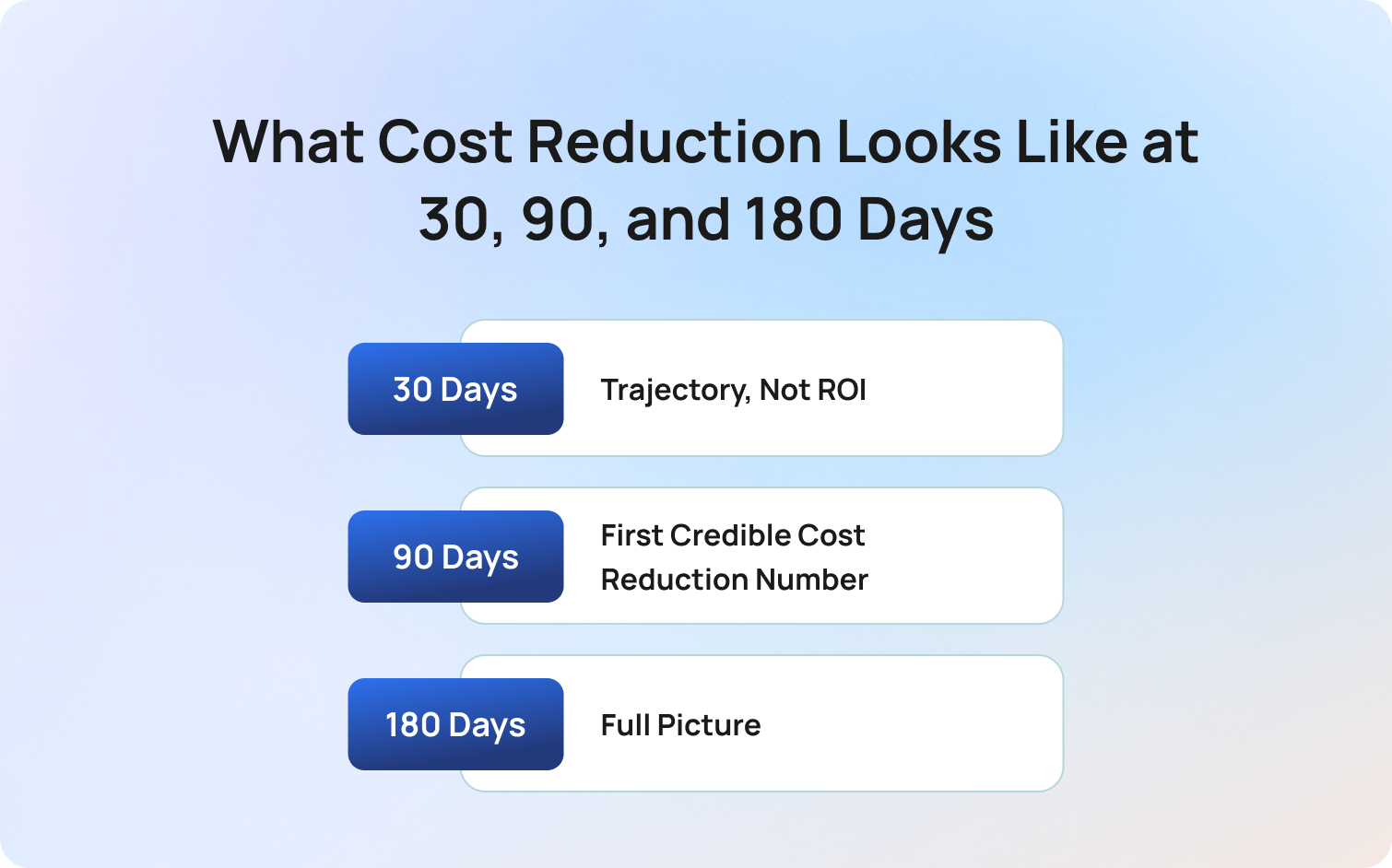
30 Days: Trajectory, Not ROI
At 30 days, the model is calibrating. Containment rate is below the steady state. CSAT on chatbot interactions may dip before it recovers. This is normal. What to track: is the containment rate improving week on week, is the escalation rate within the expected range, and what percentage of queries is the chatbot unable to answer? These are leading indicators of the cost reduction that follows, not cost reduction itself. Do not report staffing savings at 30 days.
90 Days: First Credible Cost Reduction Number
For well-scoped tier-1 deployments, 90-day benchmarks are: 55–70% containment rate, 30–40% reduction in cost per resolved contact on automated interaction types. McKinsey found that businesses implementing conversational AI saw a 25% increase in customer satisfaction scores alongside a 35% decrease in handling costs. At 90 days, the cost per resolved contact is trackable against the pre-deployment baseline, and the number is credible enough to present to leadership.
180 Days: Full Picture
At 180 days, churn rate change by interaction type is meaningful and attributable. Customer lifetime value impact is traceable through retention data. AI capabilities improve through the feedback loop between QA scoring, customer feedback, and knowledge base updates. A system built for continuous improvement shows steady containment rate gains between 90 and 180 days rather than a plateau. Support costs on affected query types continue to fall as the model gets better and KB coverage expands to new interaction types.
How BlueTweak Delivers AI Chatbot Customer Service Cost Reduction Without CX Compromise
Most AI chatbot customer service cost reduction failures share a root cause: the platform running the automation is not the same platform measuring it. Customer support costs cannot be accurately attributed when chatbot session data, support tickets, and email follow-up data live in different tools. Containment rate cannot be calculated. CSAT on chatbot interactions is blended with human-handled CSAT because the reporting layer does not distinguish between them. Knowledge base gaps are identified manually, slowly, and reactively.
BlueTweak is designed so that automation, measurement, and quality oversight run in the same workspace.
The conversational AI handles tier-1 customer interactions across chat and voice, grounded in the Smart Knowledge Base that feeds accurate, verified content into every automated response. Confidence thresholds are configured before launch. Low-confidence interactions go to human agents, not customers.
The QA module scores every interaction and tracks CSAT and sentiment separately for automated and human-handled contacts. KB gaps surfaced by QA flags are closed without manual audits. The feedback loop between quality data and content quality is automated.
The analytics and reporting layer reports containment rate, not deflection rate, alongside cost per resolved contact, FCR by channel, and CSAT by interaction type, giving support teams the measurement infrastructure to report AI support ROI credibly at 30, 90, and 180 days.
Seamless integration with existing CRM and ticketing tools means customer data flows into the platform rather than being duplicated across systems. Support operations retain full visibility of every interaction, automated or human-handled, in one workspace.
The teams that report genuine cost savings from chatbot deployment are almost always the ones that were honest about scope from the start. They deployed on the interactions the chatbot could reliably resolve, maintained their knowledge base, and measured containment rather than deflection. Those three decisions are not technical. They are operational. And they are the difference between a chatbot that cuts support costs at 180 days and one that looked good at 30 days and quietly generated more costs than it saved.

Final Thoughts
AI chatbot customer service cost reduction is a competitive advantage that is becoming a competitive necessity. The teams that have built AI-powered support infrastructure today will be at 60–70% containment by 2029. The teams that have not started will be at 20–25%, facing a competitive cost disadvantage that will be very difficult to close.
The savings are real, and the benchmarks are well-established. But saving money while maintaining high service quality is a design choice, not a default outcome. It requires the right scope, the right measurement model, and a knowledge base that is maintained as a first-class operational asset.
Teams that get those three right do not just cut support costs. They build a support operation that improves continuously and scales efficiently. That is the return that justifies the investment, not the first 30-day deflection rate, but the 180-day cost per resolved contact trend and the customer retention data that comes with it.
Run your own numbers with the BlueTweak ROI calculator, or start your free trial and build the measurement infrastructure alongside the automation from day one.
Start your 14-day free BlueTweak trial
Start Trial
As Head of Digital Transformation, Radu looks over multiple departments across the company, providing visibility over what happens in product, and what are the needs of customers. With more than 8 years in the Technology era, and part of BlueTweak since the beginning, Radu shifted from a developer (addressing end-customer needs) to a more business oriented role, to have an influence and touch base with people who use the actual technology.



